







7 Yoga Poses for Abs: Effective, Easy, and Empowering
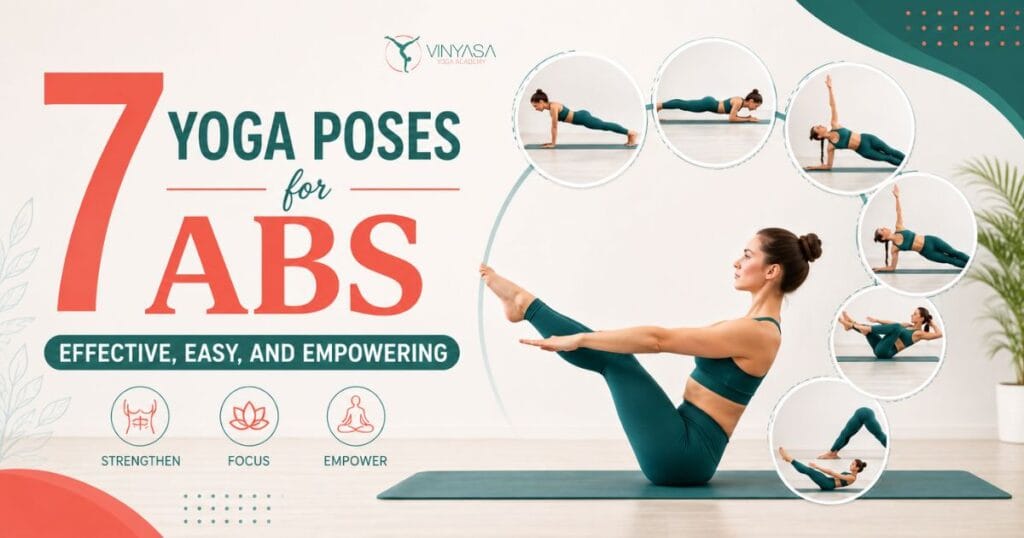
Table of Contents
- What Does ‘Core’ Actually Mean In Yoga?
- Is There a Breathing Technique That Makes Core Work In Yoga More Effective?
- The 7 Best Yoga Poses for Abs (With Function & Instructions)
- 1. Navasana (Boat Pose) | The Classic Core Builder
- 2. Phalakasana (Plank Pose) | Full-Body Core Activation
- 3. Vasisthasana (Side Plank) | Oblique Strength and Lateral Stability
- 4. Chaturanga Dandasana (Low Plank) | Dynamic Ab Endurance
- 5. Ardha Navasana (Half Boat Pose) | Deep Abdominal Work
- 6. Parivrtta Utkatasana (Revolved Chair Pose) | Obliques Meet Spinal Rotation
- 7. Uttanasana to Plank Flow | Breath-Linked Core Awakening
- Do These 7 Yoga Poses Really Strengthen Your Abs?
- What Are the Common Mistakes People Make When Using Yoga for Abs?
- How Often Should You Practice These Poses for Results?
- A Final Thought: From Practice to Progress
- Frequently Asked Questions About Yoga For Abs
- Can yoga give me a flat stomach?
- How long does it take to see results from yoga for abs?
- Is yoga better than crunches for abs?
- Can beginners do yoga for abs?
- Which yoga style is best for core strength?
- Do I need any equipment for yoga ab exercises?
Your abs are already working right now. By holding you upright and keeping your spine steady, they’re quietly doing their job. They’re not waiting to be activated by a thousand crunches. They just need a particular kind of attention. Yoga gives them exactly that. Not through grinding repetitions, but through asanas for abs that demand your whole core to show up, stabilise, balance, breathe, and hold.
The result? Deeper strength than sit-ups ever built, and a body that feels stronger and better in daily life.
What Does ‘Core’ Actually Mean In Yoga?
Before jumping right into the yoga poses for abs, please know that the core is not just the six-pack muscle (rectus abdominis) you see on magazine covers. It’s a multilayer system that includes the muscles tabled below. Yoga targets all of these layers simultaneously. Let’s help you understand what you’ll actually work on when you practice yoga.
| Muscle / Muscle Group | Type / Function |
| The transverse abdominis | Your deepest abdominal layer; acts like a natural corset around spine |
| The internal and external obliques | Responsible for rotation and side stability |
| The diaphragm | Yes, your breathing muscles are part of your core |
| The pelvic floor | Often overlooked, but critical for core health |
| The erector spinae | Muscles running along your spine |
When you hold Boat Pose or move through a Vinyasa flow sequence, you’re instructing your entire core to work as a team. That’s why practitioners of yoga often report better posture, less back pain, and a leaner midsection without ever doing a single crunch.
Is There a Breathing Technique That Makes Core Work In Yoga More Effective?
Yes, there is. Uddiyana Bandha (upward abdominal lock) is a breathing technique used extensively in yoga to deepen core activation. On a strong exhale, you draw the navel in and up, creating an internal vacuum that engages the transverse abdominis and pelvic floor simultaneously.
You don’t need to be a Bandhas (or energy locks) expert to get something out of this tradition. Be mindful to do a strong exhale in each pose, empty the lungs, and then feel how naturally your belly draws inward. That’s your transverse abdominis (a deep core muscle) waking up. It’s gradual, but over time, it becomes effortless and changes everything about how your core functions.
The 7 Best Yoga Poses for Abs (With Function & Instructions)
1. Navasana (Boat Pose) | The Classic Core Builder
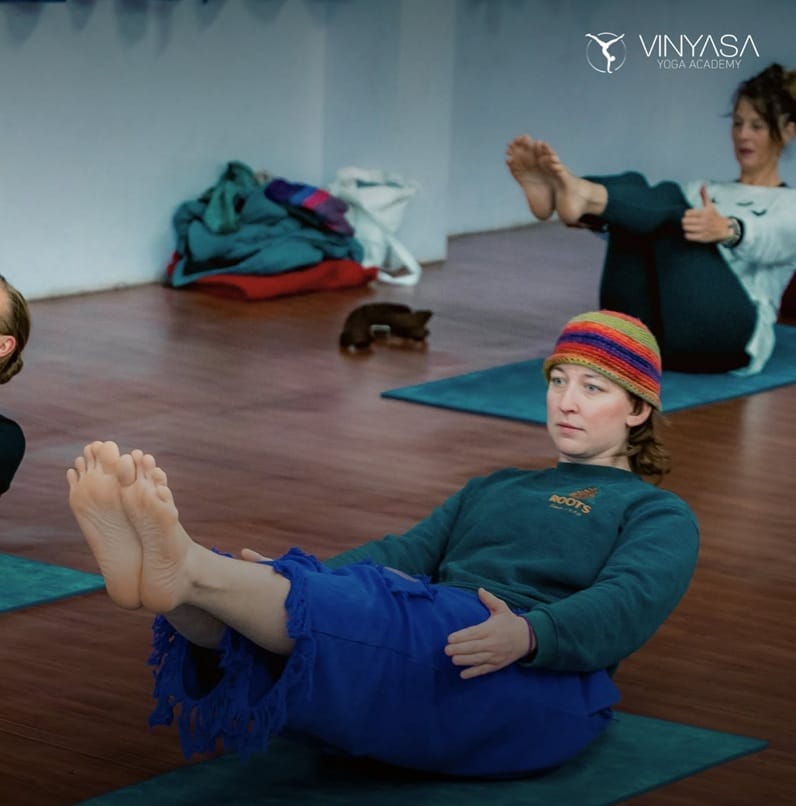
If you’ve ever been in a yoga class and felt your stomach shaking, Boat Pose was probably involved. It directly engages the rectus abdominis (abs) and hip flexors while demanding that the corset keep the spine long and stable. It’s uncomfortable in the best possible way.
How to do Boat Pose
- Sit on your mat with knees bent and feet flat.
- Lean back a bit until your core feels engaged.
- Then raise your feet and make your shins parallel to the floor.
- For full expression, straighten your legs into a V-shape with arms extended forward.
- Hold for five slow breaths.
- If your lower back rounds, keep the knees bent.
A tip most teachers skip: On every exhale, actively draw your navel toward your spine. This engages the core abdominal muscles, not just the surface muscles.
2. Phalakasana (Plank Pose) | Full-Body Core Activation
Plank Pose is deceptively simple and widely effective. Unlike a crunch, which only flexes the spine, Plank Pose asks the entire anterior chain (abs, chest, shoulders, quads) to resist gravity in a straight line. It builds core endurance in a way that adapts to everyday movement.
How to do Plank Pose
- From hands and knees, put your feet back so your body forms a straight line (from crown to heels).
- Keep your hands shoulder-width apart and fingers spread.
- Press the floor away actively, don’t just hang.
- Firmly hold the thighs, draw the low belly in, and keep the vision in front of the hands.
- Hold for 30-60 seconds, breathing steadily.
What to watch: Letting the hip area bend is the most common mistake. If such a thing happens, drop to your knees and build gradually again.
3. Vasisthasana (Side Plank) | Oblique Strength and Lateral Stability
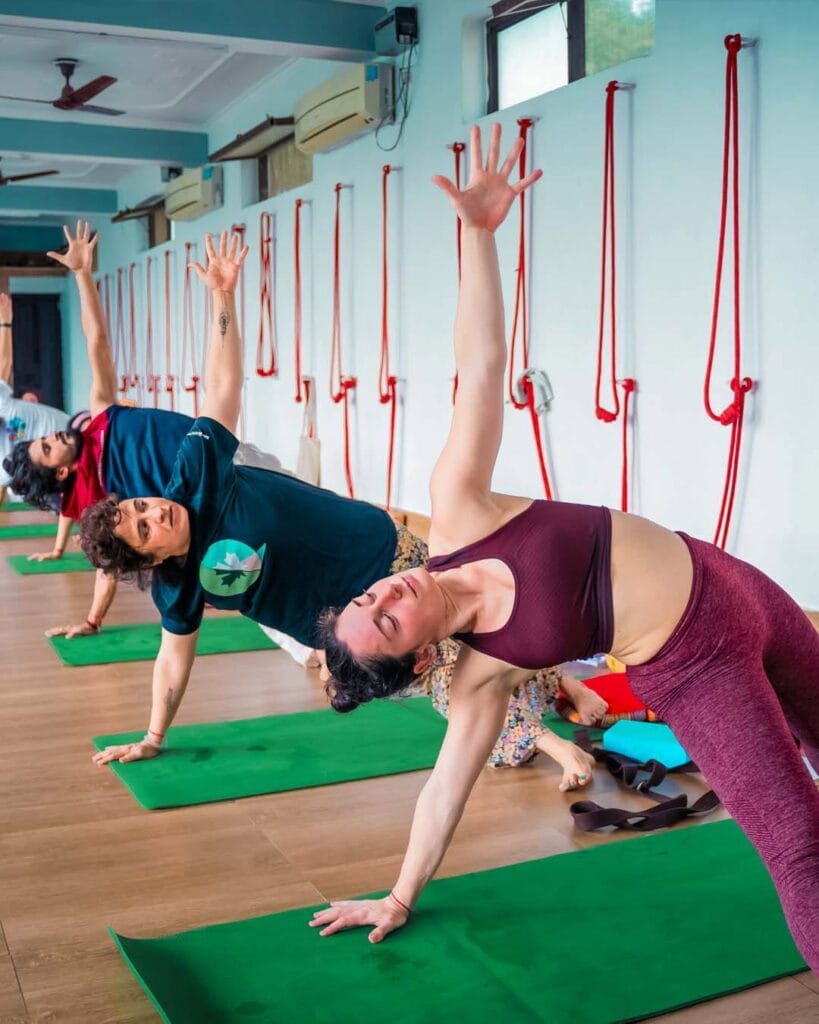
The sides of your core (the obliques) are what give your waist definition and support rotational movement. Side Plank is one of the rare yoga poses that truly unite them while building wrist, shoulder, and hip strength at the same time.
How to do Side Plank Pose
- From Plank, shift your weight onto your right hand and rotate your body to the left so you’re balancing on the outer edge of your right foot (or feet-over-feet).
- Let your left arm reach toward the ceiling. Lay your hips on top of each other.
- Hold for 6-8 breaths, then switch sides. For a modification, lower your bottom knee to the mat.
The often-missed cue: Press the floor away with your bottom hand rather than sinking into the shoulder. This keeps the supporting muscles active and protects the joint.
4. Chaturanga Dandasana (Low Plank) | Dynamic Ab Endurance
In Vinyasa yoga, Chaturanga is a transition pose that appears dozens of times in a single class. Most beginners try to rush through it. Don’t do that. Done with mindfulness, Chaturanga is one of the most effective yoga poses for ab strengthening in the entire practice.
How to do the Low Plank
- From the plank position, shift forward slightly onto your toes so the shoulders come past the wrists.
- Engage the core firmly, then bend your elbows straight back (not flared out) to lower your body halfway.
- Maintain your elbows at 90 degrees and your body hovering parallel to the floor.
- Hold here for one breath before moving to Upward Dog, or lower all the way down.
Honest beginner advice: This pose will take months to master. Until then, drop your knees first, and your core will still work hard.
5. Ardha Navasana (Half Boat Pose) | Deep Abdominal Work
Where the full Boat Pose tends to engage the hip flexors heavily, the Half Boat Pose is quieter and goes deeper. By lowering partway down and staying in the air against gravity, you specifically challenge the transverse abdominis, which is the corset muscle responsible for the flat, firm look of a toned stomach.
How to do Half Boat Pose
- From full Boat Pose, slowly lower your torso and legs toward the floor until both hover about six inches above the mat. Arms extend forward alongside the body.
- Hold here, breathing deliberately. If you feel your lower back pressing into the mat rather than hovering, you’ve gone too low. Hold for 5 breaths and repeat 3 times.
Why this matters: The lower you hover, the more the deep core must work. But going too low without the strength to support it can strain the lumbar spine (lower back). Gradual progression is the whole point.
6. Parivrtta Utkatasana (Revolved Chair Pose) | Obliques Meet Spinal Rotation
Most core poses for abs work in one plane, forward and back. Revolved Chair brings rotation into the picture, engaging the obliques in a way that standing and floor poses rarely do. It’s also wonderfully disguised, i.e., it doesn’t look like an ab exercise, but your midsection will tell you it is, the next morning.
How to do Revolved Chair Pose
- Stand with feet together, bend your knees, and sit with your hips back into Chair Pose (Utkatasana).
- Bring your hands to prayer at your chest.
- On an exhale, rotate your torso to the right, holding your left elbow to the outside of your right knee.
- Keep both knees level, don’t let the top one drift forward.
- Hold for 5 breaths, then switch sides.
The bonus benefit: The twist involved in Utkatasana massages the digestive organs, which, combined with the abdominal engagement, is why this pose is sometimes called the “detox pose” in traditional Hatha practice.
7. Uttanasana to Plank Flow | Breath-Linked Core Awakening
This is less a single static yoga pose for abs and more a moving drill, and the one that the yoga world doesn’t talk about enough for core training.
Moving intentionally between Standing Forward Fold and Plank, guided by the breath, trains the core to respond dynamically across transitions. This is exactly the kind of yoga asana for abs that develops high functionality as well.
How to do:
- Stand at the top of your mat.
- Inhale to lengthen the spine, exhale, and fold forward (Uttanasana), placing hands on the floor.
- Inhale, step or float both feet back to Plank hold, engaging the core.
- Exhale, step or float the feet back to the hands, and rise to fold.
- Repeat 6-8 times at a slow, deliberate pace. Each transition is where the core work lives.
Why it’s in this list: Static holds build strength. Dynamic breath-linked movements build control and the ability to use that strength fluidly. Both matter, yet most core routines only train one.
Do These 7 Yoga Poses Really Strengthen Your Abs?
Yes, the above-mentioned yoga poses for abs will be worth your efforts. However, there’s a meaningful distinction worth making here. Yoga strengthens and tones the abdominal muscles, improves core endurance, and enhances posture.
But, what it doesn’t do on its own is reduce belly fat on its own (no yoga asana targets fat in one specific spot, yes!). However, a consistent yoga practice lowers cortisol, the stress hormone most linked to abdominal fat storage, and has been shown to burn calories through specific asanas.
Think of it this way: These poses build the strong, toned muscle underneath. Pair that with a balanced lifestyle and holistic meals, and see results following in naturally.
What Are the Common Mistakes People Make When Using Yoga for Abs?
While doing yoga asanas for the core, a few patterns come up again and again, especially with beginners:
- Holding the Breath: The exhale is when the deep core engagement occurs. Holding the breath during a hard yoga pose for abs almost always means the core is switched off.
- Sacrificing Form for Depth: Do not compromise form for depth. A rounded-back yoga position for abs trains the wrong pattern. A shorter hold with a long spine trains the right one.
- Skipping the Sides: Most people favour forward-plane movements and neglect their obliques. Side Plank Pose and Revolved Chair Pose are two of the best yoga abs poses that fix this.
- Moving Too Fast: In Vinyasa classes, especially, rushing through transitions removes all the core effects that live in the slow, controlled movement between poses. Let time settle the efforts you make.
How Often Should You Practice These Poses for Results?
Consistency matters far more than intensity here. Doing these yoga poses for abs three or four times a week (even as a 15-minute morning routine) will produce noticeable results in four to six weeks for most people.
Your core endurance will improve first (you’ll hold poses longer), posture changes come next, and toning follows gradually as you build strength muscle by muscle. One practical suggestion from our side is to stack this sequence onto the beginning or end of any existing yoga practice rather than treating it as a separate workout.
Core work, in which every standing balance, inversion, and transition demands abdominal engagement, is more effective than any standalone ab exercises will ever be.
A Final Thought: From Practice to Progress
Core strength in yoga isn’t a destination you reach and then check off. It’s something that develops quietly, progressively, and beneath the surface of every practice. From the way you stand to the way you breathe and move through your day without thinking about pain, yoga touches your core to the core.
At Vinyasa Yoga Academy, our teachers work with not just the mechanics of a pose but also the intelligence behind it. Our Vinyasa-based curriculum is designed so that core strength builds naturally through every class and every sequence.
If you’re curious about what it looks and feels like in practice, our leading yoga teacher training courses and retreat programmes are the best place to start.
Roll out your mat, start with Plank, breathe on the exhale, the rest follows.
Frequently Asked Questions About Yoga For Abs
Can yoga give me a flat stomach?
Yoga can tone and strengthen the abdominal muscles and improve posture, which together can create a firmer, more defined midsection. It also lowers cortisol levels, which reduces belly fat storage over time. For visible fat loss, yoga works best as part of a broader lifestyle that includes a nutritious diet and, where needed, some cardiovascular activity.
How long does it take to see results from yoga for abs?
Many people do notice an improvement in core endurance within two to three weeks of consistent yoga practice. For visible toning of the core, practise regularly for four to eight weeks. Results depend on frequency, diet, and individual body composition.
Is yoga better than crunches for abs?
For most people, yes. Crunches primarily work the rectus abdominis (abs) through a limited range of motion and can strain the neck and lower back if done poorly. Yoga engages the full core, including deep stabilisers and the pelvic floor. It offers a wider variety of movements and builds strength that supports everyday posture and movement rather than just gym metrics.
Can beginners do yoga for abs?
Absolutely. Every pose listed here has a modification suitable for complete beginners. The key is to prioritise form over depth. A shorter hold in the correct position beats a longer hold in the wrong one. In case of doubt, reduce the range of motion, slow down, and focus on breathing.
Which yoga style is best for core strength?
Vinyasa yoga is particularly effective for core conditioning because it links breath to movement, meaning the core is engaged continuously throughout a session. Ashtanga yoga is another strong choice for those who want a fixed, structured practice. Yin yoga and restorative yoga styles are wonderful for recovery, but don’t build the same level of core strength.
Do I need any equipment for yoga ab exercises?
No, just a non-slip yoga mat. However, a yoga block can be helpful for modifications in poses like Revolved Chair Pose if balance is a challenge for you early on, but it’s entirely optional. No resistance bands, machines, or gym accessories are required.