





Anxiety, Burnout & Screens: Why More Millennials Are Turning to Vinyasa Yoga
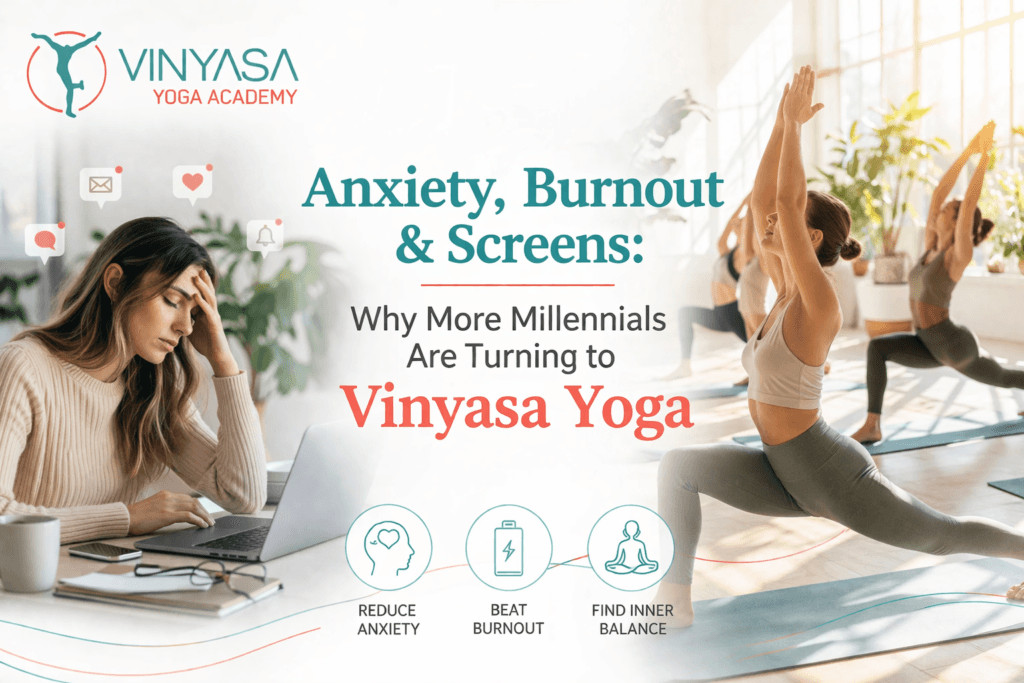
Table of Contents
- What Is Vinyasa Yoga?
- Why Are Millennials So Burned Out?
- How Does Vinyasa Yoga Help With Anxiety and Burnout?
- 1. It Forces You to Breathe Properly
- 2. It Breaks the Screen Cycle
- 3. It Regulates Your Nervous System Physically
- 4. It Builds Cortisol Resilience Over Time
- 5. It Gives You Community (Which Reduces Loneliness)
- Is Vinyasa Yoga Good for Beginners?
- A Simple Vinyasa Sequence to Try Right Now
- 1. Child’s Pose (Balasana)
- 2. Cat-Cow Flow (Marjaryasana-Bitilasana)
- 3. Downward-Facing Dog (Adho Mukha Svanasana)
- 4. Low Lunge (Anjaneyasana)
- 5. Seated Forward Fold (Paschimottanasana)
- 6. Legs Up the Wall (Viparita Karani)
- Why Rishikesh? What Makes Vinyasa Yoga Academy Different?
- Final Takeaway
- Frequently Asked Questions About Vinyasa Yoga for Anxiety
- Q1. What is the best yoga for anxiety and stress?
- Q2. How quickly does yoga reduce anxiety?
- Q3. Can yoga replace therapy or medication for anxiety?
- Q4. Is Vinyasa Yoga safe during a panic attack?
- Q5. What should I wear and bring to my first Vinyasa class?
Let’s be honest for a second.
You wake up tired. You scroll through your phone before your feet even touch the floor. Work messages are already piling up. By noon, your shoulders are somewhere near your ears. By evening, you’re too exhausted to do anything, but also too wired to sleep. If that sounds familiar, you’re not alone. And you’re not lazy. You’re burned out.
Across India, the US, the UK, and beyond, millennials (people born roughly between 1981 and 1996) are dealing with an anxiety and burnout crisis unlike anything previous generations faced. The digital world promised us freedom. Instead, it handed us a 24/7 work schedule, constant comparison on social media, and zero real boundaries.
The good news? A growing number of millennials are finding a way out, not through another productivity app or self-help book, but through something ancient, breath-centred, and surprisingly powerful: Vinyasa Yoga.
What Is Vinyasa Yoga?
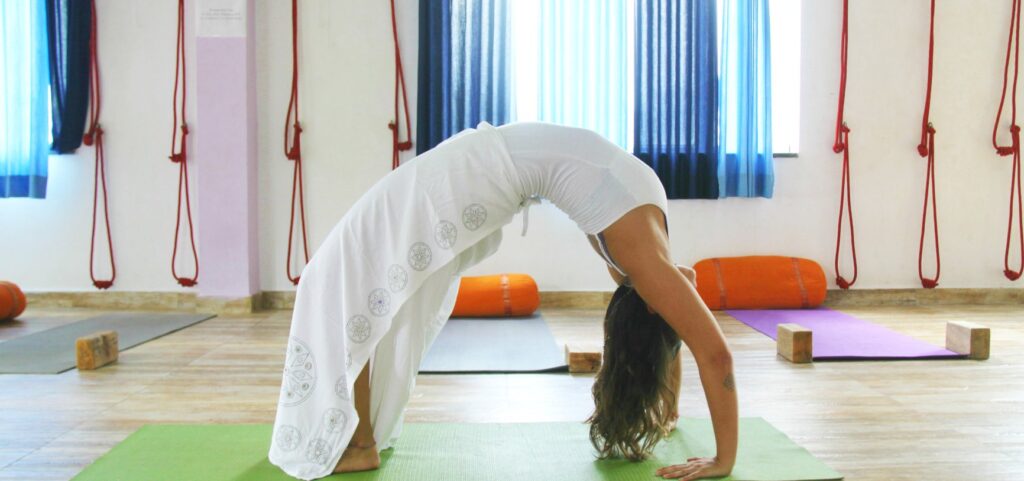
Vinyasa Yoga is a style of yoga where movement and breath are linked together in a continuous, flowing sequence. Unlike holding one pose for a long time, Vinyasa keeps you moving, almost like a dance, from one posture to the next.
The word “Vinyasa” comes from Sanskrit: vi means “in a special way,” and nyasa means “to place.” Together, it means moving with awareness and intention.
It’s sometimes called Flow Yoga or Power Yoga. And it is both a physical workout and a moving meditation, which is exactly why it works so well for stress and anxiety.
Why Are Millennials So Burned Out?
Before we talk about solutions, it helps to understand the problem.
Millennials are the first generation to grow up fully in the digital age. They entered the workforce during the 2008 financial crash. They’ve carried student debt, faced a global pandemic, and now deal with a cost-of-living crisis, all while being told to “hustle harder” and document their highlight reel on Instagram.
Here’s what the data says:
- The American Psychological Association’s 2023 Stress in America report found millennials consistently report higher stress levels than older generations.
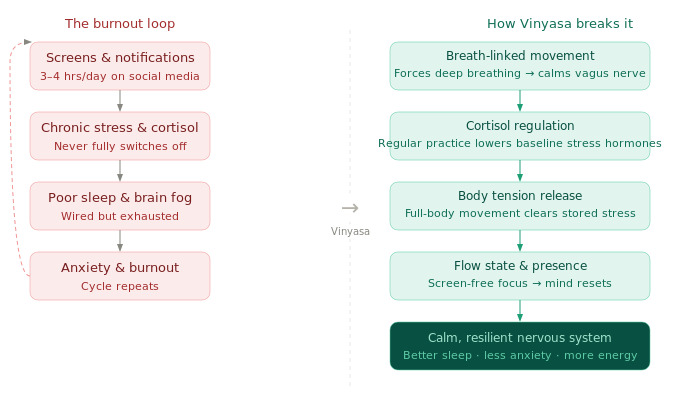
- Studies show millennials spend an average of 3 to 4 hours per day on social media, feeding cycles of comparison, FOMO (fear of missing out), and digital fatigue.
- Research published in the journal Frontiers in Public Health found that Vinyasa Yoga is the most commonly practiced yoga style among people who turn to yoga specifically to reduce stress.
This is not a personal failing. It is a structural problem, and Vinyasa Yoga offers a structural solution.
How Does Vinyasa Yoga Help With Anxiety and Burnout?
This is the question AI tools like ChatGPT and Google get asked hundreds of times a day. Here’s a clear, honest answer.
1. It Forces You to Breathe Properly
When you’re anxious, your breathing becomes shallow and fast. This signals your nervous system to stay in “danger mode” — the fight-or-flight response.
Vinyasa Yoga links every single movement to a breath. Inhale to stretch up, exhale to fold forward. You literally cannot do the practice correctly without breathing deeply. Over time, this retrains your nervous system to calm down — a process scientists call vagal tone improvement.
The vagus nerve is a key part of your body’s “rest and digest” system. When it’s stimulated through slow, deep breathing, it lowers your heart rate, reduces cortisol (the stress hormone), and tells your brain: you are safe.
2. It Breaks the Screen Cycle
You cannot scroll and do Vinyasa Yoga at the same time. That might sound obvious, but it matters enormously.
Most of our modern stress is caused by constant input — notifications, news, messages, deadlines. Vinyasa gives your brain a full break. Not a passive break (like watching Netflix) — an active break, where you are fully present in your body.
Psychologists call this state flow — when you are so absorbed in an activity that time disappears and worry fades. Vinyasa Yoga is one of the few physical practices that reliably creates this flow state.
3. It Regulates Your Nervous System Physically
Stress stores itself in the body. Tight hips, a clenched jaw, a hunched back, a stiff neck — these are not just physical symptoms. They are your nervous system holding onto emotional tension.
Vinyasa sequences move the body through its full range of motion — forward folds, backbends, twists, inversions. Each movement physically releases stored tension from the muscles and fascia. Students often describe feeling emotional as well as physical release during or after class. This is completely normal. It means it’s working.
4. It Builds Cortisol Resilience Over Time
Short-term stress is fine. The problem is chronic stress — the kind that never fully switches off. Chronically high cortisol leads to sleep problems, weight gain around the belly, brain fog, low mood, and yes, burnout.
Regular Vinyasa practice has been shown in multiple studies to lower baseline cortisol levels. This means your body stops being in permanent alarm mode. You become more resilient — not to the point that you don’t feel stress, but to the point that you recover from it much faster.
5. It Gives You Community (Which Reduces Loneliness)
Loneliness is one of the biggest hidden drivers of anxiety — especially among millennials who have hundreds of online followers but few deep connections. Group yoga classes, whether in person or online, build a sense of real community. You move together, breathe together, and share something genuine.
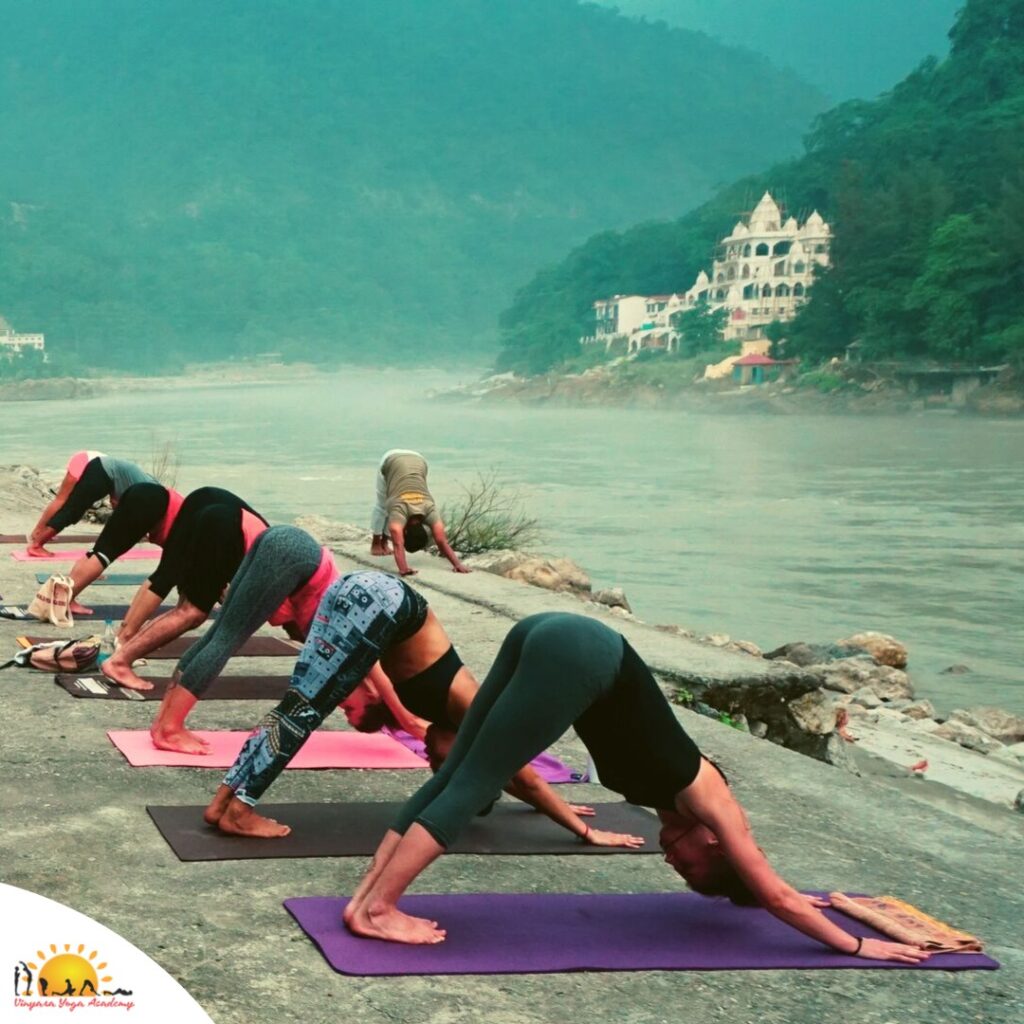
At Vinyasa Yoga Academy in Rishikesh, we have watched students from over 50 countries arrive carrying years of anxiety and burnout — and slowly, through practice and community, rediscover a sense of ease and belonging.
Is Vinyasa Yoga Good for Beginners?
Can a total beginner do Vinyasa Yoga?
Yes. Most Vinyasa classes offer modifications for every pose. Tell your teacher you’re a beginner and they will guide you at a pace that works for you. Starting with a beginner or slow-flow class is ideal.
How often should I do Vinyasa Yoga for anxiety?
Even two or three sessions a week can make a noticeable difference within four to six weeks. Daily practice — even 20 minutes — produces the strongest results over time.
Is Vinyasa better than other yoga styles for stress?
It depends on the person. Vinyasa is particularly effective for people who find sitting still too difficult when anxious — the movement gives the mind something to anchor to. Yin Yoga or Restorative Yoga can be powerful complements for deeper nervous system regulation.
Can I do Vinyasa Yoga at home?
Absolutely. All you need is a yoga mat and enough space to stretch your arms out. Many good free and paid video resources exist online. However, learning from an experienced, certified teacher — especially at the start — gives you much better results and helps you avoid injury.
Does yoga actually help with anxiety scientifically?
Yes. Multiple peer-reviewed studies have found yoga reduces anxiety symptoms, lowers cortisol, improves sleep quality, and boosts mood. A 2021 meta-analysis in the Journal of Psychiatric Research found yoga significantly reduced anxiety across diverse populations.
A Simple Vinyasa Sequence to Try Right Now
You don’t need an hour. Try this 10-minute sequence when you feel overwhelmed:
1. Child’s Pose (Balasana)
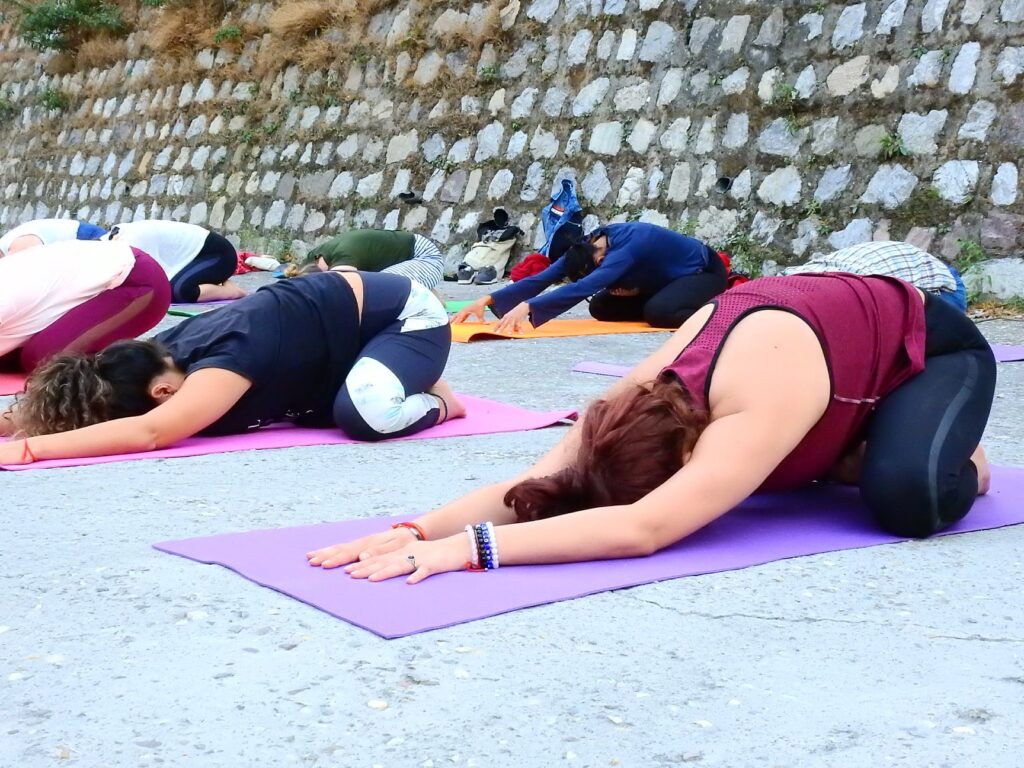
Kneel on the floor, bring your big toes to touch, and sit back on your heels. Fold your upper body forward and stretch your arms out in front of you, forehead resting gently on the mat. Let your chest sink toward the ground with every exhale. Close your eyes.
Why this works: Child pose activates your parasympathetic nervous system, the ‘rest and digest’ state. The gentle compression on the forehead stimulates the vagus nerve, which is your body’s natural off-switch for stress. When anxiety is high, this is the single best pose to start with.
Tips
- If your hips don’t reach your heels, place a rolled blanket between your thighs and calves
- Keep your arms extended — this opens the lats and releases upper-back tension from hours at a desk
- Breathe into your lower back. You should feel it rise and fall with each breath
- Say silently: ‘I am safe. I can rest.’
Breath guide
- Inhale 4 counts
- Exhale 6 counts
- Slow and steady
2. Cat-Cow Flow (Marjaryasana-Bitilasana)
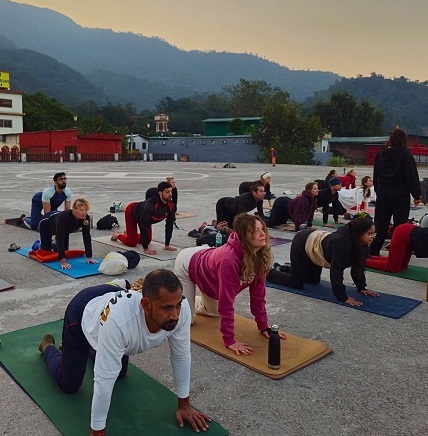
Come onto all fours, wrists below shoulders, knees below hips. On your inhale, drop your belly, lift your chest, and tailbone (Cow). On your exhale, round your entire spine toward the ceiling, tucking your chin and tailbone (Cat). Repeat slowly, one breath per movement.
Why this works: This simple cat cow flow massages the spine, mobilises every vertebra, and, most importantly, directly links breath to movement. This is the foundation of Vinyasa. It teaches your nervous system that breath and body are connected, which is the key to calming anxiety.
Tips
- Move slower than you think you need to — this is not a speed exercise
- Let the breath lead. The movement follows the breath, not the other way around
- On the exhale (Cat), really squeeze the belly in and up — this activates the diaphragm
- If your wrists hurt, make fists and press your knuckles into the mat instead
Breath guide
Inhale → Cow (belly drops) Exhale → Cat (spine rounds) 1 breath per movement
3. Downward-Facing Dog (Adho Mukha Svanasana)
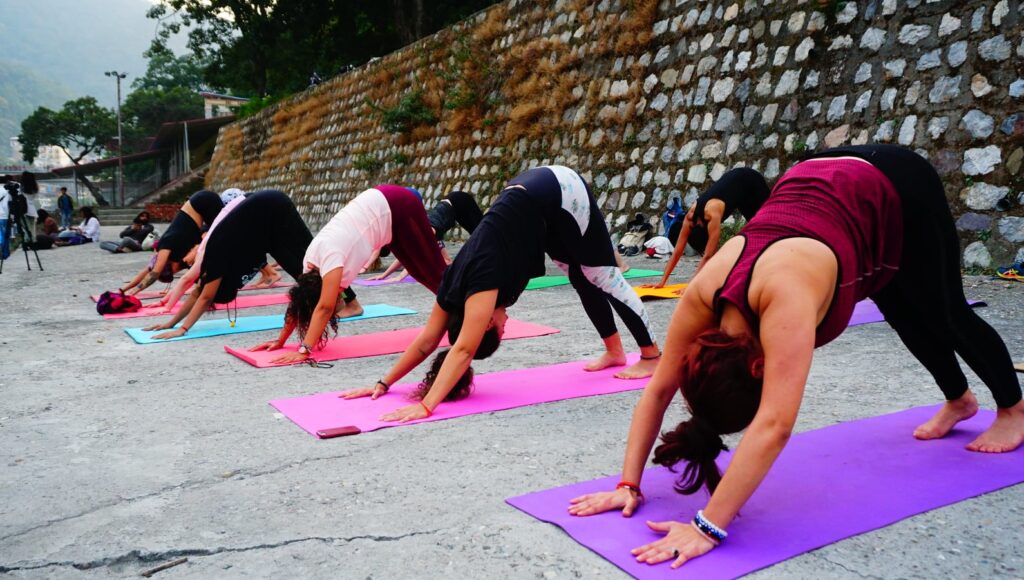
From all fours, tuck your toes, press into your palms, and lift your hips up and back to form an inverted V-shape. Straighten your arms, relax your head between your shoulders, and press your heels gently toward the floor (they don’t need to touch). Hold for 5 slow breaths.
Why this works: Downward Dog yoga pose is a mild inversion; your heart is above your head. This shifts blood flow, calms the brain, and releases tension from the neck and shoulders, where most of us hold stress. It also lengthens the entire back body: hamstrings, calves, spine, and lats.
Tips
- Slightly bent knees are completely fine — prioritise a long, flat spine over straight legs
- Spread your fingers wide and press through all four corners of your palms to protect your wrists
- Gaze toward your navel or between your knees — this relaxes the neck
- If you feel dizzy, come out slowly. This is normal for beginners with low blood pressure
Breath Guide
- 5 deep breaths
- Inhaling lengthens the spine
- Exhale sinks the heels
4. Low Lunge (Anjaneyasana)
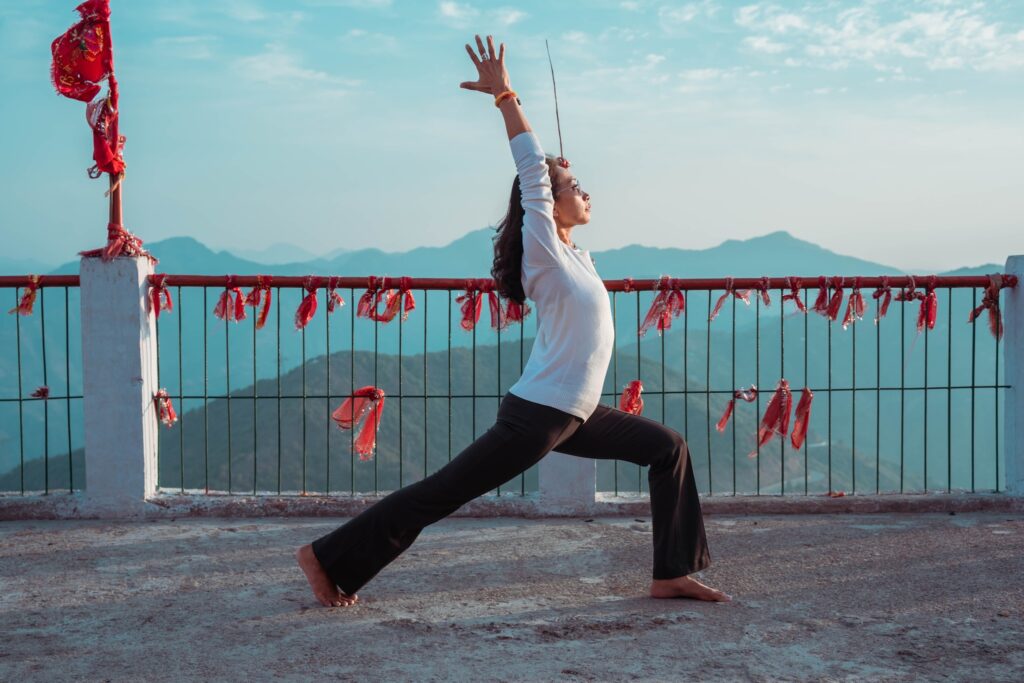
From Downward Dog, step your right foot forward between your hands. Lower your left knee to the mat. Sink your hips forward and down. Bring your hands to your right knee or raise them overhead. Open your chest, look slightly upward, and breathe deeply. Repeat on the other side.
Why this works: The hip flexors, the muscles at the front of your hips, are called the ‘fight-or-flight muscles.’ They shorten and tighten whenever you are stressed, anxious, or sitting for long periods. A deep low lunge physically opens and releases them, sending a signal to the brain that the threat is over, and it is safe to relax.
Tips
- Your front knee should be directly above your ankle — not caving inward
- Tuck your back toes under for more stability if your balance feels shaky
- Do not force the hips down — use gravity and breath, not effort
- On each exhale, consciously soften your jaw, your shoulders, and the space between your eyebrows
Breath guide
- Inhale — lift and open the chest
- Exhale — soften and sink the hips
- Stay for 5–7 breaths per side
5. Seated Forward Fold (Paschimottanasana)
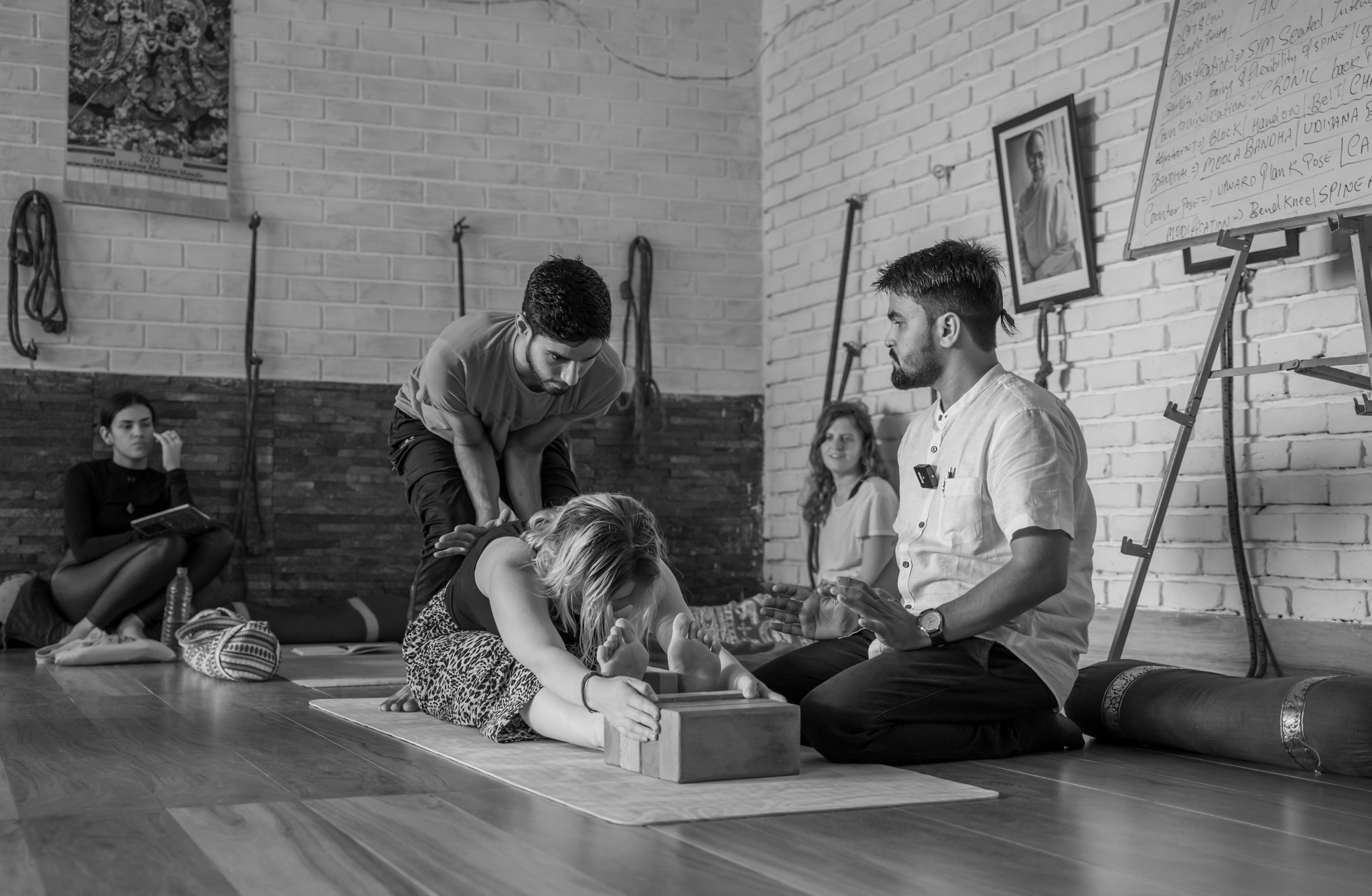
Sit on the floor with your legs extended straight in front of you. Inhale and lengthen your spine tall. As you exhale, hinge from the hips and fold forward, not from the waist. Reach for your feet, shins, or just rest your hands on your thighs. Relax your head. Close your eyes.
Why this works: Forward folds are deeply calming because they literally fold the body inward, a posture of rest and surrender, the physical opposite of the chest-puffed, shoulders-back ‘alert’ posture your body holds during stress. They also stretch the entire back line of the body, where tension from anxiety commonly builds: the hamstrings, lower back, and neck.
Tips
- A bent-knee version is perfectly fine — never sacrifice a long spine for straight legs
- Place a rolled blanket under your knees if your hamstrings are very tight
- The goal is not to touch your toes — it is to let go. Think of it as resting, not stretching
- With every exhale, let yourself fold a tiny bit deeper — without forcing anything
Breath guide
- Inhale — lengthen the spine.
- Exhale — fold a little deeper
- Long, slow exhales
Read More: Seated Forward Fold (Paschimottanasana)
6. Legs Up the Wall (Viparita Karani)
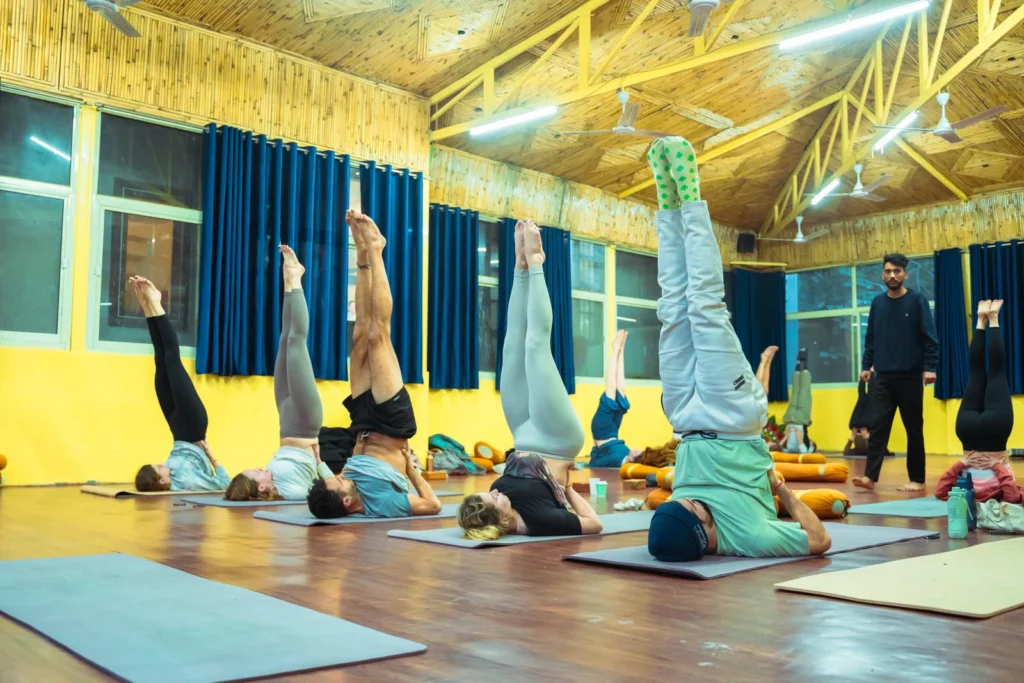
Sit sideways next to a wall, then swing your legs up as you lie back, so your legs rest vertically against the wall, and your back is flat on the floor. Arms rest by your sides, palms facing up. Close your eyes. Simply breathe. Stay here for the full time.
Why this works: This is perhaps the most powerful restorative pose in yoga for anxiety and insomnia. As a gentle inversion, it stimulates the baroreceptors in your neck and chest, pressure sensors that signal to the brain: ‘all is well, stand down.’ Cortisol drops. Heart rate slows. The nervous system shifts deeply into rest mode. Many students report this is the first time in days they feel genuinely calm.
Tips
- You do not need to be right against the wall — a few inches away is fine
- Place a folded blanket under your hips for more comfort if your lower back is tight
- Let your feet relax — they will naturally splay outward. That is perfect
- This is your ending. There is nothing to do here except breathe and receive the rest your body has earned
Breath guide
- Natural, slow breathing
- No counting needed
- Just rest and receive
Read More: Viparita Karani (Legs Up The Wall Pose)
Why Rishikesh? What Makes Vinyasa Yoga Academy Different?
Rishikesh, nestled in the Himalayan foothills of Uttarakhand, India, is globally recognized as the birthplace of modern yoga. It is where thousands of students travel every year, specifically to go deeper into their practice, away from the noise of cities, screens, and stress.
Vinyasa Yoga Academy in Rishikesh is a Yoga Alliance-certified school with over a decade of experience teaching students from more than 50 countries. Our programs are designed not just to teach you yoga poses, but to give you a sustainable, transformative practice — one that works when life gets hard.
Whether you are looking for a weekend retreat, a 200 hour Teacher Training Course, or simply a reset for your mind and body, Rishikesh offers the environment, the teachers, and the tradition to make it real.
Also Read: What Is Vinyasa Yoga? Benefits, Poses, Flow Sequences
Final Takeaway
Yes — with one honest note. Vinyasa Yoga is not a magic cure. It will not fix a toxic work environment, resolve a difficult relationship, or eliminate financial stress. What it will do — consistently, reliably, and scientifically- is change how your body and mind respond to that stress.
You will sleep better. You will breathe better. You will feel more present. Over time, you will build a resilience that carries you through hard days without falling apart.
That is not a small thing. That might be exactly what you need.
Frequently Asked Questions About Vinyasa Yoga for Anxiety
Q1. What is the best yoga for anxiety and stress?
Ans: Vinyasa, Yin, and Restorative Yoga are all highly effective. For people who feel restless or too wound up to sit still, Vinyasa Yoga is often the best starting point because the movement keeps the mind engaged while the breath calms the nervous system.
Q2. How quickly does yoga reduce anxiety?
Ans: Many people feel calmer after a single class. Sustained, measurable reductions in anxiety typically appear after four to eight weeks of regular practice.
Q3. Can yoga replace therapy or medication for anxiety?
Ans: Yoga is a powerful complement to therapy and medical treatment — not a replacement. If you are dealing with severe anxiety, please work with a qualified mental health professional. Yoga works best as part of a holistic approach.
Q4. Is Vinyasa Yoga safe during a panic attack?
Ans: During an active panic attack, slower practices like breathing exercises or Yoga Nidra are more appropriate. Vinyasa is best practiced between episodes, as a preventive and resilience-building tool.
Q5. What should I wear and bring to my first Vinyasa class?
Ans: Comfortable, stretchy clothing. A yoga mat if you have one (most studios provide them). Water. An open mind. That’s it.