







17 Types Of Yoga: Find The Best Match For Yourself
Table of Contents
- What Are the Popular Types of Yoga?
- Part 1: The Classical Four | The Roots of All Yoga
- Part 2: The Hatha Family | Foundation Styles You’ll Find in Every Studio
- 1. Hatha Yoga
- 2. Vinyasa Yoga
- 3. Ashtanga Yoga
- 4. Iyengar Yoga
- 5. Kundalini Yoga
- Part 3: Therapeutic & Wellness Styles | Yoga That Heals
- 6. Yin Yoga
- 7. Restorative Yoga
- 8. Yoga Nidra
- 9. Chair Yoga
- 10. Prenatal Yoga
- Part 4: Modern & Niche Yoga Styles | Where Tradition Met Innovation
- 11. Hot Yoga / Bikram Yoga
- 12. Power Yoga
- 13. Aerial Yoga
- 14. Acro Yoga
- 15. Rocket Yoga
- 16. Jivamukti Yoga
- 17. Yin Yang Yoga
- Best Type Of Yoga Based on Your Goals
- Is Yoga a Type of Meditation?
- What Type of Yoga is Best for Beginners?
- Final Thoughts: Your Mat, Your Path
- FAQs
- Explore Yoga Styles in Depth
Most online articles list types of yoga as if they were a menu of physical exercises, completely missing how different lineages alter your muscles, joints, and energy.
While you can find even fifty or a hundred yoga styles online, we wanted to approach this differently. In our 15+ years of running classes and watching people transform, we have seen that a yoga style that heals one person can easily cause frustration or injury in another.
Our gurus spent decades studying and mastering various types of yoga at their roots to understand how they truly impact a living body. We narrowed this down to exactly 17 types, so you can find the perfect fit for yourself.
This breakdown is designed to match and bring your current physical limits and long-term health goals to the right mat.
What Are the Popular Types of Yoga?
Yoga has four classical branches (Karma, Bhakti, Jnana, Raja), a large Hatha-based family (Hatha, Vinyasa, Ashtanga, Iyengar, Kundalini), therapeutic styles (Yin, Restorative, Yoga Nidra, Chair, Prenatal), and modern niche styles (Hot Yoga, Power Yoga, Aerial, Acro). In total, most practitioners today choose from 15+ recognised yoga styles, each with different intensity levels, goals, and physical demands.
Part 1: The Classical Four | The Roots of All Yoga
Long before yoga studios existed, yoga was a philosophy. Ancient Indian texts describe four primary paths of yoga, each a complete way of living in its own right. You would not find most fitness classes touching these, but understanding them puts everything else in context.
| Path | Sanskrit Name | Core Practice | Best For |
| Service | Karma Yoga | Selfless action; action without attachment | Those driven by purpose, not recognition |
| Devotion | Bhakti Yoga | Chanting, prayer, devotional rituals | Spiritually inclined, emotionally expressive |
| Wisdom | Jnana Yoga | Chanting, prayer, and devotional rituals | Intellectuals, those seeking self-understanding |
| Meditation | Raja Yoga | Meditation, breath, 8 limbs of yoga | Disciplined practitioners, meditators |
Raja Yoga, sometimes called Ashtanga in classical texts, follows the eight limbs of yoga outlined by the sage Patanjali, from ethical living all the way to deep meditation (samadhi). It’s the backbone of most modern yoga philosophy.
Part 2: The Hatha Family | Foundation Styles You’ll Find in Every Studio
Nearly every physical yoga class you find in a studio today is part of the Hatha family. Hatha simply means the yoga of physical postures (asanas) combined with breath. Everything else is a variation.
1. Hatha Yoga
Absolute beginners, anyone returning after a break
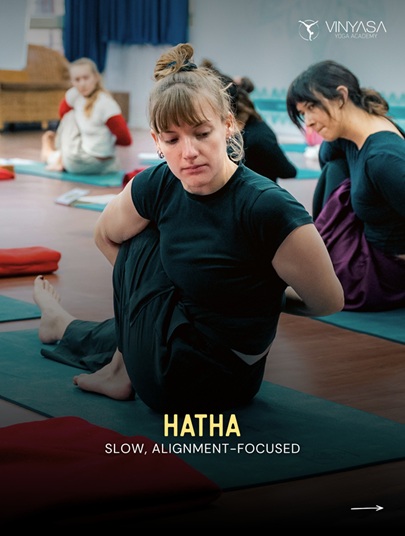
Hatha is the starting point of the yoga asanas. Classes are slower-paced. Each posture is held for several breaths, which gives you time to understand alignment. No rush or complex sequences. Just the mat, you, and a few basic starting poses.
Type: Calm, grounded, slightly stretched, approachable
Also Read:- Benefits of Hatha Yoga
2. Vinyasa Yoga
People who like rhythm, flow, and kind of a moderate workout
Vinyasa is movement synchronised with breath. Poses flow into each other like a choreographed sequence. No two classes are identical, keeping the practice and routine fresh. Vinyasa is yoga on the move. According to independent research, Vinyasa burns 150-250 calories per hour, making it one of the top answers to the question, “What type of yoga burns the most calories?”
Type: Energised, sweaty, mentally focused
Also Read:- Benefits of Vinyasa Yoga

3. Ashtanga Yoga
Disciplined practitioners who want structure and progression
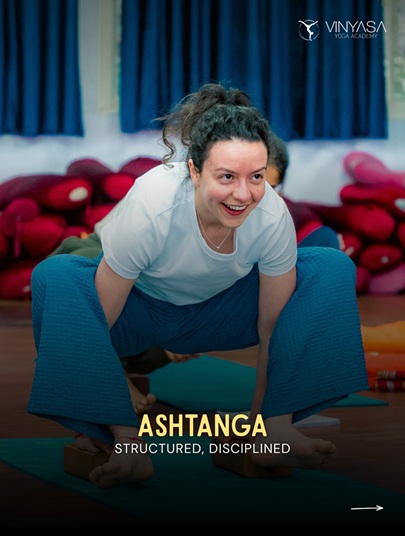
Ashtanga follows a fixed set of poses in a precise order, every single time. It’s physically intense, as jump-backs, chaturangas, and challenging balances are standard. The repetition is the point: you deepen each pose over months and years. Mysore-style Ashtanga (practiced in silence, self-paced) is one of the most authentic yoga experiences available.
Type: Challenged, disciplined, progressively stronger
Also Read: Ashtanga Vinyasa Yoga
4. Iyengar Yoga
People with injuries, chronic pain, or who care deeply about alignment
Created by B.K.S. Iyengar, this style uses props, such as blocks, straps, blankets, and bolsters, to help everybody access every pose safely. There’s no rushing here as well. Teachers are among the most thoroughly trained in the world. Yes, it’s slower than Vinyasa’s flow, but far more anatomically intelligent.
Type: Aligned, supported, therapeutically nourished
5. Kundalini Yoga
People seeking an energetic, spiritual, and breath-focused practice
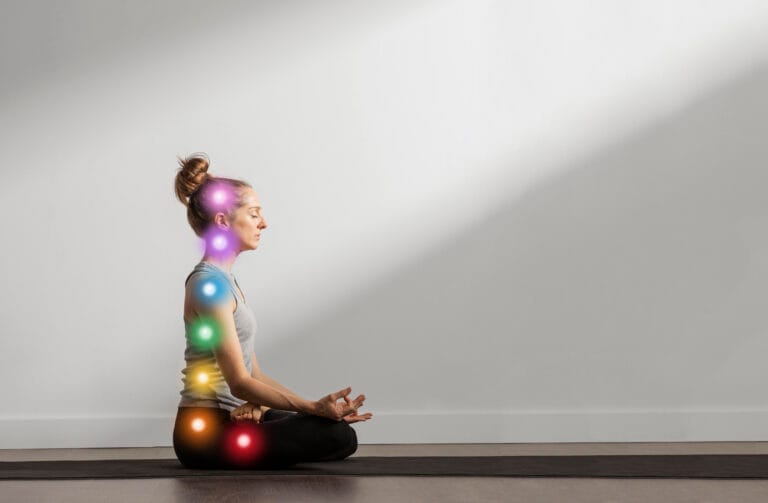
Kundalini is unlike anything else. It combines breathwork (pranayama), chanting, repetitive movement sequences called kriyas, and meditation. Its goal is to awaken the sleeping energy at the base of the spine, called the kundalini energy. And, move it upward through the chakras, all the way up to the head. It’s more intense mentally and energetically than physically.
Type: Alert, possibly emotional, spiritually activated
Part 3: Therapeutic & Wellness Styles | Yoga That Heals
These yoga practices are intended to slow you down, restore, and heal your soul. They’re not about burning calories, building strength, or flexibility. They’re all about nervous system recovery, deep tissue release, mental stillness, and inner well-being. Some of the most famous therapeutic and wellness types of yoga are:
6. Yin Yoga
Athletes with tight hips, stiff joints, or chronic tension need recovery
In Yin yoga, you hold poses for 3-5 minutes each that target the deep connective tissues, like fascia, ligaments, and joint capsules. Yin yoga is quite challenging. Lying still in a hip opener for five minutes is harder than it sounds. But the long-term improvements in mobility and joint health are significant.
One of our students suffered from chronic corporate burnout and insomnia. Our gurus guided them away from sweaty cardio flows and into passive Yin sessions. They reported their first full night of deep sleep in months after just four days of classes.
Type: Reformative, quiet, complex asanas
7. Restorative Yoga
Stress, burnout, anxiety, post-surgery recovery, menstruation
Restorative yoga uses bolsters, blankets, and props to support the body in total effortless relaxation. Poses are held for 10-20 minutes. It causes the nervous system to downshift completely and reach a relaxed state. Restorative yoga helped women with excess weight reduce body fat, including abdominal fat, without the need for tiring exercises, according to a systematic review held in 2021.
Type: Calming, beginner-friendly; for mental peace and physical unwinding
8. Yoga Nidra
Insomnia, anxiety, trauma recovery, and deepening meditation
Yoga Nidra, or ‘yogic sleep,’ is a form of guided meditation practised by lying down. It takes you to a state between waking and sleeping. One hour of Yoga Nidra is said to equal four hours of regular sleep in terms of rest. It’s one of the most powerful tools for rewiring consciousness and requires zero physical effort.
Type: Deep rest, not awake, not asleep
Also Read:- Benefits of Yoga Nidra
9. Chair Yoga
Seniors, office workers, those with mobility limitations or injuries
Chair yoga modifies traditional yoga asanas so they can be done seated or using a chair for support. It maintains all the benefits of yoga, like flexibility, joint mobility, and breath awareness, without requiring floor work. Chair yoga is designed to bring ease into the practice without losing form. It’s the best answer to anyone asking, “What type of yoga is best for seniors?”
Type: Seated asanas, use of chair, multiple styles
10. Prenatal Yoga
Pregnant women at any stage of pregnancy
Prenatal yoga is made to fit the specific needs of pregnancy. It offers yoga poses for open hips, breathing techniques for labour, relief asanas for back pain, and foundations to work for the health and well-being of expectant mothers. It’s safe, it’s deeply supportive, and it’s evidence-backed for reducing anxiety related to pregnancy and improving birth outcomes.
Various schools, including Vinyasa Yoga Academy in Rishikesh and Bali, offer Yoga Alliance-certified 85-hour Prenatal Yoga TTC. You can not only learn or practice Prenatal Yoga, but also teach and guide women in their crucial phase of life.
Part 4: Modern & Niche Yoga Styles | Where Tradition Met Innovation
These yoga styles emerged mostly in the 20th and 21st centuries. Some blend yoga with fitness. Some add heat, slings, props, or a partner. They’re less ancient but no less legitimate. And for many people, they’re the gateway into the world of yoga.
11. Hot Yoga / Bikram Yoga
Bikram yoga is a fixed 26-pose sequence
Hot yoga is a broader term for any Bikram yoga asana practised in a room heated to about 35-40°C (95-105°F). The heat deepens flexibility and increases heart rate. It is an intermediate to advanced-level yoga sequence that requires previous experience with basic yoga practice.
A 2014 study led by Dr. Brian L. Tracy at Colorado State University found men burn approximately 460 calories and women around 330 calories in a 90-minute Bikram session. Intense? Very. Effective? Also very.
12. Power Yoga
Athletes, fitness-focused practitioners, and those coming from a gym background
Power Yoga is Ashtanga-inspired but without the fixed sequence. No mantras, no philosophy, just movement and sweat. It’s fast, physically demanding, and focused on strength and power as much as flexibility and balance. If your question is “what type of yoga is best for weight loss,” Power Yoga and Vinyasa are your top two answers.
Type: Strenuous, intensive, supervised practice
13. Aerial Yoga
It is yoga in the air
Aerial yoga is a distinct type of yoga that uses a hammock or silk sling suspended from the ceiling. Practitioners perform inversions, twists, jumps, and flows while partially or fully suspended from the cloth. The hammock decompresses the spine beautifully and lets beginners safely experience inversions they might never manage on the floor.
Type: Performed under supervision, aerial flow, hand strength
14. Acro Yoga
Acro Yoga is a blended practice performed by combining yoga with acrobatics and Thai massage. One person acts as the base (on the ground), one as the flyer (elevated), and often a third one as a spotter. Acro yoga requires trust, communication, coordination, balance, and core strength, and produces a lot of laughter.
Some common beginner-friendly Acro yoga poses are the bird pose, star, throne, etc. Though other yoga styles increase strength, flexibility, and mental power, Acro yoga brings the tactical benefits of acrobatics in yoga.
Type: Acrobatic, group work, coordination, and concentration
Also Read: AcroYoga Explained – Meaning, Benefits, Techniques & Popular Partner Poses

15. Rocket Yoga
“It gets you there faster.”
Rocket Yoga is a faster, more flexible version of Ashtanga, developed by Larry Schultz in San Francisco around the 1980s. Poses are modified to make the sequence more accessible while keeping the intensity high. The name comes from its creator’s ethos, quality, and goals.
It was developed for beginners who are looking to adapt to yoga fast, get into asanas, and achieve certain physical and mental transformations in less time. Cobra pose, Crow pose, Locust pose, etc., are a few examples of Rocket Yoga sequencing.
Type: Variation of traditional Ashtanga-Vinyasa Yoga
16. Jivamukti Yoga
Holistic experience, not a workout
Jivamukti yoga is a type of yoga that is physically energetic, similar to Vinyasa, but includes Sanskrit chanting, music, and teachings on yoga philosophy, ethics, and environmental responsibility. Each class is themed, drawn from ancient yogic texts. It is centred around key pillars like bhakti, ahimsa, dhyana, etc.
Jivamukti yoga’s lesson is to live freely and let every being live freely as well, connecting the physical and spiritual spheres of self.
Type: Intense, includes music, mantra, and meditation alongside asanas.
17. Yin Yang Yoga
Taoism has a role to play here
A balanced class that combines Yin’s long, passive holds with the more dynamic flows of Vinyasa or Hatha (Yang). Your body gets deep tissue release alongside active strengthening. A great single-class solution if you want both restoration and movement in one session.
It teaches the delicate balance between motion and rest, the two states that every being juggles regularly.
Type: Philosophically-related, quiet but active
Best Type Of Yoga Based on Your Goals
Now that you know all major styles of yoga, it’s time for you to choose the one that suits you perfectly and helps strike a real shift in your mind, body, soul, and life.
| Your Goal | Best Style(s) | Intensity |
| Complete beginner | Hatha, Iyengar | Low |
| Weight loss & calorie burn | Vinyasa, Power, Hot Yoga | High |
| Stress relief & sleep | Yin, Restorative, Yoga Nidra | Very Low |
| Build strength & discipline | Ashtanga, Power Yoga | High |
| Flexibility & mobility | Yin, Hatha, Iyengar | Low-Medium |
| Seniors & disabled, less movement | Chair Yoga, Hatha, Restorative | Low |
| Spiritual deepening | Kundalini, Bhakti, Raja Yoga | Variable |
| Athletes & recovery | Yin, Restorative, Power Yoga | Low-High |
| Fun & social practice | AcroYoga, Aerial Yoga | Medium-High |
| Core strength & posture | Vinyasa, Power, Ashtanga | Medium-High |
Is Yoga a Type of Meditation?
Yoga includes meditation, but it’s not only meditation. Yoga is a broader system covering physical postures, breathwork, ethics, and meditation.
The eight limbs of yoga (Patanjali’s Ashtanga system) place asanas (physical postures) at number three. Meanwhile, Meditation Dharana (concentration) and Dhyana (meditation) come at six and seven, respectively. Yoga Nidra and Kundalini yoga are the most meditation-oriented practices. Vinyasa and Power Yoga are more movement-forward. Most modern types of yoga weave both meditation and asana together.
So yes, yoga can be deeply meditative. But not every yoga class is a meditation class. It depends on the teacher and the style.
What Type of Yoga is Best for Beginners?
These three styles of yoga work well as entry points for beginners:
- Hatha Yoga: slower pace, foundational poses, time to understand each posture
- Iyengar Yoga: props make poses accessible and exceptional for learning alignment safely
- Restorative Yoga: no wrong moves, total support from props and gravity
Starting with two classes per week is a good step. Keep a notebook of the poses you have explored and practised. Within four to six weeks, you’ll have a clear sense of which direction calls you: A more dynamic flow? Deeper stillness? Or something in between?
Also Read: Benefits of Yoga
Final Thoughts: Your Mat, Your Path
Yoga is one of the oldest wellness systems on earth. The fact that it has branched into 20+ styles isn’t a sign of fragmentation but of how deeply it works for different people in different ways.
You don’t need to commit to one style forever. Most practitioners move through phases starting with Hatha, moving into Vinyasa, deepening into Yin, and exploring Kundalini. Let your body and life stage guide you to the best type of yoga you can practice.
Want to go deeper than a studio class can take you?
At Vinyasa Yoga Academy, we offer immersive and the best yoga teacher training courses in Rishikesh, India, and Bali, Indonesia. Whether you’ve practiced for years or are simply curious about the roots of these styles, our programs go beyond the asana into pranayama, philosophy, anatomy, and teaching methodology.
You practice Hatha, Vinyasa, and Ashtanga daily, taught by E-RYT 500 instructors who live and breathe these lineages. Our retreats are also designed for practitioners and non-practitioners alike. If 2026 is the year you go all in on yoga, here is where to do it.
Explore Upcoming Programs at Vinyasa Yoga Academy
FAQs
What is the best yoga for beginners?
If you’re new to yoga, you might want to start with Hatha or Iyengar yoga. Both are slower-paced; you hold poses and understand alignment and don’t need any previous experience. If you want stress relief right from the beginning, restorative yoga is also there for you to explore.
What kind of yoga burns the most calories?
Vinyasa, Power Yoga, and Hot Yoga (Bikram) burn the most calories, between 400 and 500 per hour, according to the American Council on Exercise. These are high-level because of their demanding, uninterrupted sequences.
What is the best type of yoga for seniors?
Chair Yoga is designed especially for the elderly or anyone with limited mobility. Hatha and Restorative yoga are also excellent for elders. The trick is to find a style that avoids deep, floor-based inversions and emphasises joint-friendly movement.
What are the different kinds of asanas?
Different types of yoga focus on different groups of asanas. Yoga asanas (postures) are categorised as: standing, seated, forward bends, backbends, twists, inversions, arm balances, and restorative. Some basic ones are Downward Dog, Warrior I, II, and III, Tree Pose, Child’s Pose, and Savasana.
Which type of yoga is most effective for weight loss?
Vinyasa and Power Yoga burn the most calories for weight loss. A regular yoga practice also contributes to long-term weight management. Studies show that practitioners tend to make better food and lifestyle choices. Perform 2-3 active yoga asanasper week, and add Yin or Restorative for recovery.
What is the difference between Vinyasa and Hatha yoga?
Hatha is slow and pose-centred, i.e., you stay in each pose for a bit. Vinyasa is flowing and breath-synchronised, which means you move continuously between poses. Hatha is better for beginners trying to learn form. If you want cardio intensity and a more dynamic practice, choose Vinyasa.
What type of yoga is beneficial for back pain?
Iyengar and Restorative yoga are the gold standard in yoga for back pain. Both use props to support proper alignment without strain. Yin Yoga is another popular type of yoga that helps with chronic lower back stiffness by releasing deep fascial tissue. Always inform your teacher of any existing back condition before class.
Can beginners do Ashtanga yoga?
Ashtanga is not ideal for complete beginners. Its fixed sequence is rigorous and requires familiarity with foundational poses. Most instructors recommend at least three to six months of Hatha or Vinyasa first. However, a Mysore-style Ashtanga class (self-paced, teacher-guided) can work for willing, motivated beginners.
Explore Yoga Styles in Depth
- Hatha Yoga — the foundational style
- Vinyasa Flow — breath-linked dynamic practice
- AcroYoga — partner practice