







AcroYoga Explained – Meaning, Benefits, Techniques & Popular Partner Poses
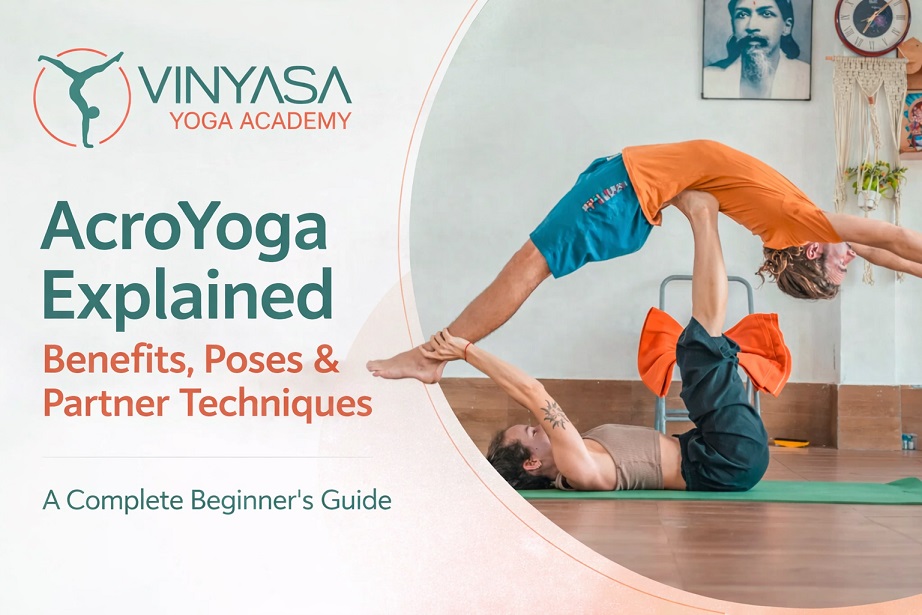
Table of Contents
- What Is Acroyoga?
- The Three Roles in Acroyoga — Base, Flyer, and Spotter
- 1. The Base
- 2. The Flyer
- 3. The Spotter
- Types of Acro Yoga — Solar, Lunar, and Therapeutic
- 1. Solar Acro Yoga
- 2. Lunar Acro Yoga
- 3. Therapeutic / Healing Arts Acro Yoga
- Benefits of Acro Yoga
- 1. Physical Benefits
- 2. Mental and Emotional Benefits
- 3. Relationship and Social Benefits
- Core Techniques Used in Acro Yoga
- 1. Bone Stacking
- 2. Counter Balancing
- 3. Communication
- Seated Acro Yoga
- 1. Back-to-Back Breathing
- 2. Seated Forward and Backbend
- 3. Double Downward Dog
- Popular Acro Yoga Poses — From Beginner to Intermediate
- 1. Beginner Acro Yoga Poses
- 2. Intermediate Acro Yoga Poses
- Acro Yoga for Beginners — Your Step-by-Step Starting Guide
- Step 1: Find the Right Partner
- Step 2: Warm Up Properly
- Step 3: Learn the Language First
- Step 4: Start With Seated Acro Yoga
- Step 5: Always Use a Spotter
- Step 6: Find a Qualified Teacher
- Safety First — Acro Yoga Contraindications and Precautions
- Do Not Practice Acro Yoga If You Have:
- General Safety Rules:
- Final Thoughts
- Frequently Asked Questions About Acro Yoga
- Q: What is acro yoga?
- Q: Is acro yoga good for beginners?
- Q: What is seated acro yoga?
- Q: What are the benefits of acro yoga?
- Q: What are the basic acro yoga poses for beginners?
- Q: How is acro yoga different from partner yoga?
- Q: Do I need a specific body type to do acro yoga?
- Q: How long does it take to learn acro yoga?
- Q: Where can I learn acro yoga in India?
Imagine doing yoga, but with a partner, in the air. That’s acro yoga in a nutshell. It looks difficult. It looks like something only circus performers or Instagram athletes can do. But here’s the truth: anyone can start acro yoga, even if you’ve never stepped on a yoga mat before.
Acro yoga (also written as acroyoga) is one of the fastest-growing yoga styles in the world right now. It blends traditional yoga postures, acrobatics, and Thai massage into one practice that builds strength, trust, and a whole lot of fun.
In this guide, we’ll break down everything: what acro yoga is, what it does for your body and mind, the best poses to try, and how to safely get started as a complete beginner. Whether you’re curious about trying it or you’re already doing yoga and want to take it further, this guide is for you.
What Is Acroyoga?
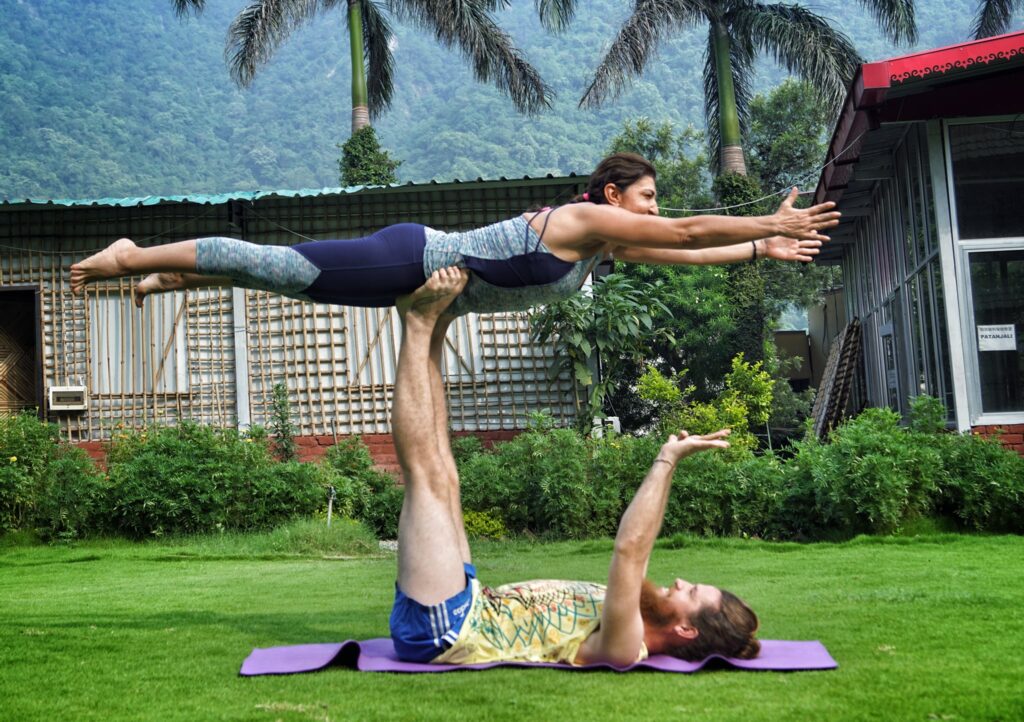
Acro yoga is a partner-based practice that combines yoga postures, acrobatics, and healing bodywork. The word itself comes from the Greek word ‘akro’, meaning ‘high’ or ‘at the extremity,’ and of course, yoga, which means union.
In plain terms, one person supports another person’s weight using their hands and feet. The person on the ground is called the base. The person in the air is called the flyer. And there’s often a third person — the spotter — who makes sure everyone stays safe.
What makes acro yoga different from regular partner yoga is the element of flight. The flyer is lifted fully off the ground and held in various yoga-inspired shapes, creating a beautiful and challenging shared experience.
Acro yoga first gained modern popularity in 2003 when Jenny Sauer-Klein and Jason Nemer began teaching it formally in San Francisco. But its roots go much deeper — partner balancing poses existed in ancient Indian yoga traditions, and T. Krishnamacharya (the father of modern yoga) was known to practice movement-based yoga with students as early as the 1930s.
The Three Roles in Acroyoga — Base, Flyer, and Spotter
Every Acroyoga practice involves three specific roles. Understanding these is the most important thing a beginner needs to know.
1. The Base
The base is the person who lies on the ground and does all the supporting. Using their feet and hands, the base lifts and balances the flyer in the air. The base needs to have solid core strength and stability. Their feet are the platform on which everything else balances.
Being a good base isn’t just about being strong. It’s about being calm, steady, and communicating clearly with the flyer.
2. The Flyer
The flyer is the person who gets lifted into the air and holds the yoga poses. Flyers need to be light on their feet (literally), agile, and able to stay focused while being balanced off the ground. They need to trust — fully — the person below them.
Being a flyer teaches you to surrender control and find stillness in unexpected positions. It’s one of the most liberating feelings in yoga.
3. The Spotter
The spotter stands nearby and watches the entire practice. If the flyer looks like they might fall, the spotter steps in to guide them safely to the ground. For beginners especially, always having a spotter is non-negotiable.
As your practice grows and you become more confident in familiar poses, you may not always need a spotter. But when learning new poses — always use one.
Types of Acro Yoga — Solar, Lunar, and Therapeutic
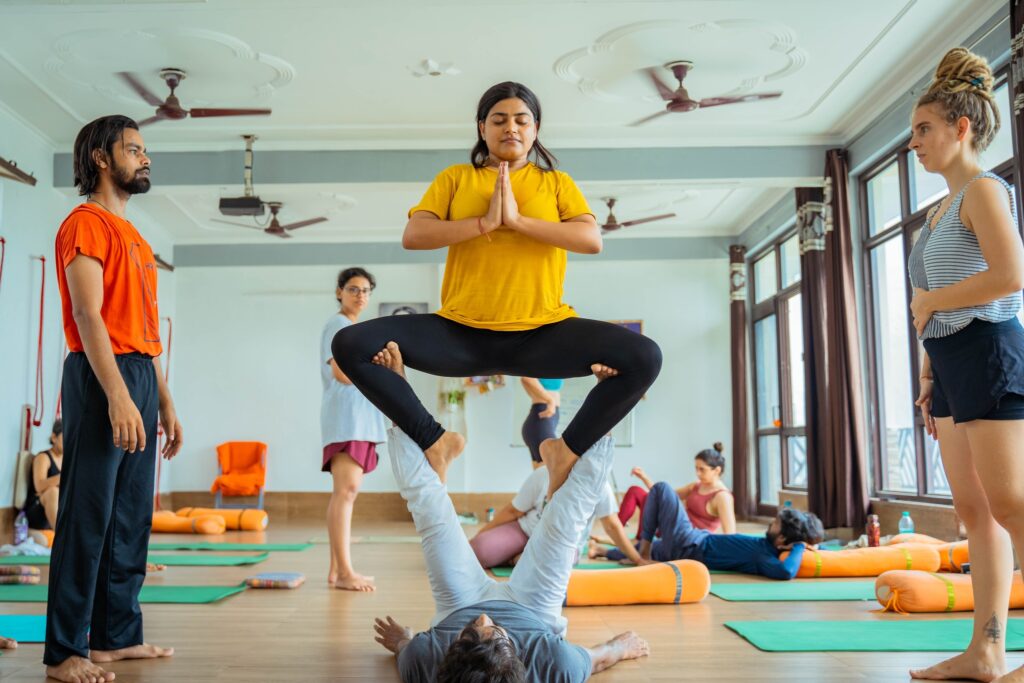
Not all acro yoga looks the same. There are three main styles, each with a different energy and purpose.
1. Solar Acro Yoga
Solar acro yoga is the more athletic, dynamic version. It’s what you typically see in videos — powerful lifts, dynamic flows, and strong acrobatic sequences. It focuses on strength, energy, and building impressive physical skills between partners.
If you enjoy active movement, physical challenges, and building serious strength, solar acro yoga is your style.
2. Lunar Acro Yoga
Lunar acro yoga is the opposite — it’s slow, healing, and deeply restorative. This style incorporates Thai massage techniques, stretching, and gentle contact. The flyer is cradled and supported in calming positions, and the overall energy is quiet and nurturing.
If you’re recovering from stress, dealing with a physically demanding job, or simply want something deeply relaxing to do with a partner, lunar acro yoga is wonderful.
3. Therapeutic / Healing Arts Acro Yoga
This is a blend of bodywork, healing touch, and restorative movement. It incorporates elements from Thai yoga massage and is often used in wellness retreats and therapeutic settings. The goal is physical and emotional healing — not performance.
Benefits of Acro Yoga
Acroyoga isn’t just fun to watch. It delivers real, measurable benefits for your body, mind, and relationships. Here’s what regular practice will give you:
1. Physical Benefits
- Builds full-body strength — especially core, arms, and legs
- Dramatically improves balance and spatial awareness
- Increases flexibility — both for the base and flyer
- Improves posture and body alignment
- Develops fine motor control and body coordination
- Activates muscles you didn’t even know existed
2. Mental and Emotional Benefits
- Builds deep trust — you literally have to trust another person with your body
- Reduces anxiety — the focus required during practice naturally quiets mental chatter
- Boosts confidence — successfully landing a pose feels incredible
- Teaches you how to communicate clearly and receive feedback without ego
- Creates a sense of playfulness and joy that most exercise routines lack
3. Relationship and Social Benefits
- Deepens bonds — whether with a partner, friend, or stranger in a class
- Teaches active listening and non-verbal communication
- Creates a strong sense of community in group classes
- Couples who practice acro yoga together report better communication overall
Research note: A study published in the Journal of Bodywork and Movement Therapies found that partner-based movement practices significantly increased feelings of social connection and emotional wellbeing in participants after just 8 weeks.
Core Techniques Used in Acro Yoga
Before you start attempting poses, understanding the two foundational techniques of acro yoga will save you a lot of frustration — and prevent injuries.
1. Bone Stacking
Bone stacking is the principle of aligning joints directly on top of each other so that bones — not muscles — bear the weight. When the base lifts the flyer, the goal is to have perfectly stacked ankles over knees over hips. When this alignment is achieved, the base can hold the flyer with very little muscular effort.
Think of it like a well-built tower of blocks. When everything lines up, the structure is stable. When things are off-center, it becomes shaky and exhausting.
2. Counter Balancing
Counter balancing is used when partners are working at the same level — neither person is on the ground while the other is in the air. Instead, both lean into or away from each other in opposite directions, using each other’s weight to create balance.
A simple example: two people sitting on the ground, facing each other, holding hands, and leaning back — they’re counter balancing each other’s weight.
3. Communication
This isn’t a physical technique, but it’s the most important one. Before every pose, partners should communicate about what they’re about to do, what the entry and exit points are, and what signals they’ll use if something feels wrong. The word ‘down’ is the universal acro yoga signal that means ‘bring me to the ground safely, now.’
Seated Acro Yoga
If the idea of being lifted into the air immediately sounds scary, seated acro yoga is exactly where you should begin. Seated acro yoga involves poses where both partners remain close to the ground, with minimal lifting.
It’s an ideal bridge between regular partner yoga and full flying acro yoga. Here are some wonderful seated acro yoga practices to try:
1. Back-to-Back Breathing
Both partners sit on the ground back-to-back, spines touching. As one partner breathes in and expands, the other breathes out and softens. This simple seated acro yoga exercise builds the fundamental quality of tuning into a partner’s body — and it’s deeply calming.
2. Seated Forward and Backbend
One partner sits in a forward fold while the other leans back gently onto their back. The pressure from the back-resting partner creates a supported stretch for both. This is a classic seated acro yoga move that also doubles as a therapeutic massage technique.
3. Double Downward Dog
Both partners start in a standard downward dog. The second partner steps their feet onto the lower back of the first, creating a double downward dog shape. This is low to the ground, gentle, and gives a fantastic stretch for both.
Seated acro yoga builds the body awareness, communication, and trust you’ll need for more advanced flying poses. Don’t skip it!
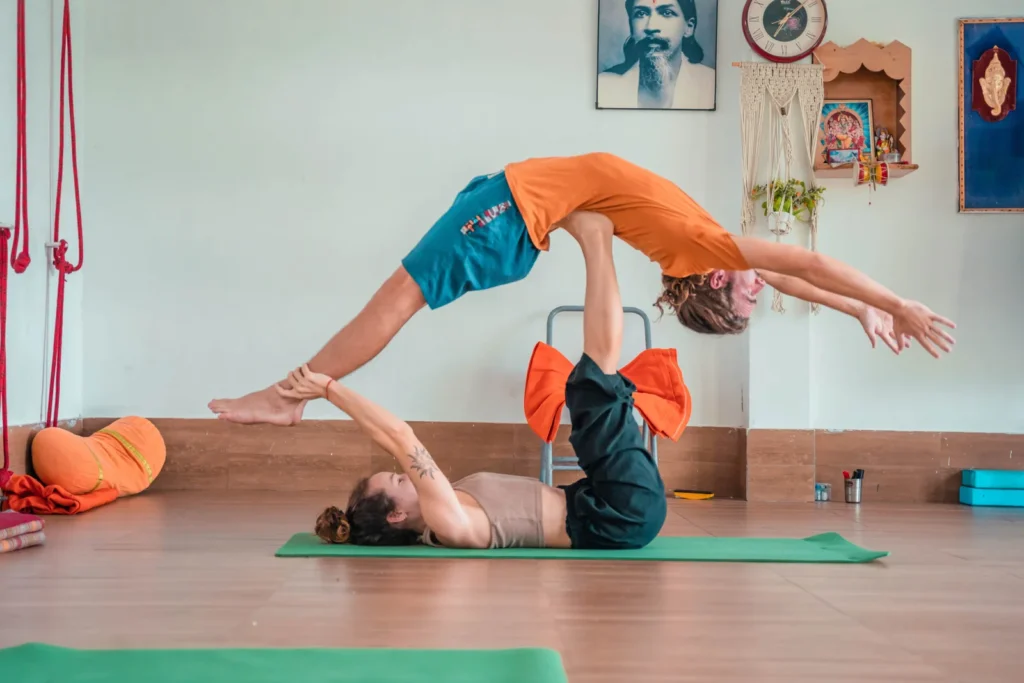
Popular Acro Yoga Poses — From Beginner to Intermediate
Here are the most popular acro yoga poses, organized by difficulty. Start with beginner poses and only progress when you feel completely comfortable and confident.
1. Beginner Acro Yoga Poses
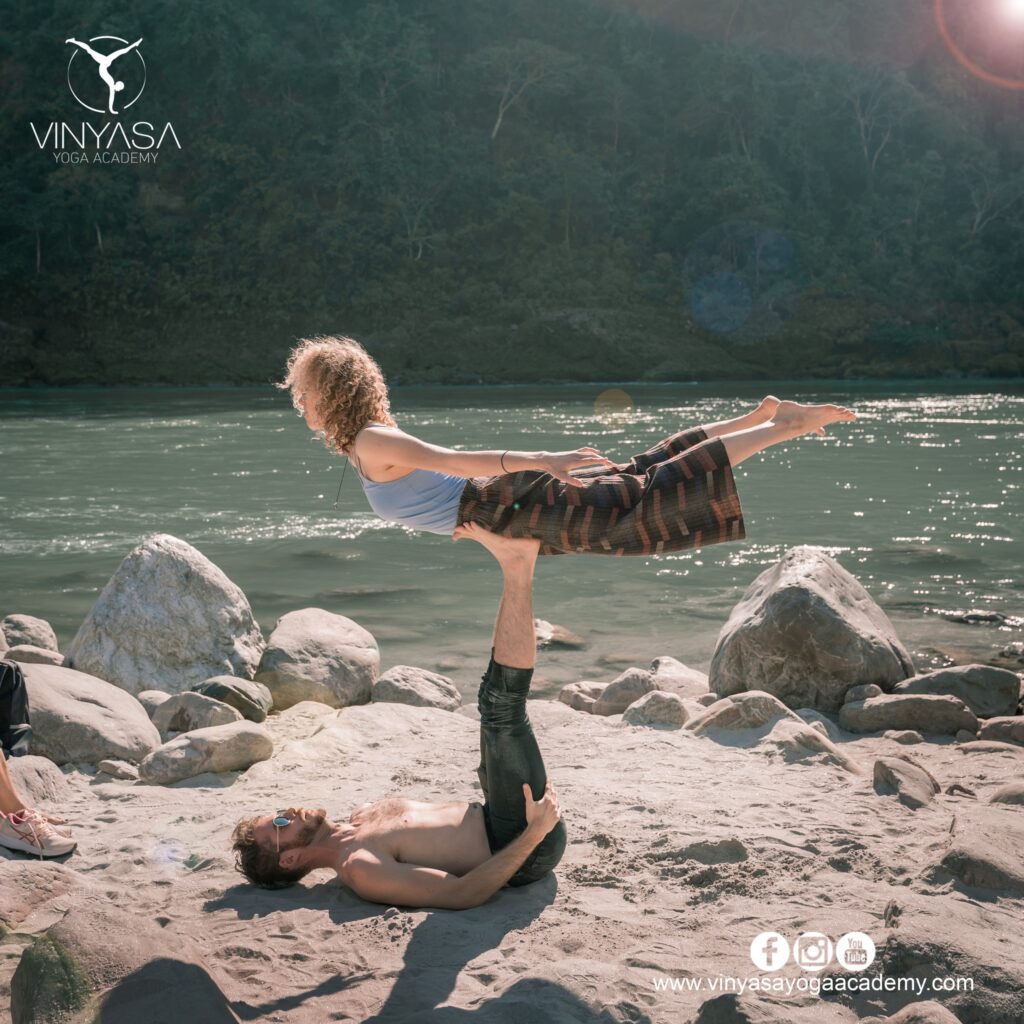
1. Bird Pose (Throne in the Air)
- Base lies on their back with knees pulled to chest.
- Flyer stands facing the base, just behind their hips.
- Base places both feet on the flyer’s hip flexors (the soft area at the front of the hips).
- Flyer leans their weight forward into the base’s feet.
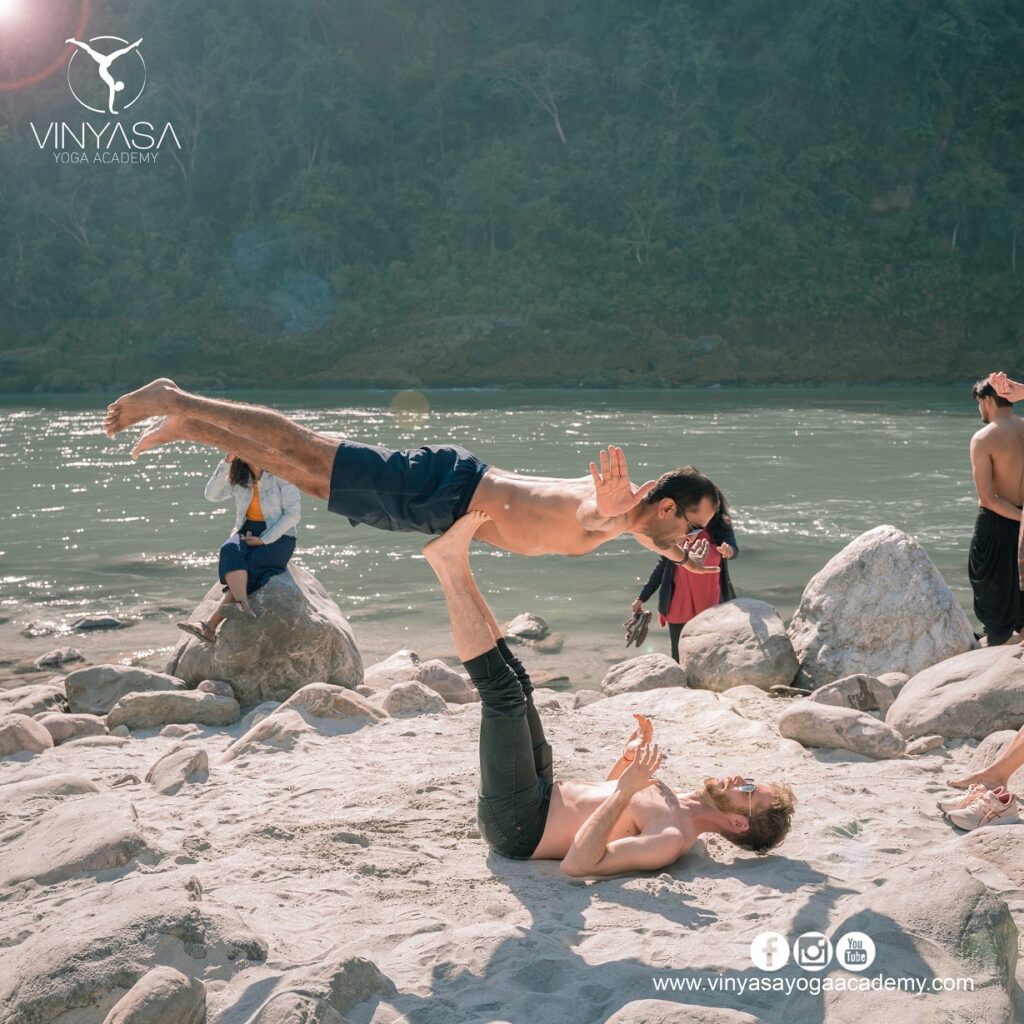
- Base straightens legs slowly while the flyer shifts their body parallel to the ground.
- Flyer extends arms out like wings and holds the pose.
- To come down: the flyer bends legs and returns to standing — spotter assists.
Bird Pose is the most common first acro yoga pose and the one taught in virtually every beginner workshop worldwide.
2. Throne Pose
- Base lies on their back with legs extended straight up, perpendicular to the floor.
- Flyer sits on the base’s feet — like sitting on a chair.
- Base wraps hands around flyer’s feet/ankles for security.
- Flyer opens arms wide and sits tall.
- To exit: flyer steps back down to the floor.
3. Front Plank Pose
- Base lies on their back, feet raised and knees bent.
- Flyer stands at base’s feet, facing away.
- Flyer leans hips into base’s feet and base presses up while flyer becomes parallel to the ground.
- Flyer reaches back to hold base’s ankles for added stability.
- Body should be straight like a plank — core tight, gaze forward.
2. Intermediate Acro Yoga Poses
4. Folded Leaf (Hanging Leaf)
The flyer drapes their torso over the base’s feet while in the air, hanging like a leaf from a branch. This is a deeply restorative pose for the flyer’s spine and hamstrings, and it’s incredibly relaxing once you overcome the initial feeling of being upside down.
5. Star Pose
Similar to Bird Pose but with the flyer’s arms and legs spread wide — creating a star shape. It requires the base to stabilize from the hips and the flyer to engage their core to stay horizontal.
6. Straddle Throne
A variation of Throne Pose where the flyer straddles the base’s feet in a wide-legged seated position. Great for opening the hips and building confidence in the base-flyer connection.
Want to master these poses the right way? Each of these acro yoga poses is covered in depth during the 300 Hour Yoga Teacher Training at Vinyasa Yoga Academy, Rishikesh — safely, step by step, under expert supervision.
Acro Yoga for Beginners — Your Step-by-Step Starting Guide
If you’ve never done acro yoga before, here’s exactly how to approach your first steps:
Step 1: Find the Right Partner
Your partner doesn’t need to be your romantic partner — acro yoga is practiced between friends, classmates, and even strangers in workshops. What matters is that you both feel comfortable, communicate well, and neither person is significantly heavier than the other (for your first few sessions).
Step 2: Warm Up Properly
Always spend at least 10-15 minutes warming up before acro yoga. Focus on wrists (for the base), shoulders, hips, and hamstrings. Sun salutations are a great warm-up. Cold muscles and stiff joints increase injury risk significantly.
Step 3: Learn the Language First
Before attempting any pose, agree on your safety signals. ‘Down’ means land immediately. ‘Ready?’ means asking for confirmation before the next move. Practice saying these out loud before you start — it will feel natural by your second session.
Step 4: Start With Seated Acro Yoga
Spend your first two or three sessions entirely on seated acro yoga. Build the sensitivity to your partner’s body, practice counter balancing, and develop your communication rhythm. This foundation makes everything else much easier.
Step 5: Always Use a Spotter
For all flying poses — no exceptions — use a spotter in the beginning. The spotter should stand at the flyer’s head height, with arms ready to catch. They should never be looking at their phone or distracted.
Step 6: Find a Qualified Teacher
Reading guides like this one is great, but there’s no substitute for learning acro yoga with an experienced, certified teacher. Acro yoga has real injury risks if techniques are done incorrectly. A teacher can see things about your alignment and weight distribution that you simply cannot feel on your own.

Safety First — Acro Yoga Contraindications and Precautions
Acro yoga is safe when practiced correctly. But there are some situations where you should either avoid it or consult a doctor first.
Do Not Practice Acro Yoga If You Have:
- Recent wrist, shoulder, or knee injuries
- Osteoporosis or brittle bone conditions
- High blood pressure or heart conditions (especially for inverted poses)
- Vertigo or severe inner ear issues
- Pregnancy (without specific guidance from a prenatal yoga expert)
- Active spinal disc injuries or herniation
General Safety Rules:
- Never practice without a spotter when learning new poses
- Always communicate with your partner before, during, and after every pose
- Practice on a yoga mat or soft surface — never on hard concrete or tiles
- Stop immediately if anything hurts — pain is not normal in acro yoga
- Don’t practice when either partner is tired, distracted, or unwell
- Warm up and cool down every single session
Also Read: Yoga Asanas For Strength Flexibility & Inner Calm
Final Thoughts
If you’ve been looking for a yoga practice that challenges your body, connects you with others, and makes you feel genuinely alive, acro yoga is it. It’s not just exercise. It’s a conversation between two bodies. It’s trust made visible. It’s yoga taken to a whole new level.
Start simple. Find a willing partner. Learn the roles. Practice seated acro yoga first. Get proper guidance from a qualified teacher. And most importantly, enjoy the process. The falls, the laughs, the ‘whoa, I actually did it’ moments are all part of what makes this practice so special.
The world of acro yoga is waiting for you. And yes, you can absolutely do this.
Frequently Asked Questions About Acro Yoga
Q: What is acro yoga?
Ans: Acro yoga is a partner practice that combines yoga postures, acrobatics, and Thai massage. One person (the base) supports another (the flyer) in yoga-inspired positions while lifted off the ground. A spotter ensures safety during the practice.
Q: Is acro yoga good for beginners?
Ans: Yes, acro yoga is suitable for beginners when taught properly. Starting with seated acro yoga and beginner poses like Bird Pose and Throne Pose allows newcomers to build strength, trust, and technique safely before progressing to more advanced flying sequences.
Q: What is seated acro yoga?
Ans: Seated acro yoga refers to partner poses done close to or on the ground, without full lifting or flying. It includes practices like back-to-back breathing, partner forward folds, and double downward dog. It is the best starting point for complete beginners.
Q: What are the benefits of acro yoga?
Ans: Acro yoga improves strength, flexibility, and balance. It also builds deep trust between partners, reduces stress and anxiety, improves communication skills, and creates a sense of community and joy that many solo yoga practices don’t provide.
Q: What are the basic acro yoga poses for beginners?
Ans: The best beginner acro yoga poses are Bird Pose (one person balances on the base’s feet in the air), Throne Pose (flyer sits on the base’s raised feet), and Front Plank Pose (flyer holds a plank position supported by the base’s feet). These are taught in most beginner workshops worldwide.
Q: How is acro yoga different from partner yoga?
Ans: Partner yoga involves two people doing yoga poses together on the ground, supporting and deepening each other’s stretches. Acro yoga goes further by incorporating actual lifting and flying — the flyer is held completely off the ground by the base. Acro yoga also has a specific role structure (base, flyer, spotter) that partner yoga does not.
Q: Do I need a specific body type to do acro yoga?
Ans: No. Acro yoga is practiced by people of all body types, ages, and fitness levels. The base does not need to be extremely heavy, and the flyer does not need to be extremely light. Good technique, communication, and alignment matter far more than body size or weight.
Q: How long does it take to learn acro yoga?
Ans: Most people can learn basic beginner poses — like Bird Pose and Throne Pose — within a few sessions. Building a confident, flowing practice typically takes 3 to 6 months of regular training. Advanced poses and flows can take years to master, making it a deeply rewarding long-term practice.
Q: Where can I learn acro yoga in India?
Abs: Rishikesh is one of the best places in the world to learn acro yoga. Vinyasa Yoga Academy offers acro yoga training as part of its 200 Hour and 300 Hour Yoga Teacher Training programs, taught by certified senior instructors in a safe, structured environment.
This article is for general information and is not medical advice. If you have a respiratory or heart condition, are pregnant, or are unsure whether these practices suit you, please speak to your doctor before beginning.