







10 Benefits of Chaturanga Dandasana for Strength and Stability
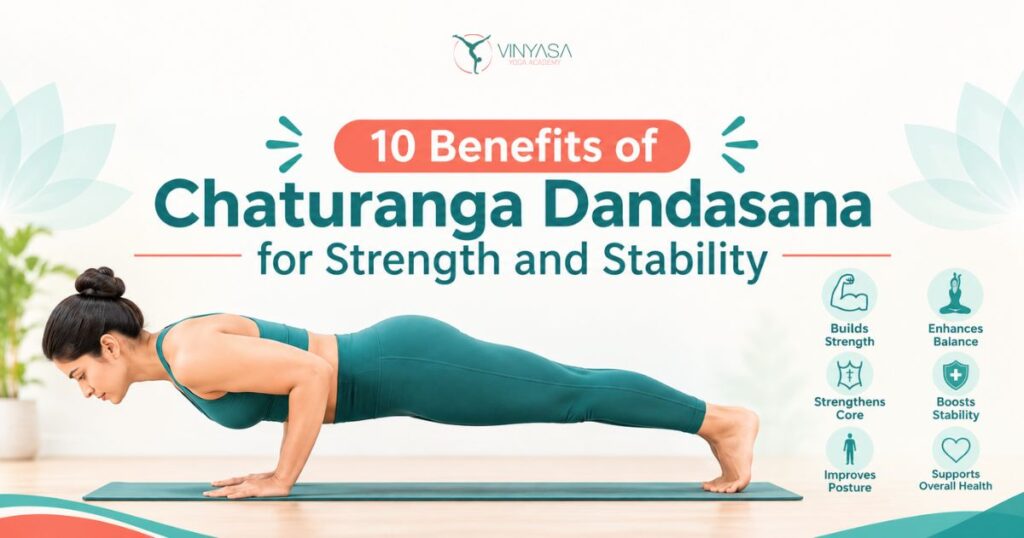
Table of Contents
- What Is Chaturanga Dandasana?
- Which Muscles Does Chaturanga Work?
- 10 Chaturanga Dandasana Benefits Explained
- 1. It Builds Upper Body Strength
- 2. It Improves Arm Strength
- 3. It Improves Shoulder Stability
- 4. It Develops Core Strength
- 5. It Wakes Up Your Legs and Glutes
- 6. It Strengthens Your Wrists and Hands
- 7. It Builds Muscle Endurance
- 8. It improves body control and awareness
- 9. It Supports Better Posture
- 10. It Prepares You For Vinyasa Flow and Arm Balances
- How Much Can One Pose Do?
- How to Do Chaturanga With Proper Alignment
- Common Chaturanga Mistakes and Easy Fixes
- Chaturanga for Beginners: Build Up Step by Step
- Who Should Take Care With Chaturanga
- Your Next Practice
- Conclusion
- Frequently Asked Questions
- Is Chaturanga the same as a push-up?
- Can I skip Chaturanga in a vinyasa class?
- How often should I practise Chaturanga?
- Why do my wrists hurt in Chaturanga?
- Will Chaturanga help me lose weight or build muscle?
Chaturanga Dandasana is the part of a vinyasa class where the arms start to shake. It is also one of the most useful poses for building real strength. The main Chaturanga Dandasana benefits are stronger arms, steadier shoulders, a firmer core and better body control. This guide shows how the pose creates each benefit and how to practise it without hurting yourself.
What Is Chaturanga Dandasana?
In Chaturanga, you hold your body in one straight line, a few inches above the floor. Your elbows bend to about 90 degrees. Only your palms and toes touch the mat. You may also see it called Four Limbed Staff Pose or Low Plank Pose.
The name comes from Sanskrit. Chatur means four, anga means limb, and danda means staff. Your body acts like a firm staff, held up by two arms and two legs.
In a Sun Salutation, this Chaturanga yoga pose links plank and Upward-Facing Dog. Think of it as a slow push-up with your elbows hugging your ribs.
Which Muscles Does Chaturanga Work?
The Chaturanga muscles worked are spread across your whole body:
- Triceps and Biceps: The triceps (back of the upper arm) control your lowering. The biceps help.
- Chest and Front Shoulders: These push you back up.
- Shoulder Blade and Rotator Cuff Muscles: These keep the shoulder joint steady. One key muscle is the serratus anterior, which runs along your ribs near the armpit.
- Abdominal and Deep Core Muscles: These stop your hips from dropping.
- Thighs and Glutes: These keep your legs straight and active.
10 Chaturanga Dandasana Benefits Explained
1. It Builds Upper Body Strength
Lowering your full body weight with control is hard work for your chest, shoulders and upper back. Many yoga poses ask you to stretch or balance. This one asks you to push. That makes it one of the better yoga poses for upper body strength.
2. It Improves Arm Strength
Your triceps decide how fast you go down. Lowering slowly keeps them working for longer, which builds more arm strength than dropping in one quick movement. Your biceps and forearms support the effort.
3. It Improves Shoulder Stability
Shoulder stability means your shoulder joint stays steady while you move. In Chaturanga, the muscles around your shoulder blades and rotator cuff hold the joint in place. The pose also teaches a useful rule: keep your shoulders level with your elbows, never lower. Practising this trains those small support muscles to switch on.
4. It Develops Core Strength
Your belly muscles stop your hips from sagging or lifting. If your core is weak, your body bends. Holding the straight line trains the front of your belly and the deeper muscles around your spine to work as a team. This is the core strength you build by holding the pose, not by doing sit-ups.
5. It Wakes Up Your Legs and Glutes
Chaturanga is not just an arm pose. When you press your heels back and keep your thighs firm, your quads and glutes share the load. Many beginners forget their legs and put all the weight on their arms. Active legs make the pose feel lighter.
6. It Strengthens Your Wrists and Hands
Your hands carry a large share of your weight. Pressing your palms and spreading fingers evenly into the mat works the muscles of your wrists, hands and forearms. This builds strength over time, as long as you place your hands well and increase the load slowly.
7. It Builds Muscle Endurance
Strength is how much force you can make. Endurance is how long you can keep going. Some vinyasa classes repeat this pose 20 times or more. In Chaturanga yoga, each round becomes a small endurance drill for your arms, shoulders and core.
8. It improves body control and awareness
As a Chaturanga yoga pose, it is easy to get wrong, and your body tells you quickly. You can feel your hips drop or your elbows slide out. Learning to spot and fix these things builds body awareness, which is your sense of where your body is in space. That skill carries over to other poses and daily movement.
9. It Supports Better Posture
Good posture depends partly on a strong upper back, chest and shoulder blades. Chaturanga works all three together. Over time, that strength can make it easier to sit and stand tall. Your lower back muscles also help hold the line. Keep your belly firm so they do not take the whole load.
10. It Prepares You For Vinyasa Flow and Arm Balances
The plank to Chaturanga transition is the base of most vinyasa flow sequences. A steady lowering makes the whole sequence smoother. The same arm, shoulder and core strength also helps in arm balances like Crow Pose (Bakasana).
How Much Can One Pose Do?
The four-limbed staff pose benefits fall into two groups. Strength gains in the arms, shoulders, core and legs come directly from the work your muscles do. Other benefits of Chaturanga pose, such as posture, endurance and body awareness, depend on regular practice with good form.
One pose is not a treatment for any health condition. It also will not replace a balanced routine. Think of it as one strong piece of yoga for strength and stability.
How to Do Chaturanga With Proper Alignment
Proper Chaturanga alignment keeps the work in your muscles and out of your joints. Move slowly the first few times.
- Start in high plank. Place your hands under your shoulders. Spread your fingers wide and point your middle fingers forward.
- Press your heels back and tuck your tailbone slightly. Your head, hips and heels should make one line.
- Rock forward onto your toes until your shoulders are just ahead of your wrists.
- Exhale and bend your elbows straight back, close to your ribs. Lower your whole body as one unit.
- Stop when your shoulders are level with your elbows and your elbows are at about 90 degrees. Your body hovers a few inches above the floor.
- In a flow, you pass through in one breath. To practise, hold for 1 to 4 breaths.
- To come out, inhale back up to plank, or exhale all the way down to the floor. In a sequence, roll forward into Upward-Facing Dog.
Common Chaturanga Mistakes and Easy Fixes
- Sagging Hips: This strains your lower back and means your core has let go. Lift your belly, or drop to your knees.
- Lifting Hips: If your hips sit high in a low plank, your core is skipping the work. Return to plank and re-form the line.
- Flaring Elbows: Wide elbows put stress on the shoulders. Point them back and keep them near your ribs.
- Shoulders Dropping Below the Elbows: This is the most important one to avoid. Stop earlier, even if you only go halfway.
- Shrugging Toward Your Ears: Press the floor away and keep your neck long.
- Rushing: Speed hides poor form. Slow down.
Chaturanga for Beginners: Build Up Step by Step
Many people find Chaturanga Dandasana yoga hard at first. That is normal. It needs strength and coordination at once. Try this order:
- Hold a high plank for 3 to 5 breaths, keeping your body in one line.
- Practise a low plank with your knees down. Lower slowly, with elbows tucked in.
- Lower from knees-down plank to the floor over three or four seconds.
- Move to the full pose when you can reach elbow height without your hips sagging.
A teacher’s eyes help a lot here, because you cannot see your own hips and elbows in the pose. If you want to study Four Limbed Staff Pose and other poses in more depth, a Yoga Teacher Training in Rishikesh, such as the programmes at Vinyasa Yoga Academy, can give you time to practise alignment with guidance and learn how to explain it clearly to others.
Who Should Take Care With Chaturanga
Chaturanga Dandasana yoga puts real load on the wrists, shoulders and arms. Be careful, and speak to your doctor or a qualified teacher first, if you have:
- A recent or long-term injury to your arms, shoulders, wrists or back
- Carpal tunnel syndrome
- Pregnancy (a modified version is usually needed)
Muscle effort is normal. Sharp pain, pinching in the shoulder or tingling in the hands are not. Stop if you feel any of these. This article is general information and not medical advice.
Your Next Practice
At the end of your next session, try three slow Chaturangas. Keep your elbows in, your hips level and your shoulders at elbow height. Chaturanga yoga rewards slow, clean repetitions more than fast, messy ones.
Conclusion
Chaturanga builds strength where many yoga students need it most: the arms, shoulders and core. It also teaches patience, because the pose only works when you move slowly and keep your alignment. Fast, sloppy rounds give you very little.
If the full pose feels too hard, start with your knees down. Keep your shoulders level with your elbows and your hips in line. Add a few more rounds as you get stronger. At the end of your next session, try three slow Chaturangas and notice where you feel the work. Practised this way, Chaturanga yoga becomes a steady, safe way to build strength and stability that carries into the rest of your practice.
Frequently Asked Questions
Is Chaturanga the same as a push-up?
They are similar but not identical. Low Plank Pose in yoga keeps the elbows close to the ribs, stops at elbow height and moves with the breath. Many gym push-ups use wider elbows and a deeper lowering.
Can I skip Chaturanga in a vinyasa class?
Yes. You can lower your knees first, or lower all the way to your belly and then move into Cobra or Upward-Facing Dog. Doing fewer rounds with good form is better than doing every round badly.
How often should I practise Chaturanga?
There is no fixed number. A common approach is a few slow rounds on two or three days a week. Add rounds as your strength grows. Give your shoulders and wrists a rest day if they feel sore.
Why do my wrists hurt in Chaturanga?
Usually your weight is sitting on the heel of the hand, or your fingers are lifting. Spread your fingers wide, press through the base of your thumb and index finger, and keep your elbows over your wrists. Let your legs carry more weight. If the pain stays, stop and ask a teacher or doctor.
Will Chaturanga help me lose weight or build muscle?
It builds strength in your arms, shoulders, core and legs. One pose alone will not change your body weight. That depends on your whole routine, food, sleep and daily activity.
This article is for general information and is not medical advice. If you have a respiratory or heart condition, are pregnant, or are unsure whether these practices suit you, please speak to your doctor before beginning.