What Is Half Prayer Twist (Ardha Namaskar Parsvakonasana)? Steps, Benefits, Precautions & More
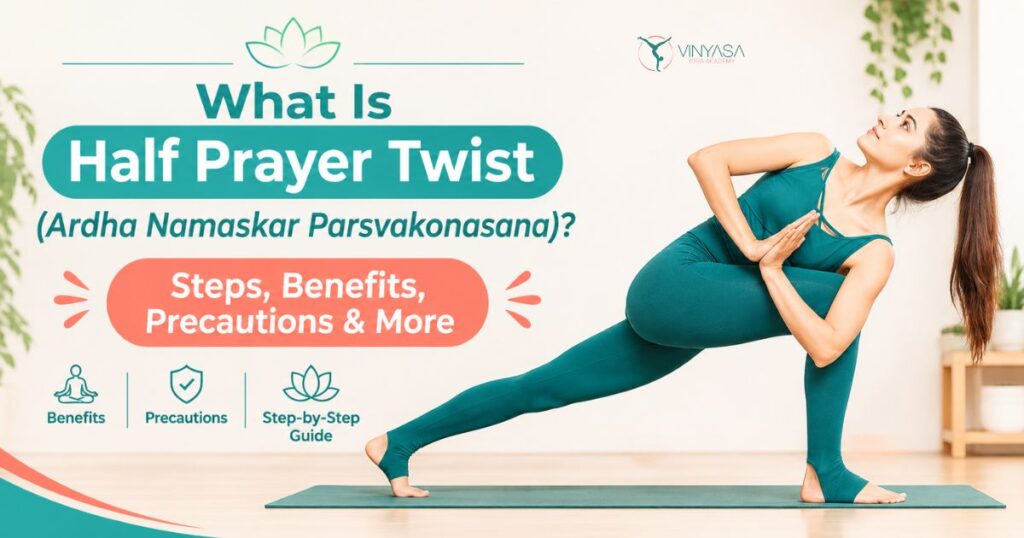
Table of Contents
- Ardha Namaskar Parsvakonasana At a Glance:
- What Is Half Prayer Twist or Ardha Namaskar Parsvakonasana?
- Breaking Down the Name
- How to Do Half Prayer Twist: Step-by-Step
- Start
- Step
- Bring the Hands to Prayer
- Add the Twist
- Your Gaze
- Hold and Breathe
- To Exit
- Benefits of Half Prayer Twist Pose (Ardha Namaskar Parsvakonasana)
- 1. Opens the Hips and Chest Simultaneously
- 2. Strengthens Core, Thighs and Glutes
- 3. Stretches and Realigns the Spine
- 4. Supports Healthy Digestion
- 5. Improves Balance and Coordination
- 6. Calms the Mind
- 7. Activates Manipura Chakra, Your Power Centre
- Modifications and Variations for Half Prayer Twist
- Who Should Be Careful: Contraindications for
- Where Does Half Prayer Twist Fit in a Vinyasa Flow?
- 5 Tips to Get More From Ardha Namaskar Parsvakonasana
- Final Thoughts
- Frequently Asked Questions
- What is the difference between Half Prayer Twist and Full Prayer Twist?
- Can beginners do Ardha Namaskar Parsvakonasana?
- How long should I hold the half prayer twist?
- Is the half prayer twist good for back pain?
- What is Anjali Mudra and why is it used in this pose?
- How is the Half Prayer Twist different from the Revolved Lunge Pose?
- When is the best time to practice twisting yoga poses?
Bringing your palms together at the centre of your chest is an act of attention and intention. When you pair this gesture with a lunge posture and a spinal twist, what you get is one of yoga’s most underrated poses, Ardha Namaskar Parvatasana.
It is mostly known as the Half Prayer Twist. Yoga teachers slip it into vinyasa sequences and flow classes at will but if you have ever held it properly, you know this pose is anything but casual.
Here, we bring you a complete map to the Half Prayer Twist pose with its Sanskrit meaning, step-by-step instructions, benefits, modifications, and how to use it in your yoga practice.
Ardha Namaskar Parsvakonasana At a Glance:
| Also Known As | Half Prayer Twist, Revolved Low Lunge Pose, Kneeling Prayer Twist |
| Level | Beginner to Intermediate |
| Type | Twisting, Strength, Hip Opener |
| Good For | Digestion, spinal flexibility, hip opening, core strength, focus |
| Chakra | Manipura (Solar Plexus), 3rd Chakra |
| Hold Time | 4-8 breaths per side |
| Preparatory Poses | Anjaneyasana, Child’s Pose, Cat-Cow |
| Counter Poses | Low Lunge, Half Pyramid, Downward Dog |
What Is Half Prayer Twist or Ardha Namaskar Parsvakonasana?
Half Prayer Twist is an asymmetrical, low-level spinal rotation yoga asana. It is often practiced as a variation of Parivrtta Parsvakonasana or a crescent lunge twist. In this posture, the lower body provides a stable base while the upper torso rotates over a bent knee, also taking advantage of pressed palms to release stress off the vertebrae.
In therapeutic yoga lineages, Ardha Namaskar Parsvakonasana is treated less like a stretch and more like a physical pump that utilises targeted abdominal pressure to compress and then charge the internal organs with a fresh rush of oxygenated blood upon release.
Breaking Down the Name
Half Prayer Twist serves as an all-in-one remedy for modern fatigue. It skilfully opens the chest, releases deep-seated tension along the nervous system, and cultivates sthira (steadiness) required for an advanced physical practice.
– Guru Yogi Vishnu Panigrahi
Sanskrit names in yoga are not just labels. They tell you exactly what you’re doing and why. Ardha Namaskar Parsvakonasana carries a rich meaning as well. Like all yoga poses, it doesn’t only signify a posture or structure but also the work and value it brings to the body.
Before we get to the how-to, let’s understand the what-is:
| Sanskrit Word | Meaning | What It Tells You |
| Ardha | Half | This is the easy, modified version of the full prayer twist |
| Namaskar | Bow / Salutation | Hands are in Anjali Mudra at the heart |
| Parsva | Side / Flank | The body opens to the side |
| Kona | Angle | Working with an angular, diagonal shape in the body |
| Asana | Posture / Pose | An intentionally held position in yoga |
Bring all of these together and you get a half-salutation, a side-angle pose. Simple enough to do in your first week of yoga. Deep enough to work on for years.
How to Do Half Prayer Twist: Step-by-Step
Read this before you practise Ardha Namaskar Parsvakonasana. Rushing the setup inevitably collapses the twist. By building the shape slowly from the ground up, you protect your bones and allow the spine to expand naturally rather than forcing it with rotation.
Start
1. Come onto all four limbs (tabletop position) or form Downward Facing Dog pose
2. Place your wrists under your shoulders and knees under your hips
Step
3. Move your right foot forward between your hands
4. The right knee should stay directly above the right ankle, making a 90-degree angle
5. Left knee rests on the floor; left foot stays relaxed
This is your low lunge base. Get comfortable here first before you move to add the twist
Bring the Hands to Prayer
6. On an inhale, lift your upper body upright
7. Bring both palms together at your chest in Anjali Mudra (prayer position)
8. Your fingers point upward toward your chin, and elbows to the sides
Add the Twist
9. Exhale slowly and twist your upper body toward your right (front) leg
10. Bring your left elbow or upper arm to the outside of your right knee
11. Press your elbow into your knee, and use that force to open the chest upward and to the right
12. Your palms remain pressed together at the centre of your chest (praying)
Your Gaze
13. Look straight ahead, or gaze upward toward the ceiling
14. No need to strain if you have any neck sensitivity. You may keep your gaze forward
Hold and Breathe
15. Hold for 5 to 8 deep breaths
16. On each exhale, see if you can twist a little further (but don’t force)
To Exit
17. Inhale, and bring your hands back to the floor
18. Return to the Table Top or Downward Dog pose
19. Repeat on the left side
One small tip to make a big difference: Before you twist, inhale to lengthen your spine. Keep your back straight, then rotate. Twisting a rounded spine is where people get hurt. A tall spine is a safe spine.
Want to understand yoga asana in depth? Not just the shape, but the anatomy, the breath, the energy, and the teaching method? Vinyasa Yoga Academy’s residential yoga teacher training in Rishikesh and Bali are designed exactly for this. Our students learn to study each pose from the inside out, so they master it with precision and authenticity.
Benefits of Half Prayer Twist Pose (Ardha Namaskar Parsvakonasana)
Here is where this pose earns its place in your practice. Often highlighted by our expert educators for its impactful therapeutic value, Half Prayer Twist (Ardha Namaskar Parsvakonasana) does a lot of good, all at once.
1. Opens the Hips and Chest Simultaneously
The low lunge position stretches your hip flexors while the twist opens your chest and shoulders.
2. Strengthens Core, Thighs and Glutes
To do the low lunge with a twist, you must actively engage your quadriceps, glutes, and deep core muscles. It gets you stronger and adds to your stability and stamina over time.
3. Stretches and Realigns the Spine
The spinal rotation in this pose works through the middle and upper back. This is an area that gets stiff from desk work, driving, and phone use. The half prayer twist creates space between the vertebrae and brings fresh circulation to the spinal discs.
4. Supports Healthy Digestion
The twisting action compresses and releases the abdominal organs, including the digestive system. Traditional yoga calls this the “squeeze and soak” effect. You filter out stale blood from the organs, and fresh, oxygenated blood rushes back in when you release.
5. Improves Balance and Coordination
Twisting while in a lunge requires your nervous system to coordinate multiple things at once. Stability in the legs, rotation in the torso, steadiness in the gaze, and more. Regular yoga helps build this mind-body coordination that carries over into everyday happenings.
6. Calms the Mind
This is a pose that pulls you into the present moment. The combination of intentional breath, an inward hand gesture (Anjali Mudra), and focused rotation creates natural quieting for mental chatter.
7. Activates Manipura Chakra, Your Power Centre
In yogic anatomy, the Manipura Chakra sits at the solar plexus, just above the navel. It rules personal power, confidence, willpower and more. Twisting poses directly stimulate this centre of energy. Those who practise often report feeling more focused, more decisive, and more grounded after working with poses that target Manipura.
By combining a grounded foundation with an intentional spinal rotation, the Half Prayer Twist yoga pose bridges traditional energy work and modern physical form to decompress the vertebrae and energise your core. In our teacher training lineages, we teach this specific posture as a potent tool for balancing the spine, rinsing the digestive organs, and building deep lower-body stability in a single, unified movement.
Modifications and Variations for Half Prayer Twist
Earlier, we shared how to perform and the benefits of Ardha Namaskar Parsvakonasana. But we understand that it would not be viable for everyone to do the pose fully and as it is. So, here is how to adjust the Half Prayer Twist based on your level:
1. Made Easier | For Beginners
- Place a folded blanket or pillow under your back knee for added padding
- Don’t tilt your head anywhere; stare straight ahead
- Instead of resting your hand on your knee, rest it on a block next to your front foot
- Build up gradually and hold for fewer breaths
2. Go Deeper | For Intermediate Practitioners
- Slide the back knee further away from the front foot to increase the depth of the lunge
- Increase the rotation by trying to get the elbow past the knee
- Maintain holding for 6-10 breaths on each side
3. Upgrade to Full Prayer Twists
In the full version, Namaskar Parsvakonasana, you tuck the toes of your back foot under, lift the back knee off the floor, and straighten the back leg fully. This requires more power and stability in the core and legs. Practise this progression with a qualified teacher who can check and guide your alignment.
At Vinyasa Yoga Academy, students learn to practice and teach these modifications with clarity and confidence. Whether you’re at VYA Rishikesh or at the Bali campus, the focus is always on correct alignment, safe progression, and mindful sequencing. Asana training forms a core part of every 200-hour and 300-hour yoga teacher training course.
Who Should Be Careful: Contraindications for
This pose is generally safe and beginner-friendly, but it’s not for everyone in every situation. When dealing with any of this, avoid this pose.
- Recent or Chronic Knee Injury: The kneeling position puts pressure on the back knee
- Hip Injuries or Replacements: The deep lunge may be too intense
- Acute Lower Back Pain or Disc Herniation: Spinal rotation can worsen this
- Shoulder Injuries: Holding arms in the prayer position may be tough
- High or Low Blood Pressure: Approach cautiously and avoid extreme rotation
- Pregnancy (later stages): The deep abdominal compression is really not recommended
Where Does Half Prayer Twist Fit in a Vinyasa Flow?
The Half Prayer Twist flows naturally into the middle of a standing or a lunge-based yoga pose sequence. Here is an example of how it is often fitted:
| Step | Pose | Why It’s Here |
| 1. | Child’s Pose (Balasana) | Settle the body, lengthen the spine |
| 2. | Cat-Cow (Marjaryasana-Bitilasana) | Warming up the spinal flexion and extension |
| 3. | Low Lunge (Anjaneyasana) | Open the hip flexors, establishes foundation for lunge |
| 4. | Half Prayer Twist (Ardha Namaskar Parsvakonasana) | Add rotation, activate core and manipura |
| 5. | Low Lunge (return) | Settle and neutralise the spine |
| 6. | Downward Dog (Adho Mukha Svanasana) | Reset and repeat on the other side |
5 Tips to Get More From Ardha Namaskar Parsvakonasana
- Inhale First, Always: Before you rotate, take a full breath in and grow taller through the crown of your head. Rotation happens in the exhale. Lengthening comes first.
- Use the Elbow-Knee Connection Intentionally: When you press your elbow against the outside of your knee and the knee presses back, that resistance is what opens the chest. It’s an active lever.
- Keep the Front Knee Over the Second Toe: Letting the knee cave inward is one of the most common alignment errors for twisted yoga poses. Ensure you’re doing it right before you twist.
- Don’t Rush the Eyes: The eyes affect the neck. Let the twist settle first. Then, only if it feels comfortable, bring your gaze up toward the ceiling.
- Both Sides are Not Equal, That’s Fine: Most people find one side easier than the other. Spend a breath or two more on the tighter side. Observe and treat the difference with curiosity, not frustration.
Final Thoughts
Whether you approach yoga from a spiritual or purely physical angle, the effect on your core awareness is something you cannot ignore.
– Guru Yogi Vishnu Panigrahi
The Half Prayer Twist is one of those poses that will earn your trust by looking straightforward. But stay in it for eight breaths. Really press the elbow into the knee. Let the chest open, notice how your spine responds and what happens to your mind.
That’s when you understand why this pose has been part of yoga for so long. It’s not just a hip stretch or a spinal rotation. It is a full-body, full-breath, full-attention experience. And these are the qualities that quietly help you grow.
Ready to go deeper into yoga asana, anatomy, and teaching?
Vinyasa Yoga Academy offers RYS-certified Yoga Teacher Training courses in Rishikesh, India, and Bali, Indonesia, from 100-hour to 500-hour Yoga TTCs. Our yoga training programs are rooted in traditional yoga philosophy and modern alignment science. Small groups, experienced teachers, and relaxing retreats in two of the world’s most transformative yoga destinations. Contact us today!
Frequently Asked Questions
What is the difference between Half Prayer Twist and Full Prayer Twist?
Ardha Namaskar Parsvakonasana, or Half Prayer Twist, is more stable and accessible as the back knee stays on the ground. In the Full Prayer Twist (Namaskar Parsvakonasana), the back knee lifts and the back leg straightens, requiring more strength and balance from the practitioner. The half pose forms a great starting point for the full pose.
Can beginners do Ardha Namaskar Parsvakonasana?
Yes. It is considered a beginner-to-intermediate pose. With a folded blanket under the knee and a forward gaze (instead of looking up), most beginners can practice it safely from their first few weeks on the mat.
How long should I hold the half prayer twist?
A good starting point is 4 to 6 controlled, full breaths per side. As your strength and flexibility improve, work up to 8 to 10 breaths. The key is that each breath should feel steady, not strained.
Is the half prayer twist good for back pain?
For general tightness and postural stiffness, gentle spinal twists like this one can bring real relief. However, if you have a disc injury, herniation, or acute back pain, you should consult a doctor or physiotherapist before attempting this pose or any other spinal rotation.
What is Anjali Mudra and why is it used in this pose?
Anjali comes from Sanskrit and means ‘offering’ or ‘salutation.’ In the Half Prayer Twist, using Anjali Mudra connects the pose to the heart centre and adds an element of focused attention. Pressing of the palms also helps you achieve a deeper spinal rotation.
How is the Half Prayer Twist different from the Revolved Lunge Pose?
They are very similar and some teachers use the terms synonymously. In Revolved Lunge Pose (Parivrtta Anjaneyasana), you generally place one hand on the floor and stretch the other hand up. The Half Prayer Twist keeps both hands at the chest in a prayer position.
When is the best time to practice twisting yoga poses?
Twisting yoga poses are most effective when the body is already warm, so midway through a practice is ideal. Many teachers place twists after standing poses and before floor work. Avoid deep twists first thing in the morning when the discs are still hydrated from sleep.
This article is for general information and is not medical advice. If you have a respiratory or heart condition, are pregnant, or are unsure whether these practices suit you, please speak to your doctor before beginning.