






What Is Natarajasana? Dancer Pose Benefits, Steps, Modifications And More
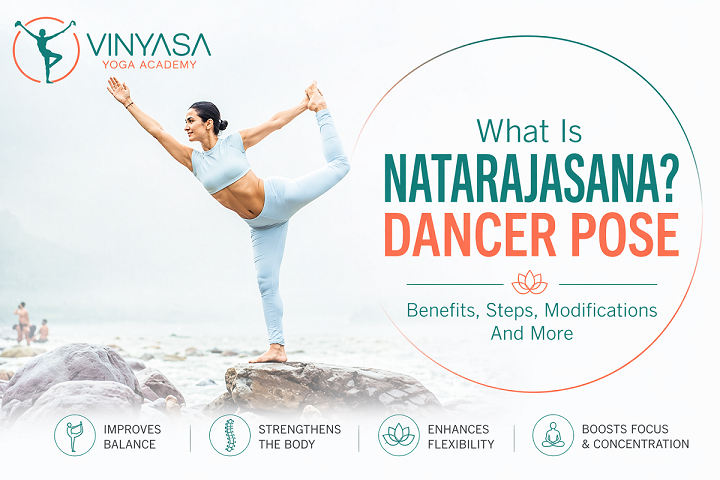
Table of Contents
- What Is Natarajasana? Why Is It Called Dancer Pose?
- What Are the Other Names of Natarajasana?
- The Dance of Shiva’s Story Behind Natarajasana
- How To Do Natarajasana?
- Natarajasana Steps:
- Make Natarajasana Work for You: Modifications & Variations
- Modifications for Natarajasana
- Variations of Natarajasana
- 15 Benefits Of Natarajasana for Mind, Body & Soul
- Physical Benefits
- Mental and Emotional Benefits
- Energetic / Spiritual Benefits
- Is Natarajasana Suitable for Beginners?
- What Are The Best Preparatory Poses for Natarajasana?
- What Muscles Does the Dancer Pose Activate?
- Common Mistakes To Avoid In Natarajasana
- When Should You Be Careful? Contraindications for Natarajasana
- Moving Forward
- FAQs
- What is the meaning of Natarajasana?
- Is Natarajasana (Dancer Pose) suitable for beginners?
- How long should you hold the Dancer Pose?
- What is the difference between the dancer pose and the lord of the dance pose?
- What are the main Natarajasana benefits?
- Can Natarajasana (Dancer Pose) help with back pain?
- What is the best time to practise Natarajasana?
- Why do I keep falling in Natarajasana?
Some yoga poses you learn, others you grow into. Natarajasana is firmly the second.
Natarajasana, or Dancer Pose, is one of the most recognised standing balances in yoga. It builds physical strength, teaches your mind to focus, and connects you to one of the oldest stories in Indian mythology.
Here we cover everything you need: the meaning, the story, the steps, the benefits, the modifications, and who should take care when performing this great pose. By the end, you will not just know how to practise natarajasana. You will know why.
What Is Natarajasana? Why Is It Called Dancer Pose?
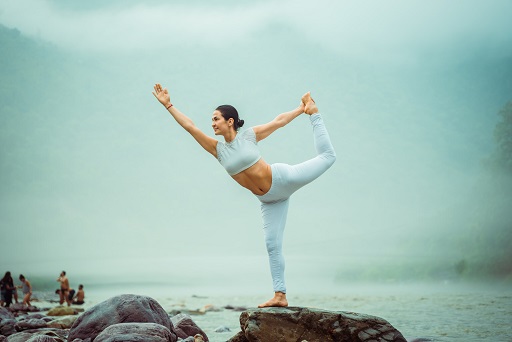
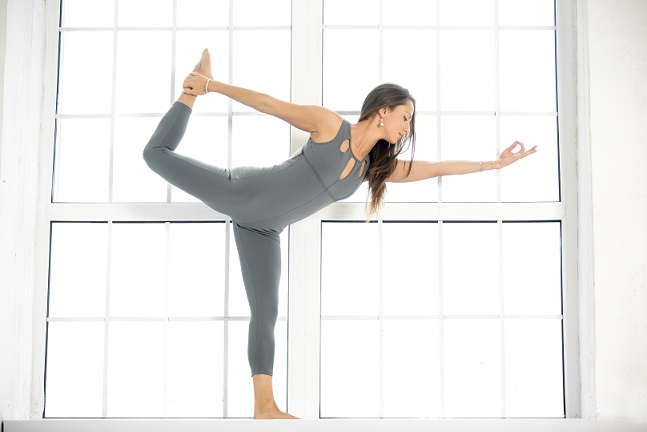
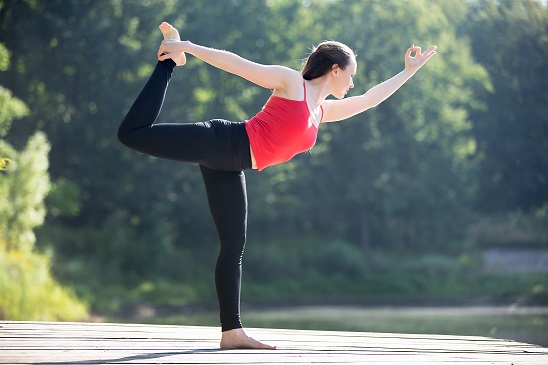
Natarajasana is both a standing balance and a backbend yoga pose. You stand on one leg, lift the other behind you, reach back to hold the raised foot, and extend the free arm forward. The body creates a graceful arc-like shape, somewhere in the middle of a half-turned dancer and an archer drawing a bow.
The name Natarajasana (pronounced na-tuh-RAH-jah-sah-nah) comes from three Sanskrit words:
| Sanskrit Word | Meaning |
| Nata | Dancer or actor |
| Raja | King or lord |
| Asana | Pose or posture |
Together, they mean ‘the King of Dancers’, or ‘Lord of the Dance Pose’, which is another name you will often hear for this asana.
In yoga, the dancer pose signifies Lord Shiva in his Nataraja form. Shiva is the cosmic dancer whose movement represents the entire cycle of existence. When you hold this pose, you are not just balancing on one leg. You are stepping into his image.
What Are the Other Names of Natarajasana?
Natarajasana goes by several names depending on the tradition, the teacher, and the style of yoga. It is useful to know them:
| Name | Context |
| Natarajasana | Primary name in Sanskrit; most widely used |
| Dancer Pose | Common English translation |
| Lord of the Dance Pose | Full translation; honours the mythology of Lord Shiva |
| King Dancer Pose | Emphasises Raja, which means ‘King’ |
| Nataraj Asana | An informal way to address the same pose |
In Ashtanga yoga, the pose appears in more advanced sequences and is held for a defined number of breaths. In Hatha and Vinyasa classes, it is often taught as a freestanding peak pose or as a balance challenge. Some Iyengar teachers use a strap to make it accessible at every level.
The Dance of Shiva’s Story Behind Natarajasana
To understand the dancer pose yoga, you need to know who Nataraja actually is.
In Hindu mythology, Nataraja is one of the most iconic and revered forms of Lord Shiva. He is shown dancing within a ring of fire, with one leg raised, and surrounded by cosmic flames, choking a demon beneath his foot.
That demon, called Apasmara, is a representation of ignorance and forgetfulness. Although Shiva does not kill him. He keeps him pinned and permanently subdued because the destruction of ignorance (Apasmara) would mean the end of the learning process itself.
Shiva’s dance is called the ‘Tandava‘, i.e., a vigorous, energetic dance that embodies creation, preservation, and destruction all at once. Key symbolic elements from this lore include:
- Ananda Tandava (Dance of Bliss)
- The victory over ignorance
- Cycles of existence
- Fearlessness and support
- And, the five functions
Britannica describes the form of Nataraja as representing five cosmic acts, known as the Panchakritya. When you practise this asana, you should try to strike the same balance between effort and ease. You must stand firm and anchored like Shiva, overcome ignorance, and be elegant and expressive in your own “cosmic dance.”
What’s interesting: A bronze Nataraja stands at CERN in Geneva, the world’s largest physics laboratory. Physicist Fritjof Capra writes that Shiva’s dance represents “the basis of all existence” and mirrors the behaviour of subatomic particles.
Ancient mythology and modern physics point at the same truth from different directions. When you hold natarajasana pose, the image you embody by keeping one foot grounded and one lifted directs creation and release to happen at the same time.
How To Do Natarajasana?
Before you begin with Natarajasana, always warm the body properly. This pose requires open quadriceps, flexible hip flexors, and shoulders. Rush in cold, and the pose will resist you.
Few Preparatory warm-ups (do these first):
- Surya Namaskar: 5 to 8 rounds to heat the body
- Low Lunge (Anjaneyasana): to open hip flexors
- Reclining Hero Pose (Supta Virasana): to stretch the quadriceps
- Warrior III (Virabhadrasana III): to build balance on one leg
Natarajasana Steps:
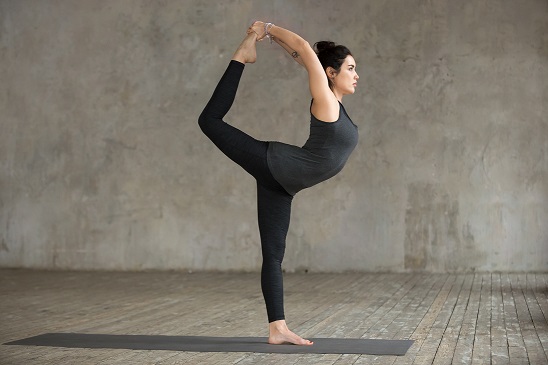
- Stand with your feet together, spine tall, and shoulders relaxed.
- Find a fixed point at eye level. This is your drishti (gaze point). Do not let your eyes wander.
- Shift your weight onto your left foot. Feel the whole foot grounding down.
- Bend your right knee and bring your right heel towards your right buttock.
- Bring your right hand back and hold the inner arch of your right foot, thumb pointing upward.
- Extend your left arm forward, straight and parallel to the floor, palm facing down.
- On an inhale, press your right foot into your right hand and begin to extend your leg back and upward. As your leg lifts, the torso leans naturally forward. Let this happen gently.
- Keep pressing the foot back into your hand. This active pressing is what opens the chest and creates the arc. Without it, the pose collapses.
- Hold for 5 to 8 steady breaths. Keep your gaze fixed, your core engaged, and your standing knee soft, never stiff.
- To wind up, release and lower the raised leg slowly. Return both feet to Tadasana (mountain pose).
- Take a deep breath. Repeat on the other side.
Key tip: Don’t worry if you lose your balance! Step out and begin again without frustration. In natarajasana, falling is part of the practice, not a failure.
Make Natarajasana Work for You: Modifications & Variations
Natarajasana pose looks deceptively simple from the outside: one leg lifted, one arm reaching forward, the body arched into a quiet bow. But the moment you try it, everything changes. Your balance starts to waver, your mind scrambles, and suddenly you understand why this pose needs good flexibility and command over balance.
Modifications for Natarajasana
Most people cannot reach their foot in the full pose straightaway, or can’t hold the position for long. That’s normal. Use these modifications of Natarajasna to safely build towards the full expression:
| Modification | How To Apply | Way It Helps |
| Use a yoga strap | Loop it around the raised foot | Gives reach without strain (best for complete beginners) |
| Practise near a wall | Place the free hand on the wall for balance | Lets you focus on the backbend without fear of falling |
| Keep the raised leg lower | You don’t need the leg parallel to the floor | Lifting to 45 degrees is also a complete practice |
| Bend the front arm | Instead of extending straight, bend the elbow slightly | Reduces shoulder tension |
| One-hand version | Free arm extended | A good mid-point before the full pose |
Variations of Natarajasana
There are several variations of Natarajasana, from beginner-friendly ones that use props to more challenging ones like Purna Natarajasana. These versions are different from each other in terms of position, form, and structure. They let people of various skill levels work on the balance, flexibility, and strength they need to do the full position.
| Variation Type | Pose Name | Key Features & Focus |
| Beginner | Standing Quad Stretch | Stand on one leg and pull the opposite heel toward your glutes without leaning forward |
| Beginner | Prone Dancer (Supta Natarajasana) | Performed by lying on the belly, it removes the balance challenge and focuses on the backbend and quad stretch |
| Intermediate | Standard Natarajasana (Dancer Pose) | Reaching forward with one arm while the other holds the inner ankle, the body hinges through the hip |
| Intermediate | Natarajasana II | The torso hinges further forward; the lifted leg is pulled higher, using a firmer grip on the ankles |
| Intermediate | Standing Bow Pose (Dandayamana Dhanurasana) | It emphasises a powerful “kickback” to create a bow-like shape with the body. |
| Advanced | Purna Natarajasana (Full King Dancer) | Reaching forward with one arm while the other holds the inner ankle; the body hinges through the hip |
| Advanced | Baddha Natarajasana | The arms and legs create a locked circle, focusing on total body tension and the “King” expression |
Natarajasana is one of those poses that feels different for every practitioner. It may look like an easy task to do, but certain things make this pose worthy of guidance by a highly trained yoga expert like Guru Vishnu Panigrahi. If you wish to learn this pose under superior guidance, our experienced instructors in Vinyasa Yoga Academy, Rishikesh, will help you grasp the completeness of this pose in the best possible way.
Understand alignment, warm-up sequence, routine integration, and the philosophy behind yoga asanas in our 200 Hour Yoga Teacher Training in Rishikesh. Master your body, master your soul.
15 Benefits Of Natarajasana for Mind, Body & Soul
Natarajasana benefits stretch across the physical, mental, and energetic layers of the body. Here is what regular practice of dancer pose yoga genuinely delivers:
Physical Benefits
- Strengthens the standing leg: quadriceps, hamstrings, calves, and ankle
- Improves spinal flexibility through the gentle backbend
- Strengthens the shoulders and upper back
- Improves overall posture: counteracts the rounding effect of long hours at a desk
- Opens the chest and front body: a natural heart opener
- Stretches the quadriceps and hip flexors of the lifted leg
- Builds core stability: the entire midsection engages to hold the balance
- Stimulates the digestive organs through the core and abdominal engagement
Mental and Emotional Benefits
- Sharpens concentration: a wandering mind makes you fall. The pose trains focus directly.
- Reduces stress, tension, and anxiety: the one-pointed awareness required naturally quiets mental chatter
- Builds self-confidence: holding the pose, even briefly, creates a sense of accomplishment
- Builds patience: until the full pose comes slowly, with consistent practice
- Enhances body awareness and proprioception (your sense of where your body is in space)
Energetic / Spiritual Benefits
- Activates Muladhara (root) and Anahata (heart) chakras: getting grounded through the standing leg and opening through the chest and the heart
- Embodies the balance of effort and surrender: the core philosophical lesson of the Dancer Pose
Is Natarajasana Suitable for Beginners?
Yes, but not in its full form, i.e., the full expression.
This pose, Natarajasana, is for people who already practise yoga. It requires you to balance on one leg, be flexible in your hips, open your quadriceps, and move your shoulders all at the same time. Although beginners can definitely work toward it. Most people may find a version of the position that works for them in a few months if they practise its variations regularly, warm up appropriately, and gain the strength and flexibility they need.
However, the strap modification and wall-assisted version make the pose accessible from day one. If you can, try to practise Natarajasana in the presence of a guide or a yoga teacher.
One honest benchmark: If you can hold Warrior III (Virabhadrasana III) comfortably for 5-6 breaths and can hold your own foot in a reclining quad stretch, then you are ready to work with natarajasana.
What Are The Best Preparatory Poses for Natarajasana?
If you are directly jumping to Natarajasana (Dancer Pose) without preparing the body for the challenges it brings, you are going wrong. It is important to open your shoulders, chest, hip flexors, and build stability in the standing leg, even before you think of practising Natarajasana.
These preparatory poses of Natarajasana will help you make your body and soul ready for the deeds and demands of the pose:
| Preparatory Pose | What It Builds | Why It Matters |
| Tadasana (Mountain Pose) | Grounding and alignment | Foundation for all standing poses |
| Vrksasana (Tree Pose) | Single-leg balance | Trains the standing leg and focus |
| Virabhadrasana III (Warrior III) | Balance + core + back strength | Closest preparatory shape |
| Anjaneyasana (Low Lunge) | Hip flexor openness | Lifts the restriction in the raised leg |
| Supta Virasana (Reclining Hero) | Deep quad stretch | Essential for kicking back in Natarajasana |
| Bhujangasana (Cobra Pose) | Spine extension | Warms the backbend |
| Dhanurasana (Bow Pose) | Full front-body opening | Closest analogue to the full arc of the Dancer Pose |
What Muscles Does the Dancer Pose Activate?
Natarajasana works both sides of the body differently. The standing side stabilises, while the lifted side stretches. Here is the breakdown of what muscles the Lord of the Dance Pose targets and activates:
| Body Area | What Happens |
| Standing leg quadriceps | Engage to support and stabilise the whole body |
| Standing leg, ankle, and calf | Active stability; strengthening with consistent practice |
| Core and abdominals | Engage to maintain spinal length and prevent collapse |
| Lifted leg quadriceps | Stretched deeply as the leg extends back |
| Hip flexors (lifted side) | Lengthened; excellent for desk workers and runners |
| Chest and shoulders | Open through backbending and stretching |
| Upper and mid-back muscles | Strengthen as the spine extends |
| Gluteus maximus | Supports hip alignment on the standing leg |
Common Mistakes To Avoid In Natarajasana
No one is perfect. Sometimes, even the practitioners themselves make mistakes that can significantly impact the form in Nataraj asana.
These are the mistakes that either limit the pose or lead to injury in Natarajasana (Dancer Pose):
- Ignoring the drishti: Your gaze is everything in a balance pose, especially Natarajasana. Fix your eyes on one still point before you lift the leg. Eyes that wander here and there cause you to fail.
- Rushing into the full pose: Yes, this is a mistake, and most early practitioners run after it. Natarajasana is a pose you build into. Spending time in the strap modification or with its variations is not a shortcut or a fail. It is how the body learns the pathway correctly.
- Collapsing the standing knee inward (fatal): The knee should stay not only strong but also soft and aligned. To protect the joint, micro-bend the knee. Never lock it stiff and straight.
- Gripping the outside of the foot (instead of the inner arch): Holding the outer ankle rotates the hip outward and compresses the lower back. Reach for the inner arch with your thumb pointing upwards.
When Should You Be Careful? Contraindications for Natarajasana
The Dancer Pose is not suitable for everyone in its full expression. Take extra care or avoid Natarajasana entirely if you have the following:
- Knee injuries, as the standing knee bears a significant load
- Hip injuries or recent hip surgery
- Lower back pain or lumbar disc issues, as the backbend can aggravate both
- Shoulder injuries, such as reaching back to hold the foot, place demand on the shoulder joint
- High blood pressure or heart conditions, consult your doctor before attempting inversions and deep backbends
- Ankle instability, as the standing ankle should be strong and stable
- During pregnancy, the balance, backbend, and compression involved are not advisable
A note on beginners with these conditions: Many can still do a modified version, like holding a wall, keeping the lifted leg low, or using a strap. The key is never to force the full pose until you can. Always tell your doctor or yoga teacher about any conditions before taking class.
Moving Forward
Natarajasana rewards consistency more than effort. Practising it three to four times a week, with proper warm-up, good alignment, and patience, will produce visible change within a few months.
- Start with the wall or the strap
- Hold each side for five breaths
- Come out slowly
- Rest, and see the pose gradually unfold its effects
One thing practitioners often discover is that the pose is different every day. Some mornings, the balance is solid. Others, you cannot hold it for two breaths. This variation in progress is not for you to let yourself down. It is data about your nervous system, your sleep, and your stress levels. Dancer pose yoga teaches you to accept and meet yourself where you are, not where you think you should be.
Begin with small steps, and when you feel prepared to progress further, work towards achieving the complete “King Dancer”. Yes, it will take time, effort, and patience, but remember that every step of the journey is a practice in itself.
FAQs
What is the meaning of Natarajasana?
Natarajasana means the pose of the “Lord of Dance.” In Sanskrit, ‘Nata’ means ‘dancer’, ‘Raja’ means ‘king’, and ‘Asana’ means ‘posture’. It honours Lord Shiva in his Nataraja form, the cosmic dancer whose movement symbolises creation, preservation, and destruction.
Is Natarajasana (Dancer Pose) suitable for beginners?
In full form, no. It is an intermediate to advanced pose. However, with a strap, wall support, or reduced leg height, beginners can practise safely and build towards the full expression over time.
How long should you hold the Dancer Pose?
Start with 3 to 5 steady breaths per side (of the leg). As your balance and strength improve, try to target 5 to 8 breaths or more. Advanced practitioners may hold for 30 to 60 seconds.
What is the difference between the dancer pose and the lord of the dance pose?
They are the same asana, i.e., Natarajasana. “Lord of the Dance Pose” is simply the full Sanskrit translation, while “Dancer Pose” is the more common shorthand used in modern yoga classes.
What are the main Natarajasana benefits?
Improved balance and coordination, strengthened legs and core, more open chest and hip flexors, better concentration, reduced stress, and improved posture. The mental focus and commitment demanded by the pose are arguably its greatest benefits.
Can Natarajasana (Dancer Pose) help with back pain?
For some people, the gentle backbend can relieve upper back tension and improve posture. However, if you have lower back issues or lumbar disc problems, the backbend of this pose may aggravate symptoms. Speak to a doctor or a qualified yoga teacher first.
What is the best time to practise Natarajasana?
Morning practice on an empty stomach is traditionally suggested. Evening practice works as well, provided the body is warmed up. Avoid practising immediately after having meals.
Why do I keep falling in Natarajasana?
It’s usually one of three things: the gaze is unfixed, the core is unengaged, or the standing knee is locked. Fix your drishti on a still point, lightly engage your belly, and keep a micro-bend in your standing knee to fix this issue.