 +91-8755744872
  contact@vinyasayogaacademy.com





Before You Read: Some Facts That Might Surprise You
- 284 million people worldwide live with an anxiety disorder, making it the most common mental health condition on earth. (WHO, 2023)
- A landmark study published in the Journal of Psychiatric Research found that yoga reduced anxiety symptoms by up to 57% in participants after just 8 weeks of regular practice.
- Cortisol — the body's primary stress hormone- has been shown to drop significantly after a single 60-minute yoga session, according to research from Harvard Medical School.
- The ancient Indian practice of yoga is now formally recommended as a complementary therapy for anxiety by the American Psychological Association (APA).
- Despite all this, only 1 in 5 people dealing with anxiety ever try yoga as a management tool.
If you are reading this, you are already ahead of the curve. Let's make sure you get the most out of it.
Understanding Anxiety: What Exactly Is Anxiety?
Before jumping into poses, it helps to understand what you're actually dealing with.
Anxiety is not a character flaw. It is not a weakness. It is your nervous system responding to perceived threat, sometimes a real one, sometimes an imagined or exaggerated one. The problem is that in today's world, the "threats" never stop: work pressure, financial stress, relationship tension, social media overload, and health worries. Your nervous system was built for occasional short bursts of stress, not a constant drip of it.
Common anxiety disorders include generalised anxiety disorder (GAD), panic disorder, social anxiety, phobias, and OCD. Anxiety also sits at the root of many cases of depression, which is why yoga for anxiety and depression is increasingly studied together, as a unified practice.
The most important thing to understand: chronic anxiety is a nervous system problem. And yoga, particularly when it involves breath-focused movement and stillness, is one of the most direct ways to reset an overworked nervous system.
How Yoga Helps Relieve Anxiety: The Science Behind It
There is a common misconception that yoga is simply a physical exercise, something you do to become more flexible or lose weight. And while those benefits are real, yoga's relationship with anxiety goes far, far deeper.
When anxiety hits, your body enters what scientists call the fight-or-flight response. Your heart rate climbs. Your muscles tighten. Your breathing becomes shallow. Stress hormones flood your bloodstream. This is your nervous system doing its job, but in modern life, this alarm bell rings far too often and stays on far too long.
Yoga works on anxiety from three directions simultaneously: the body, the breath, and the mind. No other single practice does all three together.
When you hold a grounding pose and breathe consciously, you are directly activating the parasympathetic nervous system, the biological counterweight to fight-or-flight. This is the "rest and digest" system. Heart rate drops. Muscles release. Cortisol falls. And the mind, almost automatically, begins to quiet.
This is not philosophy. This is measurable, repeatable physiology. A 2017 study in Neuropsychiatry confirmed that regular yoga practice structurally changes the brain — increasing gray matter volume in areas responsible for emotional regulation and reducing activity in the amygdala, which is the brain's anxiety center.
So yes, yoga is genuinely good for anxiety. Not as a replacement for clinical care in severe cases, but as one of the most powerful tools available to manage, reduce, and prevent anxious feelings in everyday life.
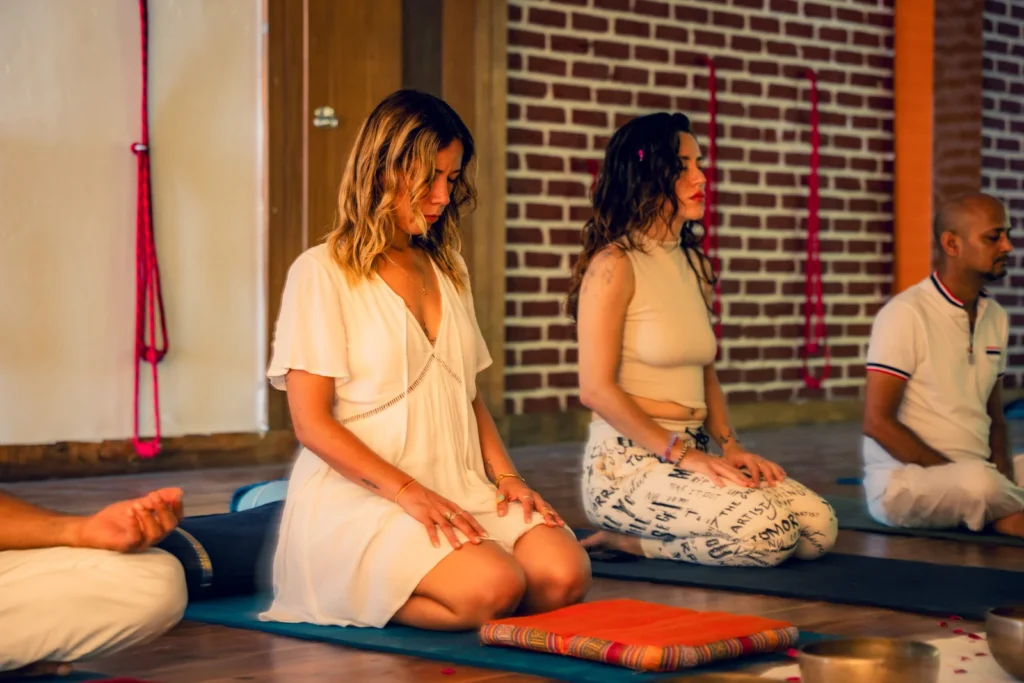
The 8 Best Yoga Poses for Anxiety Relief (With Step-by-Step Instructions)
These poses have been selected not just for their popularity, but for their direct physiological impact on the stress response. Practiced in sequence, they form a 25–30 minute anxiety-relief routine you can do at home.
1. Balasana (Child's Pose)
If anxiety had an antidote pose, it would be this one. Child's Pose gently compresses the abdomen, stimulates the vagus nerve, and creates an immediate sense of physical safety. It is the first pose taught in almost every restorative yoga for anxiety sequence, and for good reason.
How to do it:
- Kneel on the mat, big toes touching, knees hip-width apart
- Slowly lower your torso forward between your thighs
- Extend arms forward or rest them alongside your body
- Rest your forehead on the mat — this gentle pressure on the forehead activates the parasympathetic response
- Hold for 1–3 minutes, breathing deeply into your lower back
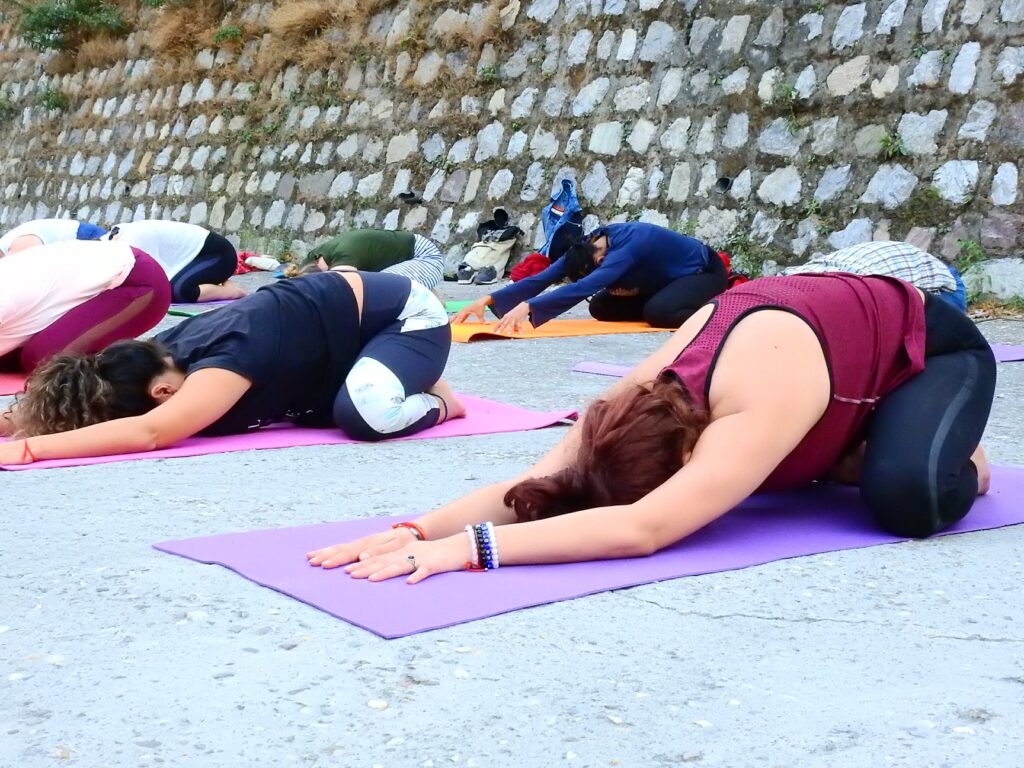
Why it works for anxiety: The fetal-like position signals safety to your nervous system. The forward fold calms the adrenal glands sitting just above your kidneys.
2. Uttanasana (Standing Forward Fold)
One of the most effective yoga poses for stress, Uttanasana reverses blood flow to the brain, quiets mental chatter, and creates a natural release of physical tension held in the hamstrings and lower back — exactly where anxiety lives in the body.
How to do it:
- Stand with feet hip-width apart, spine long
- Exhale and hinge forward from the hips (not the waist)
- Let your hands fall to the floor, or clasp opposite elbows
- Let your head hang completely — no holding, no tension in the neck
- Breathe slowly and hold for 30–60 seconds
- Rise back up slowly, one vertebra at a time
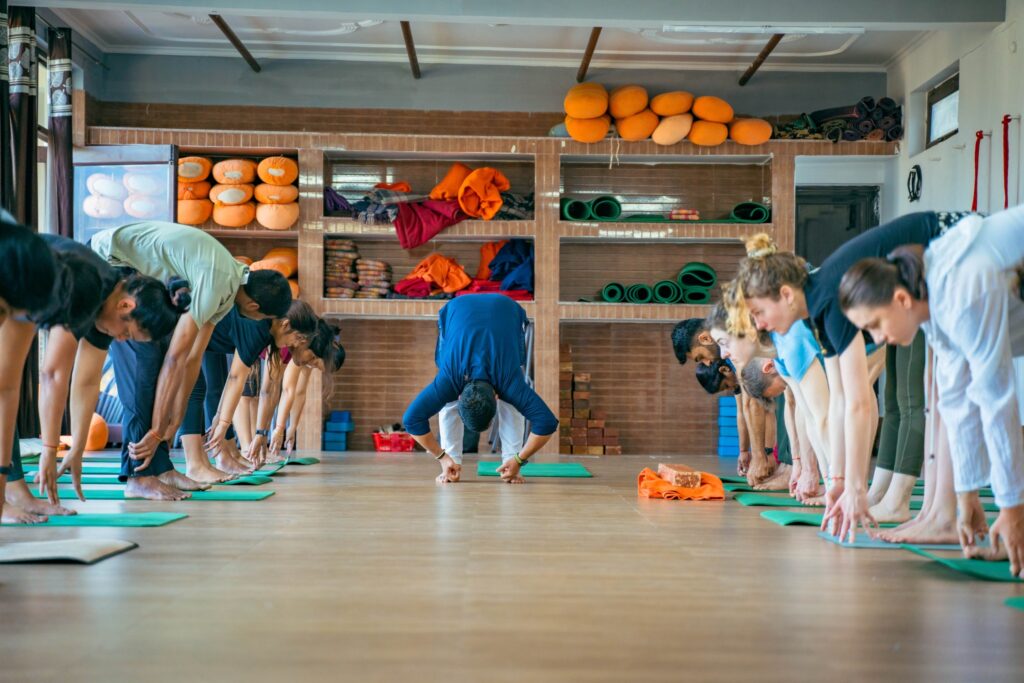
Why it works for anxiety: Inverted positions increase blood flow to the prefrontal cortex — the rational, calm part of the brain. This literally helps you think more clearly when anxious.
3. Vrikshasana (Tree Pose)
When anxiety spins you out into worst-case scenarios and "what ifs," Tree Pose brings you back into your body and into this moment. Balance poses demand full present-moment awareness; you simply cannot balance and catastrophise at the same time.
How to do it:
- Stand tall, feet together, gaze fixed on a still point ahead
- Shift weight to your left foot, rooting all four corners into the earth
- Place the right foot on the inner left thigh (above or below the knee, never on it)
- Bring your hands to the heart centre in Anjali mudra, or raise them overhead
- Hold for 30–60 seconds, then switch sides
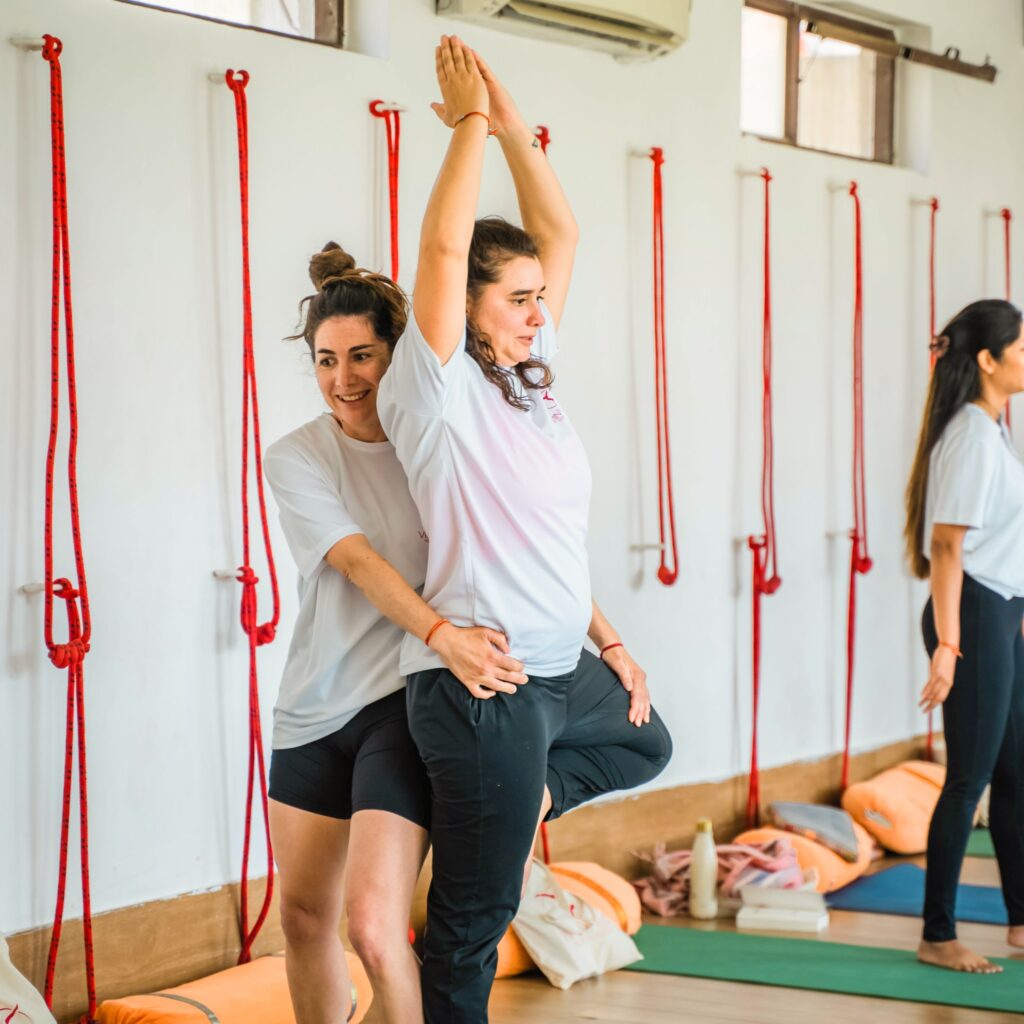
Why it works for anxiety: The focused gaze (drishti) and balance challenge engage the prefrontal cortex, quieting the overactive amygdala. Regular practice builds what neuroscientists call interoceptive awareness — the ability to feel your own body, which is strongly linked to reduced anxiety.
4. Viparita Karani (Legs-Up-The-Wall Pose)
Viparita Karani is perhaps the single most underrated calming yoga pose in existence. It requires almost no flexibility, no strength, and almost no effort — yet its impact on the nervous system is profound. Every teacher at Vinyasa Yoga Academy recommends this to students dealing with anxiety, insomnia, or burnout.
How to do it:
- Sit sideways next to a wall, then swing your legs up as you lie back
- Your legs rest against the wall, and your body forms an L-shape
- Arms rest comfortably by your sides, palms up
- Close your eyes. Stay for 5–15 minutes
- Breathe naturally — no forcing
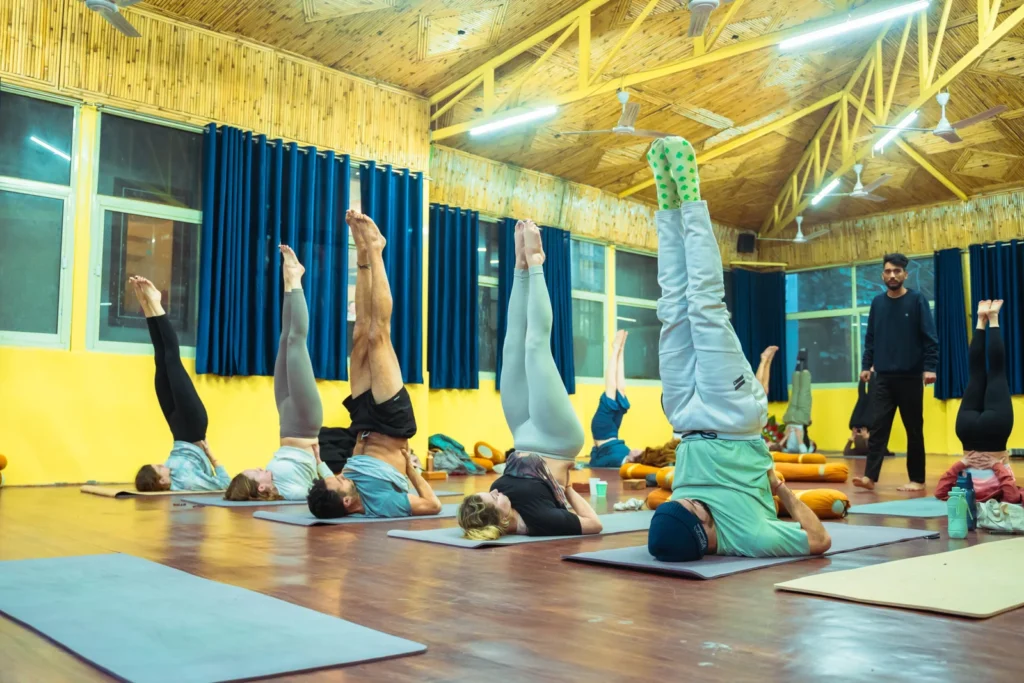
Why it works for anxiety: This gentle inversion signals the body to downregulate stress hormones. The position stimulates the baroreceptors in the neck and chest that signal to the brain: all is well, stand down.
5. Trikonasana (Triangle Pose)
Anxiety causes us to contract, physically and emotionally. We hunch, we pull inward, we close off. Trikonasana does the opposite: it opens the entire side body, expands the chest, and creates a sense of spaciousness that directly counters the constriction of anxiety.
How to do it:
- Stand with feet about 3–4 feet apart
- Turn the right foot out 90 degrees, the left foot slightly in
- Extend arms parallel to the floor
- Reach right hand toward right shin, ankle, or the floor (whatever your flexibility allows)
- Left arm extends straight up, gaze follows
- Hold 5 breaths, then switch sides
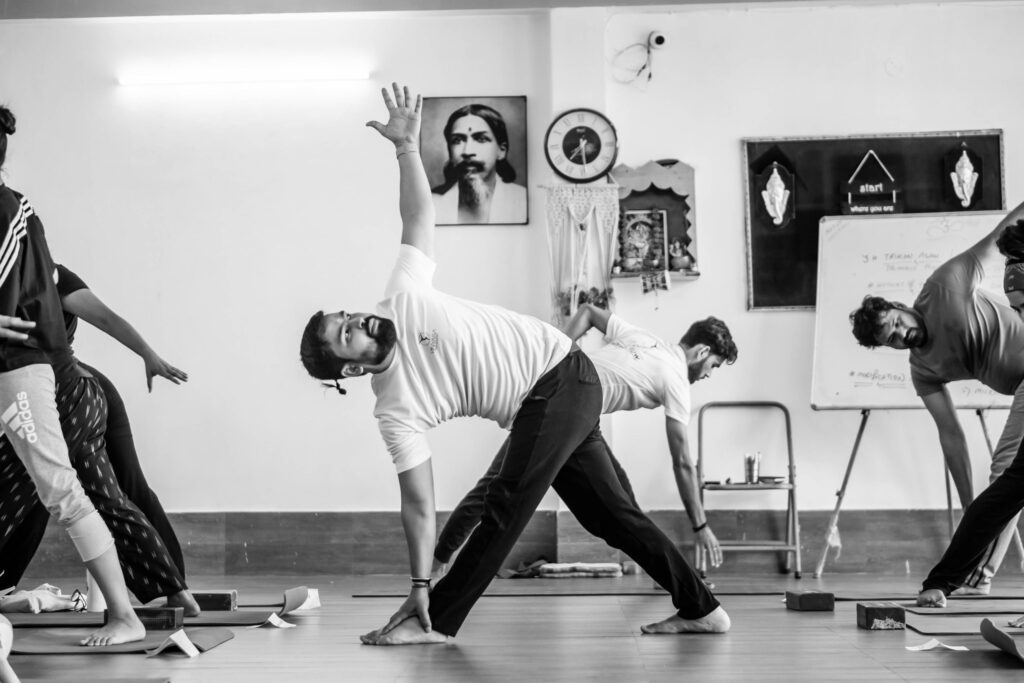
Why it works for anxiety: The lateral stretch opens the intercostal muscles between the ribs, physically allowing deeper breathing. Deeper breathing = slower heart rate = calmer nervous system.
6. Urdhva Mukha Svanasana (Upward-Facing Dog)
When we're anxious, the chest caves in, restricting breath and compressing the heart centre. Upward-Facing Dog is a powerful heart-opener that counters this pattern at the structural level.
How to do it:
- Lie face down on your mat, legs extended, tops of feet on the floor
- Place your hands beside your lower ribs, fingers spread
- Press firmly into palms, straightening arms and lifting chest and hips off the floor
- Shoulders roll back and down — chest lifts and opens
- Gaze forward or gently upward
- Hold for 5 deep breaths
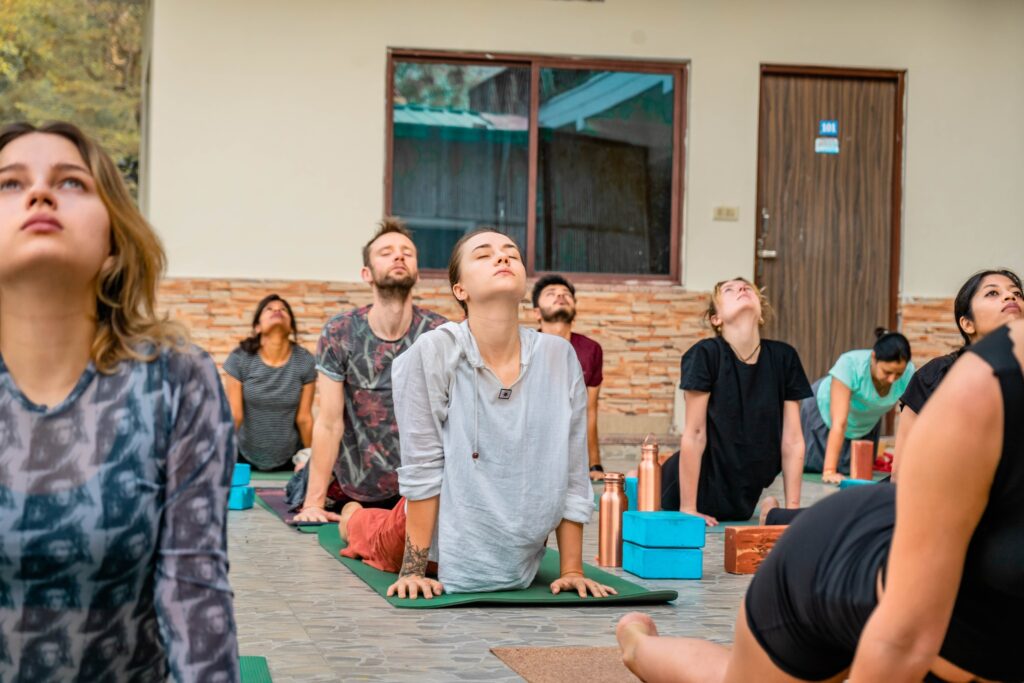
Why it works for anxiety: Chest-opening poses physically increase lung capacity in the moment. Research shows that even a single session of heart-opening yoga asanas for anxiety increases feelings of emotional openness and reduces self-reported anxiety scores.
7. Setu Bandhasana (Bridge Pose)
Bridge Pose gently stimulates the thyroid gland, which plays a major role in regulating mood and anxiety. It also strengthens the posterior chain, the muscles along the back of the body, that tend to weaken and tighten under chronic stress.
How to do it:
- Lie on your back, knees bent, feet flat on the mat hip-width apart
- Arms alongside the body, palms flat on the floor
- Press into feet and arms, lifting hips toward the ceiling
- Optionally, clasp hands beneath the body and press arms into the mat
- Hold for 5–8 breaths, lower slowly, repeat 2–3 times
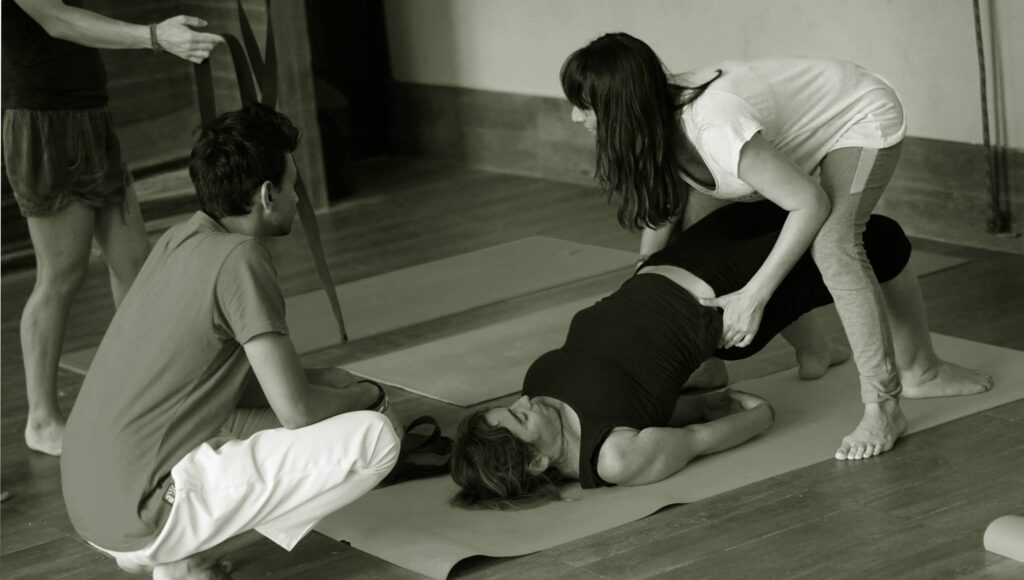
Why it works for anxiety: The mild compression of the throat in the full variation gently stimulates the vagus nerve, the same nerve targeted in clinical vagal nerve stimulation therapy for anxiety disorders.
8. Shavasana (Corpse Pose)
Never skip Shavasana. Never. This is not the "rest at the end" — it is where all the work actually lands. During Shavasana, your nervous system integrates the shifts created by the practice. Your body learns, neurologically, what calm feels like.
How to do it:
- Lie flat on your back, legs slightly apart, arms a little away from your body
- Palms face up, the gesture of receiving and releasing
- Close your eyes, let your breath return to its natural rhythm
- Systematically release every part of your body from feet to face
- Remain completely still for at least 10–15 minutes
- To exit: wiggle fingers and toes, roll gently to one side, and rise slowly
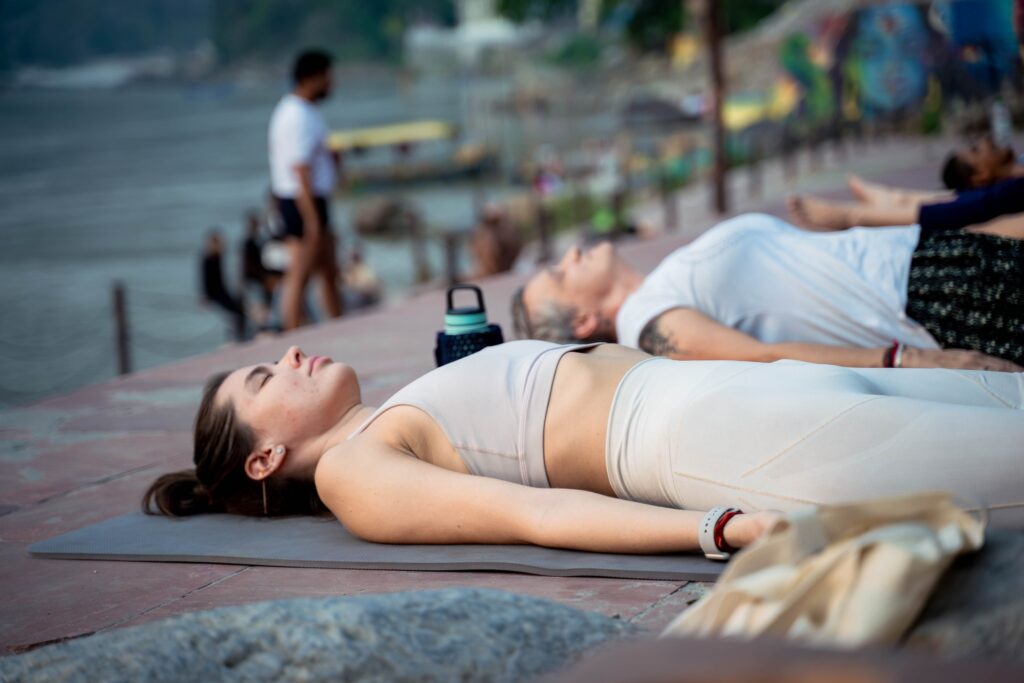
Why it works for anxiety: Shavasana directly activates the parasympathetic nervous system. EEG studies show that after 10 minutes in Shavasana, brain waves shift from beta (active, stressed) toward alpha and theta (calm, creative, meditative).
Many of these anxiety-relief yoga asanas are taught in the 200 Hour Yoga Teacher Training in Rishikesh with proper guidance on alignment and breath awareness.
Pranayama for Anxiety: The Breathing Techniques That Work Fast
No discussion of yoga for stress and anxiety is complete without pranayama, conscious breathing. In fact, if you only have five minutes, skip the poses and just do the breathing.
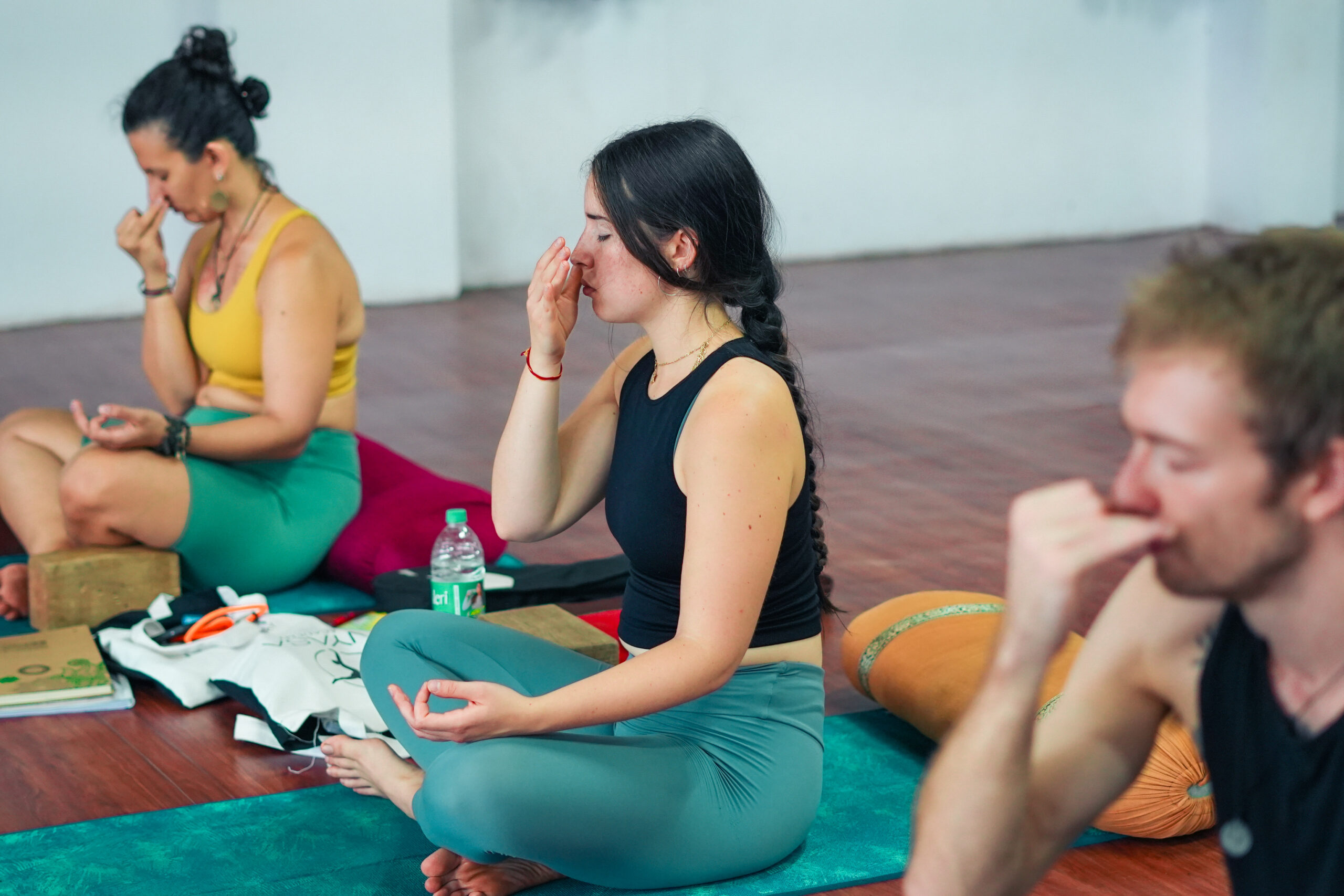
- Nadi Shodhana (Alternate Nostril Breathing) is the gold standard for anxiety. It balances the left and right hemispheres of the brain, calms the nervous system, and can reduce anxiety symptoms within 5 minutes of practice. Close the right nostril, inhale left. Close the left nostril, exhale right. Inhale right. Exhale left. That is one round — do 10 rounds.
- Bhramari (Humming Bee Breath) is particularly powerful for panic attacks and acute anxiety. The humming vibration stimulates the vagus nerve and creates an internal sound that draws the mind away from anxious thoughts. Inhale fully, then hum steadily on the exhale for as long as comfortable. Repeat 8–10 times.
- 4-7-8 Breathing (a modern adaptation of the ancient Pranava pranayama) — inhale for 4 counts, hold for 7, exhale for 8. The extended exhale activates the parasympathetic nervous system almost instantly.
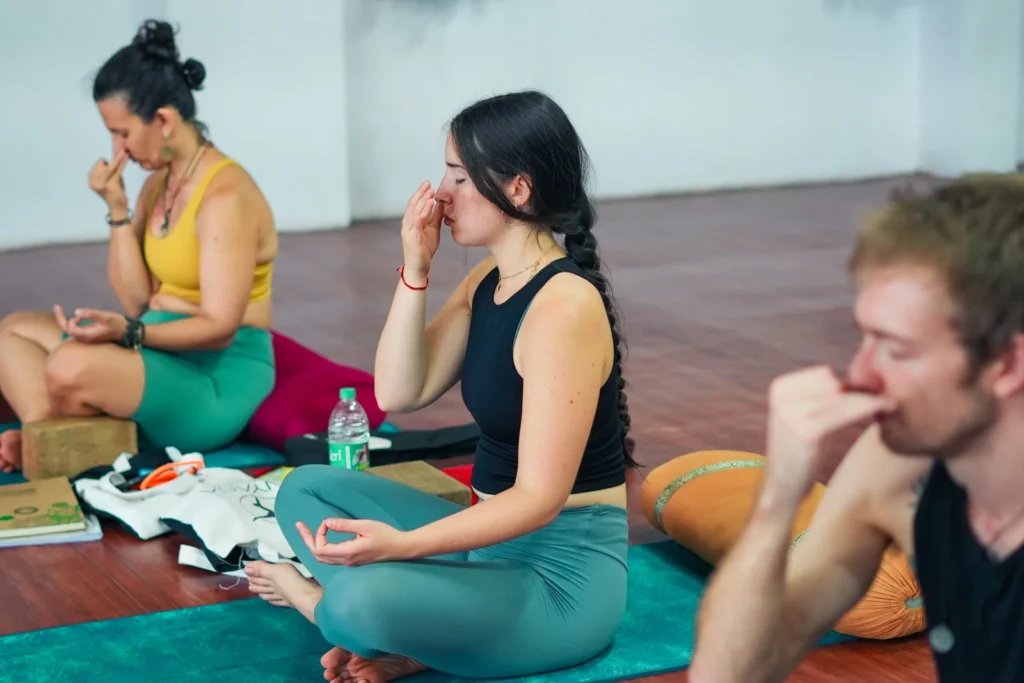
These are not relaxation tricks. They are direct physiological interventions. Yoga breathing for anxiety works because the breath is the one part of the autonomic nervous system you can consciously control — and by controlling it, you gain indirect control over your heart rate, blood pressure, and stress hormone levels.
Yoga for Anxiety Disorders: What the Research Actually Says
For those managing diagnosed anxiety disorders, generalised anxiety, social anxiety, panic disorder, or anxiety alongside depression, here is what science currently tells us:
A 2021 meta-analysis in the British Journal of Sports Medicine analysed 33 clinical trials and found that yoga was significantly more effective than control conditions at reducing anxiety symptoms across multiple disorder types.
Research from Boston University found that yoga increases GABA levels in the brain, the same neurotransmitter targeted by anti-anxiety medications like benzodiazepines. After a 60-minute yoga session, GABA levels increased by 27% compared to a walking group.
Yoga for anxiety and depression has also shown remarkable results in studies — particularly for Major Depressive Disorder (MDD) with co-occurring anxiety, where participants practicing yoga 3 times per week showed clinically significant reductions in both anxiety and depression scores after 12 weeks.
Important note: If you have a diagnosed anxiety disorder, yoga works best as a complement to professional care, not a replacement for it. Always consult your healthcare provider. That said, many therapists now actively recommend yoga as part of an integrated treatment plan.
How to Build a Daily Yoga Practice for Anxiety
The biggest mistake people make: trying to do too much too soon, burning out, and quitting. Anxiety already makes consistency hard. Here is a gentle, realistic framework:
- Week 1–2: Just 10 minutes daily — one pranayama technique and Shavasana only
- Week 3–4: Add 2–3 poses before Shavasana (Child's Pose, Legs-Up-Wall, Bridge)
- Month 2: Build to 20–25 minutes, adding the full sequence above
- Month 3 onward: 30-minute daily practice, with consistency as the goal over perfection
Morning practice tends to set a calmer tone for the day. Evening practice helps release accumulated tension before sleep. Both are valid — the best time to practice yoga for anxiety is the time you will actually do it.
Also Read: Mastering Breathwork: A Natural Solution For Stress And Anxiety
Final Takeaway
At Vinyasa Yoga Academy in Rishikesh, we have worked with students from over 50 countries, many of whom arrived carrying years of anxiety, burnout, and stress. What we see, time and time again, is that yoga does not just manage anxiety. When practiced with intention and proper guidance, it gradually changes your relationship with anxiety itself.
You stop being afraid of the feeling. You start to notice it earlier, respond to it more skillfully, and recover from it faster. The poses become tools. The breath becomes an anchor. And slowly, the nervous system learns, truly learns, at a cellular level, that it is safe to be calm.
That is the real promise of yoga for anxiety. Not the elimination of difficulty, but the cultivation of resilience.
If you are ready to go deeper, to learn these practices not just intellectually but experientially, under the guidance of senior teachers with decades of practice, we invite you to explore our Yoga Teacher Training programs in Rishikesh and Bali because some things are simply better learned in person, in the right environment, with the right community.
Your nervous system deserves that investment.
Frequently Asked Questions (FAQ)
Is yoga good for anxiety?
Yes. Multiple peer-reviewed studies confirm that regular yoga practice significantly reduces anxiety symptoms by activating the parasympathetic nervous system, lowering cortisol, and increasing brain GABA levels.
How often should I do yoga for anxiety relief?
Research suggests 3–5 sessions per week for measurable results, but even 10 minutes daily shows benefit. Consistency matters more than duration.
Which yoga poses are best for acute anxiety or panic attacks?
Child's Pose, Legs-Up-The-Wall, and Bhramari pranayama are the fastest-acting. They can calm an acute anxiety response within minutes.
Can yoga replace medication for anxiety disorders?
No — yoga should complement, not replace, professional treatment for diagnosed anxiety disorders. However, it can significantly reduce reliance on medication over time when practiced consistently alongside professional guidance.
Is yoga good for anxiety and depression together?
Yes. Research shows yoga addresses both simultaneously by regulating neurotransmitters (GABA, serotonin) and the HPA axis (the stress hormone system), which underpins both conditions.
Can beginners do yoga for stress and anxiety?
Absolutely. Every pose listed in this guide is beginner-friendly. In fact, the most effective anxiety-relief poses — Child's Pose, Legs-Up-The-Wall, Shavasana — require no prior yoga experience.
What type of yoga is best for anxiety?
Restorative yoga, Yin yoga, and Hatha yoga are generally most effective for anxiety. Vigorous styles like Power Yoga can also help but may initially feel overwhelming for those with high anxiety.
Written with expertise from the teaching faculty of Vinyasa Yoga Academy, Rishikesh — a Yoga Alliance Certified school with 786+ verified student reviews and over a decade of experience in therapeutic yoga education.