








10 Teaching Tips for Yoga Teachers: Go From Good To Unforgettable
Table of Contents
- A Word On Teaching Yoga
- An Honest Look At Your Last Class
- 10 Teaching Tips for Yoga Teachers
- 1. Read the Energy of Your Class Before You Begin
- 2. Make Your Voice Your Most Powerful Teaching Tool
- 3. Learn Yoga Anatomy (It Will Save Your Students)
- 4. Teach According to the Students, Not the Sequence
- 5. The Evolution Loop: Always Be Upgrading
- 6. Give Minimum Cues, Maximum Pauses
- 7. Offer Modifications Without Making It a Big Deal
- 8. Hands-On Adjustments (Ask First)
- 9. Keep Learning, Even After Your Certification
- 10. Build Relationship, Not Just Class Attendance
- Bonus Tip
- 11. Teach from Your Mat’s Edge (Beyond the Routine)
- Your Next Class Checklist: Bring The Above Tips Into Action
- Going Ahead
- Frequently Asked Questions
- 1. How do I become a better yoga teacher?
- 2. How do I find my authentic voice as a yoga teacher?
- 3. What are some of the most important qualities of a good yoga teacher?
- 4. What should I study after my 200-hour yoga teacher training?
- 5. What is the right way to sequence a yoga class?
- 6. How do I keep my yoga students engaged and coming back?
- 7. Should yoga teachers do physical adjustments?
- 8. How long should a yoga class be?
Teaching yoga is a completely different skill from practising it. The 10 tips for yoga teachers (plus one bonus tip) shared below are not theory or some made-up stuff. They come from the teaching floor and from thousands of hours spent guiding students through their practice.
Whether you are a new yoga instructor finding your voice or an experienced teacher looking to sharpen your teaching method, teaching yoga becomes easier when you learn to adapt to real students and real classroom energy.
The best yoga teacher you can be is the one who never stops growing.
– Guru Yogi Vishnu Panigrahi
A Word On Teaching Yoga
You completed your 200-hour yoga teacher training and gained an RYT certification. You know your asanas and can cue Surya Namaskar in your imagination. But the moment you stand in front of a real class, with real people and real expectations, something in you tingles.
The good news? Every great yoga teacher you admire had their first awkward class. Most teachers, when they start, fumble their cues, talk too much, or forget to breathe with the room. This is not to ease your tension, but to let you know that it will become the most important founding stone for your establishment as a yoga teacher.
An Honest Look At Your Last Class
Before you look at the yoga teaching tips below, think about the last class you taught (if any) and try to answer these four questions honestly. Use these to check where your energy and attention are flowing in class:
- Did I teach the exact sequence I wanted to practice, or the sequence that specific bodies in the room needed?
- Am I stepping into the class today to show what I know, or am I stepping in to allow space for what the students feel?
- Were there any moments of natural, unscripted human connection, or did I stick entirely to my notes?
- Did I allow my students to sit in comfortable silence, or was there an anxious urge to fill every gap with my voice?
Note: In Vinyasa Yoga Academy’s 200 Hour Yoga Teacher Training Course curriculum, we intentionally dedicate hours to this style of self-evaluation, helping budding yoga teachers build the confidence to lead with calm and control.
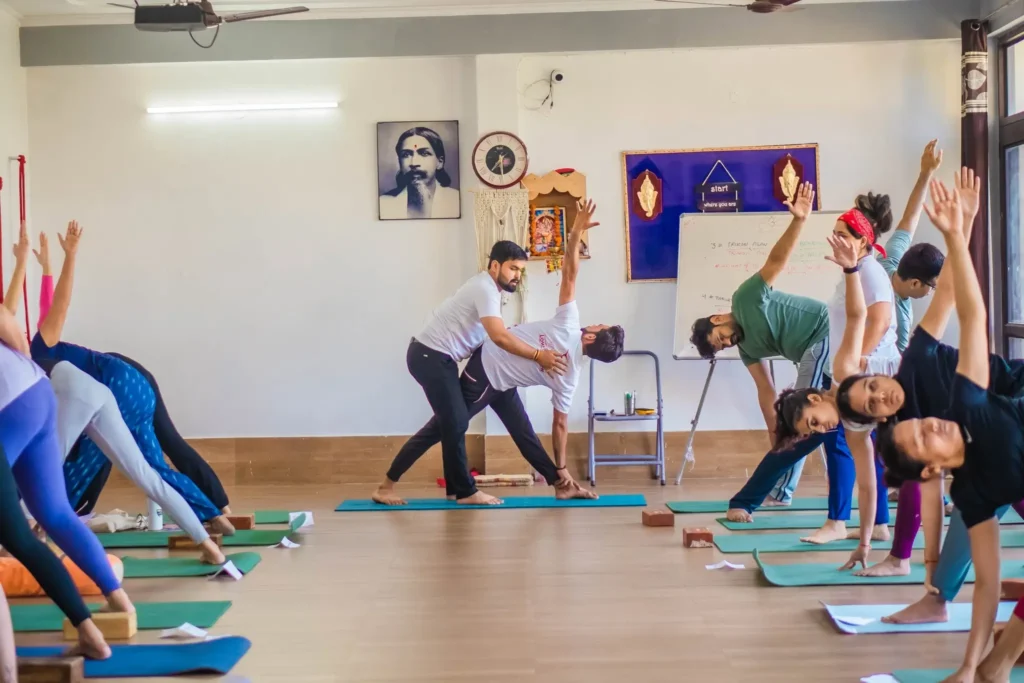
10 Teaching Tips for Yoga Teachers
1. Read the Energy of Your Class Before You Begin
Before you say a single word in class, take 30 seconds and just observe. Are students chatting enthusiastically? Are they lying quietly on their mats? Are they scattered and distracted?
Doing this before every class will tell you everything about how to begin your lecture. A buzzing, social group may need a strong pranayama opener to settle. A quiet, tired Monday crowd might need a slow, warm build rather than some dynamic Vinyasa sequence.
Great yoga teaching is responsive. You cannot read a room if you walk in with your head in your diary. Show up early. Breathe, watch, then teach. The more you observe, the better you guide. These are some of the most practical yoga tips for teachers who want to build stronger student connections.
2. Make Your Voice Your Most Powerful Teaching Tool
The tone, pace, flow, and rhythm of how you speak matter more than most new yoga teachers realise. You do not need to demonstrate every pose, but your voice needs to do the work your body would do.
Listen and observe more, and speak slowly. Slower than what feels comfortable. In a calm yoga class, your natural speaking pace shouldn’t feel rushed. A quiet, steady, controlled voice creates safety. These same principles are equally effective as tips for teaching yoga online, especially when building connection and engagement through a screen. It tells your nervous system (and of your students) that everything is okay here.
Read More: Is Online Yoga Teacher Training Effective?
Silence is not empty. Speak in pauses to give students time to actually absorb what you said.
Brief Voice Pacing Manual:
| Situation | Voice Quality | Why It Works |
| Opening / Grounding | Slow, low, soft | Activates parasympathetic nervous system |
| Pranayama | Clear, bold | Let the setting be submerged in practice |
| Building / Flow | Medium pace, clear | Leads movement without rushing breath |
| Peak pose / Challenge | Steady, encouraging | Builds confidence, reduces fear |
| Savasana / Meditation | Slow, almost whispered | Signals the body to release fully |
3. Learn Yoga Anatomy (It Will Save Your Students)
You do not need a physiology or an MBBS degree. But having an understanding of the basic mechanics of the human body will make you a much safer and more effective yoga instructor.
Knowing the difference between hamstring tightness and a nerve issue will stop you from pushing a student too far. Being familiar with details like muscle movements, joint names, and functions will make your yoga teaching and cueing more intelligent and specific.
Beyond safety, anatomy gives you authority. Students trust teachers more who speak with clarity about the body. It builds your credibility and confidence at the same time.
Where to start: Study the spine, the hips, and the shoulders. These three areas are where most yoga-related discomfort and injury occur.
4. Teach According to the Students, Not the Sequence
Like in any business, understanding the audience is the key to conversion. In yoga training, knowing your students well is essential for their transformation.
Most yoga teachers walk into class with a beautifully planned sequence in their head. That plan is a great starting point. But if you are staring at your notes while five students are quietly struggling in Warrior II, you are not teaching. You are performing on your own.
The moment you step in front of your students, put your plan in the backseat. Look at the room, notice who looks tense and who is rushing ahead. Notice the energy. Is it heavy and tired, or light and energised? These things tell you how to teach a vinyasa yoga class according to the students in front of you rather than following a rigid flow. These things tell you how to teach today’s class.
A good yoga teacher is a good observer first. Your sequence is a map, not a script.
Try this: Before your next class, write your sequence. Then flip it face down and teach from observation. See what changes.
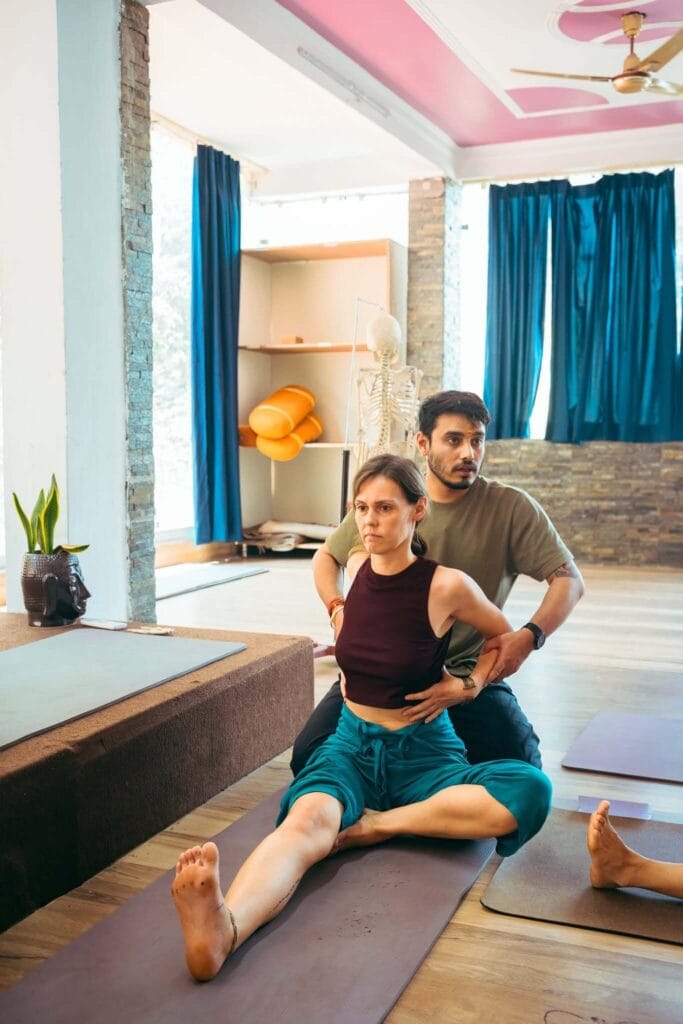
5. The Evolution Loop: Always Be Upgrading
Great teachers don’t treat their classes like a fixed script. They treat them like a living experiment.
– Guru Yogi Vishnu Panigrahi
Let’s be honest, teaching the same sequence with the same cues for five years straight is monotonous.
Evolving is about growing with your community. It means actively noticing the gaps in your teaching. Pay attention to where your students look confused, where they lose their balance, or when their energy dips. Don’t feel hesitant to ask for honest feedback and, more importantly, actually do something with it.
When you commit to this constant loop of updating your style, you stop teaching a generic crowd and start teaching the real, breathing human beings (up for transformation) right in front of you. These are valuable coaching tips for yoga practitioners who want to become impactful teachers over time.
6. Give Minimum Cues, Maximum Pauses
Over-cueing is one of the most common mistakes yoga instructors make. You want to be helpful. So you keep adding instructions. ‘Press your left foot down.. now lift your kneecap.. engage your core.. soften your jaw.. reach through your fingertips..’
At some point, your students stop practising yoga. They start processing commands. This is not actually recommended, as you want your students to thoroughly grasp the postures, not memorise steps like a rule.
Use minimum cues to get someone into a pose, then pause. Count ten slow breaths in your head before you say anything else. Let the room breathe. Let the students feel. The most meaningful teaching often occurs in the gaps between your words rather than in the words themselves.
7. Offer Modifications Without Making It a Big Deal
The best yoga teachers make modifications feel like intelligent choices.
– Guru Yogi Vishnu Panigrahi
Modifications in yoga are not just for beginners. They are for anybody, on any day. And how you offer them is important.
Every class is not alike. The composition is unique. From our personal experiences, we know that each class is a mix of someone with a shoulder injury, someone on their first day, someone who is one month pregnant, and someone who teaches yoga themselves but is in your class to rest.
Do not single people out. Do not say, ‘If you cannot do this, try…’ Instead, build modifications into your standard cueing. ‘You can take this with your knee down, or lift the knee if it feels accessible today.’ This makes every student feel included, not accommodated.
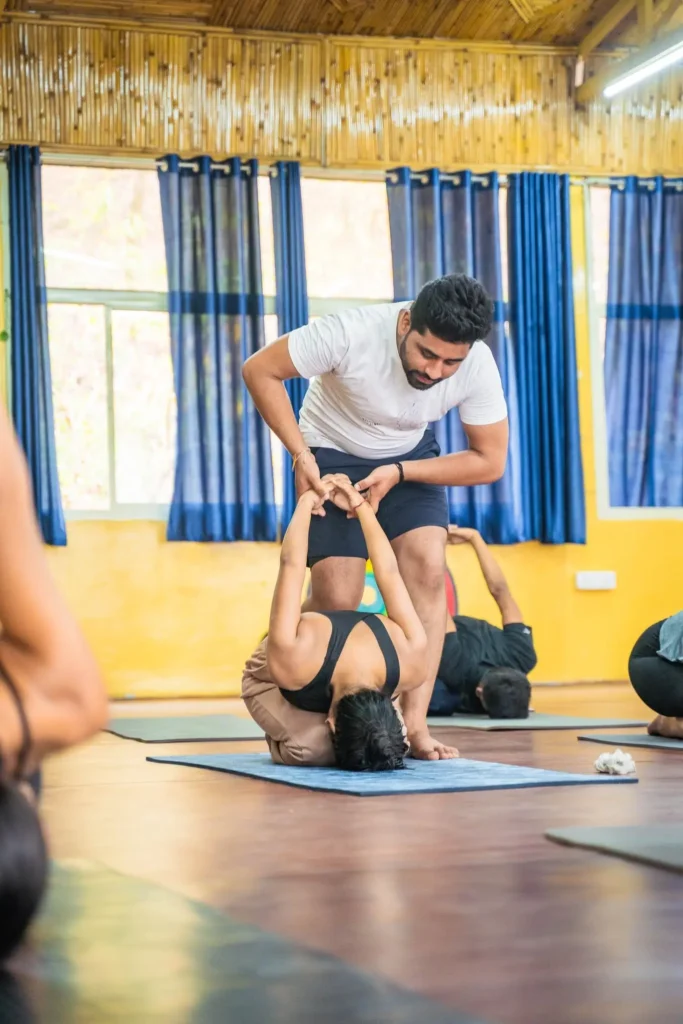
8. Hands-On Adjustments (Ask First)
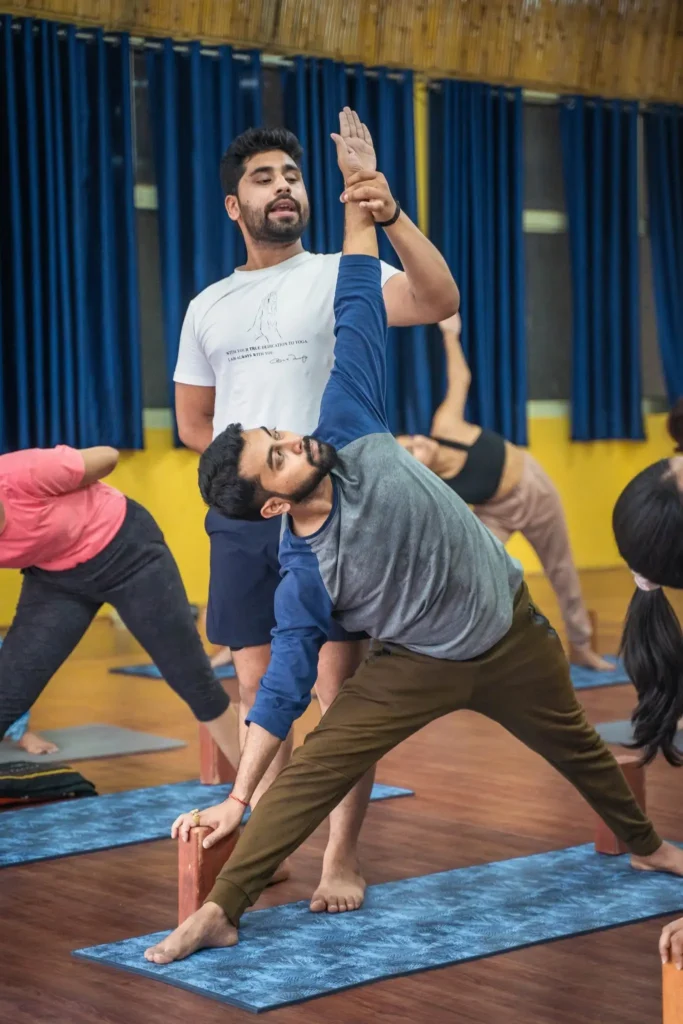
Something that is non-negotiable in modern yoga teaching is to always ask before you touch any student. Touching is a deeply personal matter. What feels supportive to one student may feel invasive to another.
The simplest approach is a consent card system at the door, through which students indicate yes, no, or sometimes. Some studios use tokens or chips. Others simply make it part of the opening of class: ‘I may offer hands-on adjustments today. Please let me know before or during class if you prefer no touch.’
When you do offer adjustments, less is often more. Avoid forcing a deeper range of motion. Instead, use light touch to bring awareness to a shoulder that could soften or a hip that could release. You are not fixing. You are reminding.
Remember: The goal of an adjustment is to deepen awareness, not to deepen a pose.
9. Keep Learning, Even After Your Certification
Your 200-hour yoga teacher training is not the end of your education. It is the beginning. Yoga teachers who grow and who build loyal, trusting communities of students are the ones who never stop learning.
They study with teachers they admire. They read, practise, and explore styles outside their comfort zone. Continuing education in yoga makes you better at your job and keeps you inspired. A bored teacher creates a flat class. A curious teacher creates an alive one.
Here Are Some Unique Areas Worth Exploring:
- Trauma-informed yoga teaching
- Yoga for specific populations, like seniors, athletes, and prenatal
- Pranayama and breathwork, deeper studies
- Yoga philosophy and the Yoga Sutras of Patanjali
- Restorative and yin yoga methodologies
10. Build Relationship, Not Just Class Attendance
Students do not just come back to a class. They come back to a teacher.
It is a teacher who knew their name, remembered their injury, and noticed when they were having a hard week. This does not mean therapy. It means genuine presence. Greet people when they arrive. Remember small things. Check in after class, and if someone looks like they were struggling, speak to them.
A two-sentence conversation at the door builds more loyalty than any marketing campaign. Your students are trusting you with their bodies and their time. When they feel seen, they stay.
Bonus Tip
11. Teach from Your Mat’s Edge (Beyond the Routine)
Most advice tells you to “practice what you preach,” but let’s take that a step deeper. Your personal practice shouldn’t just be a repetition of the poses you plan to teach the following day or week. It needs to be something where you explore your own physical and mental boundaries.
When you step onto your mat as a student of your own body, you rediscover many things. You remember what it’s like to struggle with a transition, to feel a block, or to find a sudden moment of deep release.
By staying at the edge of your own personal practice, your teaching stays raw, practical and empathetic. You wouldn’t just be passing down textbook alignments; you’d be sharing fresh, real-time wisdom from your own ongoing journey. That is the difference between a good instructor and an unforgettable one.
Your Next Class Checklist: Bring The Above Tips Into Action
Reading advice is easy, but integrating it into a live room full of moving students is where the real work happens. You don’t need to overhaul your entire teaching identity by tomorrow morning.
In fact, trying to change everything at once usually leads to a scattered, confusing vibe for your students. Instead, look at how your classes currently feel, pick one direct area of focus for your next session, and use this simple roadmap to subtly upgrade your room:
| If Your Classes Feel | Focus On This | Your Action Step |
| A bit stale or predictable | The Evolution Loop | Ask a trusted regular student after class what they want to learn next week |
| Technical or textbook-heavy | Teach from Your Mat’s Edge | Share one raw, real sensation or mental hurdle you personally encountered ever |
| Rushed and low-energy | The Breath-Pause Rule | Leave two full, deep breath cycles completely uncued during a peak holding pose. Let the room hear itself breathe |
| Rigid or overly formal | Unscripted Adaptation | Ditch the perfect transition you planned. If the room looks exhausted, drop into a restorative posture |
| Disconnected from individuals | The Inner Shift | Walk the inner and outer boundaries of the room to observe your students’ energy from new angles |
This framework is a small part of the practical approach we cultivate in our students during our foundational Yoga Teacher Training Course, ensuring our trainees step off their mats and into the studio completely prepared for the real world.
Going Ahead
At the end of the day, implementing these yoga teaching tips isn’t about transforming into a completely flawless instructor. True mastery in leading classes comes from your willingness to step away from a fixed template, listen to the energy of the room, and adapt your sequencing to the real people breathing on the mats in front of you.
As you take these strategies into your next session, remember that every great yoga instructor is simply a loyal yoga student who never stopped learning. Give yourself permission to experiment, make mistakes, and evolve. Step off your mat, trust your instincts, and let your authentic voice guide the room.
Whether you are just starting out or ready to enrich your yoga teaching, Vinyasa Yoga Academy is where good yoga teachers become great. For instructors expanding digitally, these same principles apply equally to tips for teaching virtual yoga sessions where voice, observation, and connection become even more important. In case of any queries, reach us at 08755744872.
Frequently Asked Questions
1. How do I become a better yoga teacher?
By focusing on consistent assessment of your students, refining your verbal cueing, continuing your study of anatomy and yoga philosophy, and teaching as often as you can. Your experience will be your fastest teacher.
2. How do I find my authentic voice as a yoga teacher?
First, stop trying to sound like your favourite teacher or the one you saw on YouTube. Start teaching from your actual experience. Share what you really know and feel. And be honest. Your unique perspective is the most valuable thing you bring to the room, not a borrowed style or experience.
3. What are some of the most important qualities of a good yoga teacher?
Active presence, polite communication, safety awareness, the ability to offer adjustments and modifications, and a commitment to continued learning. Beyond technique, students value teachers who make them feel seen and supported and empower them in their journey.
4. What should I study after my 200-hour yoga teacher training?
The best path forward is a 300-hr yoga teacher training from an RYS-registered school (like Vinyasa Yoga Academy). Additionally, anatomy, trauma-informed yoga, speciality types like prenatal yoga, kids’ yoga, kundalini yoga, yin yoga, or advanced pranayama, and yoga philosophy are all valuable next steps.
5. What is the right way to sequence a yoga class?
Start with grounding, meditation, or breath awareness. Then move through a gradual warm-up to build toward the peak pose or the theme of the day. Later, counterbalance and close with cooling/resting postures and Savasana.
6. How do I keep my yoga students engaged and coming back?
To keep your students coming back, build real relationships with them. Remember their names, check between classes, offer lessons that evolve, and try to teach with an intention that gives each session meaning beyond just the physical practice.
7. Should yoga teachers do physical adjustments?
Yes, as and when required and with explicit consent of the student. Always ask before touching. Use light, awareness-based adjustments rather than force. Teachers seek pre-approval or use consent cards or tokens to make adjustments simple, easy, and efficient.
8. How long should a yoga class be?
Standard classes run for 60 or 75 minutes. A well-structured class of 60 minutes includes 5-10 minutes of opening breathwork, 40-45 minutes of asanas, and a minimum of 5-7 minutes of Savasana (Corpse Pose) before the end.
This article is for general information and is not medical advice. If you have a respiratory or heart condition, are pregnant, or are unsure whether these practices suit you, please speak to your doctor before beginning.