






Mastering Naukasana (Boat Pose): The Anatomy, Benefits & Your Physical Core
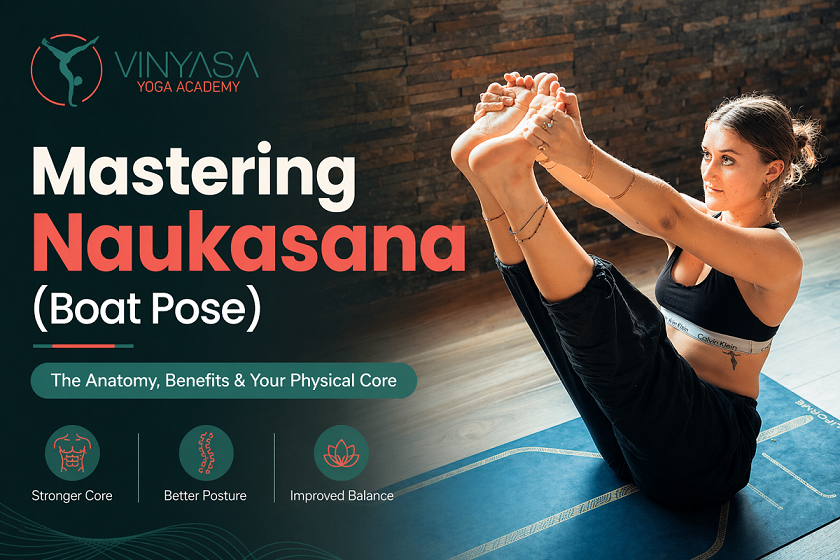
Table of Contents
- What Is Naukasana or Navasana (Boat Pose)?
- Anatomy of Perfect “V”: Finding Your Balance Point on the Sit Bones
- The Primary Movers: Iliopsoas and Quadriceps
- The Secondary Stabilisers: Core
- The Balance Point: Sitting Bones (Not Tailbone)
- How to Perform Boat Pose with Perfect Form? (Step-By-Step)
- Seated Navasana: Full Expression
- Supine Naukasana:
- What Boat Pose Actually Does To Your Body/Core?
- 12 Science-Backed Benefits of Naukasana
- Boat Pose & Yogic Philosophy
- Naukasana Variations: Beginner To Advanced
- 1. Ardha Navasana, or Half Boat Pose (Beginner–Intermediate)
- 2. Supine Naukasana, or Prone Back-Bending Version (Beginner–Intermediate)
- 3. Eka Pada Navasana, or One-Leg Boat Pose (Intermediate)
- 4. Navasana with Twist, or Parivrtta Variation (Intermediate–Advanced)
- 5. Dynamic Navasana, or Lowering and Lifting (All Levels)
- 5 Common Boat Pose Mistakes Killing Your Progress
- Mistake 1: Holding the Breath
- Mistake 2: Rounding the Lower Back
- Mistake 3: Collapsing the Chest
- Mistake 4: Straining the Neck
- Mistake 5: Skipping the Prep and Going Straight to Full Expression
- Few Preparatory & Counter Poses For Naukasna
- Preparatory Poses
- Counter Poses
- Winding Up
- FAQs – Naukasana (Boat Pose)
- What is the meaning of Naukasana?
- Is Navasana the same as Naukasana?
- Can Naukasana help in reducing belly fat?
- Should my legs be straight or bent while practising Boat Pose?
- Can I practise Boat Pose during pregnancy?
- Who should avoid Naukasana?
Some yoga poses look simple from the outside, but reveal their true depth and demand only when practised for real. Naukasana, also known as Navasana or the Boat Pose in English, is one of those postures as well.
What appears to be basic at first glance soon becomes the test of your strength, control, and balance. First appearing in the 19th-century text Sritattvanidhi under the names Naukasana and Purna Naukasana, it entered modern yoga through Ashtanga’s primary series, where it sits near the midpoint of the sequence.
What Is Naukasana or Navasana (Boat Pose)?
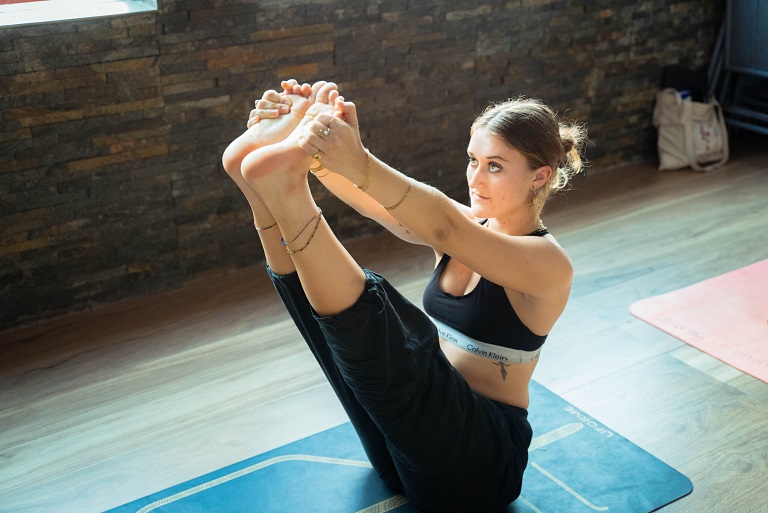
Naukasana or Navasana, also known as Boat Pose, is a seated balancing yoga posture where you lift your legs and chest off the ground while balancing the body on your sitting bones. Your body forms a “V” shape, similar to a boat floating on water.
Its name comes from the two Sanskrit words ‘nauka’ (boat) and ‘asana’ (seat or pose), and carries a deeply rich symbolic load as well. The two Sanskrit names of the Boat pose, Naukasana and Navasana, refer to the same seated balancing pose in the modern yoga context. However, the distinction arises in the traditional practice of Hatha yoga.
Navasana (from Sanskrit nava, meaning boat) is the Ashtanga and modern yoga term for the seated V-shape. It is balanced on the sitting bones, with legs extended at roughly 45 degrees and arms reaching forward parallel to the floor. This is the pose most practitioners mean when they say Boat Pose.
On the other hand, Naukasana (from nauka, also meaning boat) is the traditional Hatha yoga term. In several classical sequences, it refers specifically to the supine version, where one lies face-up on the floor, lifting the chest, arms, and legs simultaneously into a curved boat shape from the back. The body hovers over the mat at both ends, balancing on the sacrum and lower back.
Yoga Journal describes the seated Navasana as requiring “constant muscular effort,” unlike most forward bends. Meaning it is an active strengthening pose, not just a passive stretch.
Anatomy of Perfect “V”: Finding Your Balance Point on the Sit Bones
The Boat Pose is primarily a hip flexor pose disguised as a core exercise. Understanding what is actually major here changes how you train the pose and why it feels wrong sometimes. The anatomy behind Naukasana is as follows:
The Primary Movers: Iliopsoas and Quadriceps
When you lift your legs off the floor in Navasana, the muscle that does the heavy lifting is ‘iliopsoas’ (the deepest hip flexor in the body). These muscles attach from the inner lumbar spine and run down to the lesser trochanter of the femur. The same muscle that enables you to walk, run, climb stairs, and stand upright from a chair. Their job is to bring the thigh toward the torso.
The quadriceps work alongside the iliopsoas, extending the knee to keep the legs straight. If your hamstrings are tight, the quads work harder to resist the pull, which is why straight-leg Boat Pose fatigues the quads faster in practitioners with limited hamstring mobility.
The Secondary Stabilisers: Core
The core muscles are not the primary drivers of the pose. Their job is stabilisation. To hold the pelvis neutral so the iliopsoas can do its work efficiently, preventing the lower back from either collapsing into a deep arch or getting rounded.
When your core stabilisers are weak or disengaged, the pelvis tilts into a posterior tuck (tail tucking under), which transfers the load from the hip flexors directly to the lumbar spine. The lower back is not built to sustain that compressive load. Bending the knees in Ardha Navasana reduces the lever arm, makes it easier to hold the pelvis neutral, and is anatomically smarter for many practitioners.
The Balance Point: Sitting Bones (Not Tailbone)
The instruction to balance on the sit bones (ischial tuberosities) is functional guidance. When you are genuinely balanced on the sit bones, the pelvis is in a neutral tilt, the hip flexors can work freely, and the spine can lengthen.
When you slide back onto the tailbone or sacrum (which happens the moment hip flexors fatigue), the lumbar spine rounds, the chest collapses, and the pose effectively stops working. You are just sitting on the floor with your legs in the air.
The practical test: If you can see your lower back rounding and your chest dropping, you are no longer sitting on the sit bones. Bend your knees, reset on the pelvis, and rebuild from there.
How to Perform Boat Pose with Perfect Form? (Step-By-Step)
Before attempting Naukasana, spend at least ten to fifteen minutes doing a dynamic warm-up like Sun Salutations, Utkatasana (Chair Pose), forward bends, or standing leg work. Try to prepare the hip flexors, hamstrings, and core for what is coming.
Seated Navasana: Full Expression
- Start with your legs extended, spine tall, and thighs pressing into the floor. Rest your hands beside your hips with fingers pointing forward.
- Bend your knees, keeping your feet flat on the floor, at least hip-width apart. Lean back slightly until you feel the weight shift onto your seat bones. This is the moment to find balance before the legs leave the floor.
- On an exhale, draw the navel in and up. Your lower abdomen should feel engaged before anything else.
- Now, lift your feet and pause. If your lower back rounds immediately, stay at this half-boat stage (Ardha Navasana) and build strength before progressing to full-boat.
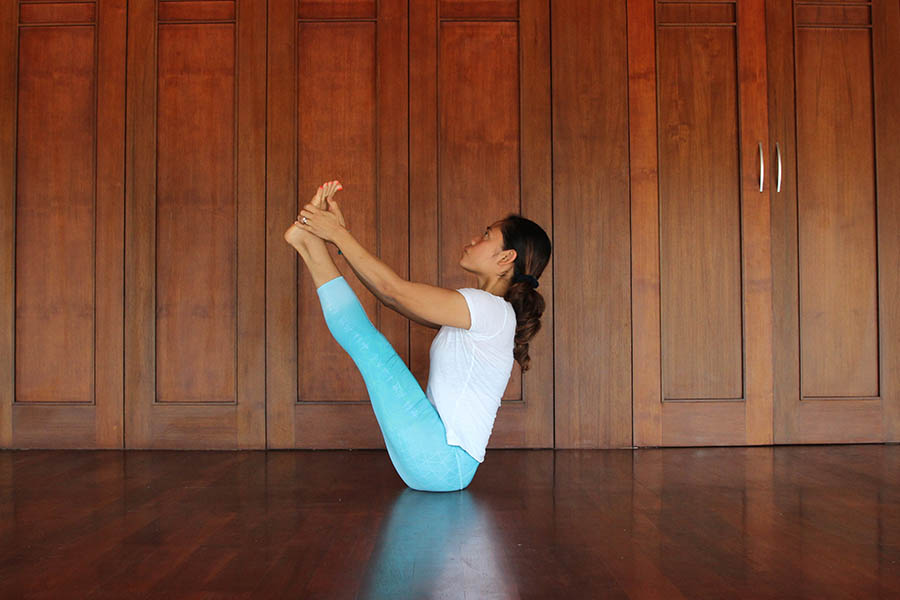
- If your pelvis remains neutral and the chest stays lifted, begin to straighten the legs. Move your knees away from your chest and raise your feet above eye level. Legs at roughly 45 degrees from the floor.
- Extend both arms forward, parallel to the floor, palms facing each other or facing down. Shoulders drawn back and down.
- Try to fix your eyesight forward or slightly upward toward the toes.
- Breathe slowly. Deliberate breathing keeps the nervous system out of fight-or-flight and allows the muscles to work more efficiently.
- Hold for five to ten breaths initially. Lower with balance on an exhale. Do not drop the legs suddenly.
- Rest briefly in Dandasana between repetitions. Repeat two to three times, building duration and quality rather than just struggling through time.
Important: The moment you stop breathing, the abdominal wall locks up, blood pressure spikes, and the pose becomes a fight rather than a practice. If you are holding your breath, the pose is too intense for your current capacity. Bend the knees and breathe first.
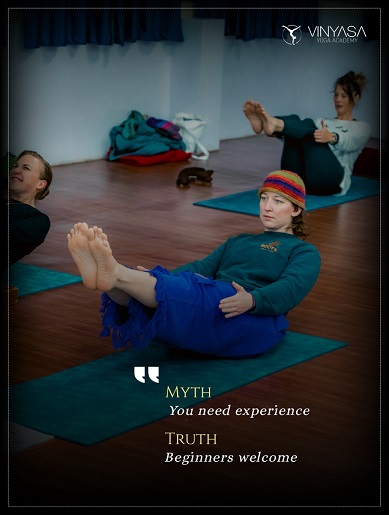
Supine Naukasana:
- Lie on your back, legs stuck together, arms alongside the body.
- On an inhale, lift your chest, head, and both legs off the floor simultaneously, forming a curved boat shape.
- Eyes, fingertips, and toes should align in one diagonal line.
- The body balances on the sacrum.
- Hold for 15 to 30 seconds, breathing steadily, then lower everything together on an exhale.
This variation works the spinal extensors, glutes, and lower back.
At Vinyasa Yoga Academy in Rishikesh, Naukasana, or Navasana (Boat Pose) is taught as part of a coherent physical and philosophical system: sequenced thoughtfully within practice, explored anatomically, and connected to the broader tradition it comes from. If you’re looking for an environment to reach your higher self and practise mindfulness, we welcome you with a whole heart (and all facilities). Namaskaram.
What Boat Pose Actually Does To Your Body/Core?
Here is the layer-by-layer breakdown of what is actually occurring when you hold Naukasana:
- At the hip joint: The iliopsoas (hip flexor muscle) is under sustained contraction, holding the legs at 45 degrees against gravitational pull. Most people in day-to-day lives have a shortened, underactive iliopsoas. Naukasana wakes it up and teaches it to hold a load at length.
- At the spine: The erector spinae muscles work to hold the torso at its leaned-back angle without collapsing. The deep spinal stabilisers contract with the abdominal wall to keep the intervertebral pressure balanced. This is spinal stability training.
- In the nervous system: Sustained isometric effort under controlled breathing activates the parasympathetic nervous system over time. Practitioners who hold the pose while maintaining slow, deliberate breath experience a unique mental settling after the initial intensity. The nervous system learns to remain calm under pressure.
- In the digestive organs: The compression of the abdominal region increases blood flow to the digestive organs upon release. The alternating compression and release created by breathing inside the pose acts as a gentle massage on these organs, stimulating peristalsis and supporting the digestive fire (agni) that Ayurvedic tradition identifies with the Manipura region.
12 Science-Backed Benefits of Naukasana
The table below summarises the 12 proven benefits of Naukasana (Boat Pose), along with what each benefit does mechanically (in the body) and who gains most from it.
| Benefits | What It Does | Who Benefits Most |
| Core Strength | Engages the core muscles and prepares a tough and flexible body | Athletes, desk workers, and beginners building foundations |
| Digestive Health | Compresses the abdominal organs; stimulates the liver, kidneys, and pancreas | Those with sluggish digestion or bloating |
| Hip Flexor Strength | Directly address the body’s deepest hip flexor | Runners, cyclists. Anyone with anterior hip weakness |
| Spinal Stability | Builds the erector muscles that support upright posture and a strong spine | People with lower back discomfort from sitting |
| Manipura Activation | Fires up solar plexus energy, which directly links to confidence, willpower, and focus | Practitioners working on mental power, focus, and determination |
| Stress Reduction | Breathwork and the formation of the pose shift the nervous system state | Balancing on the sitting bones trains the body’s awareness, concentration, and coordination |
| Thyroid Stimulation | Neck extension in Supine Naukasana activates the thyroid region | Those in need of supporting metabolism or hormonal balance |
| Balance & Proprioception | Athletes, desk workers, and beginners are building foundations | Everyone, anyone looking forward to improving core strength and balance |
| Leg Toning | Quadriceps and hamstrings engage to hold the legs extended | Anyone looking to tone thighs alongside core work |
| Pelvic Floor Engagement | The upward lift of the lower abdomen activates the deep pelvic floor muscles | Post-partum recovery (with medical guidance) |
| Mental Discipline | Staying in the discomfort of this pose teaches tolerance and develops mental discipline | Yoga students or anyone building meditation readiness |
| Arm Balance Prep | Builds the core foundation needed for many yoga poses | Practitioners working towards arm balances |
Also Read: 8 Yoga Poses for Bloating and Gas Relief
Boat Pose & Yogic Philosophy
When you practise Naukasana, you are simultaneously the boat and the navigator. The pose asks you to find stability amid effort and instability, to be both the vehicle of your crossing and the one who decides the direction. The idea connects directly to the Manipura Chakra, the third energy center in yogic anatomy, located at the solar plexus, just above the navel.
Manipura Chakra is said to govern confidence, willpower, digestive fire (agni), and the capacity and ability to take action. When it is balanced and active, you feel clear, grounded, and capable. When it is blocked or weak, these physical symptoms often appear: sluggish digestion, fatigue, and a tendency to abandon effort when things get hard.
Naukasana (or Navasana) activates Manipura directly. The compression of the abdominal region, the effort of holding the pose, and the heat generated in the core all concentrate energy in exactly this area. The pose’s physical formation and energetic intention reinforce each other, and the result is both a stronger core and a more resolute mind.
Naukasana Variations: Beginner To Advanced
1. Ardha Navasana, or Half Boat Pose (Beginner–Intermediate)
This version reduces the lever arm significantly, making it accessible for those building initial strength. For many people (especially beginners), it is precisely the right version. Hold it for eight to ten breaths, focusing on the neutral pelvis and active lower belly.
2. Supine Naukasana, or Prone Back-Bending Version (Beginner–Intermediate)
The traditional Hatha version described earlier. The practitioner lies on their back, raising their chest and legs simultaneously. More accessible than the seated version for those with hip flexor weakness and more effective for the posterior chain. Additionally, a useful counterpart to the seated Navasana in the same session.
3. Eka Pada Navasana, or One-Leg Boat Pose (Intermediate)
From Full Boat, lower one leg until it is a few inches from the floor while keeping the other extended at 45 degrees. This creates an asymmetric challenge. The pelvis must resist rotational forces, engaging the lateral stabilisers more intensely. It also develops the unilateral hip flexor strength that is directly relevant to balancing poses.
4. Navasana with Twist, or Parivrtta Variation (Intermediate–Advanced)
This is an excellent Vinyasa sequencing aid and a natural bridge toward Revolved side-body poses. From the full or half boat, extend both arms to one side and rotate the torso while holding the leg position. The obliques and deep spinal rotators work against the resistance of the balance.
5. Dynamic Navasana, or Lowering and Lifting (All Levels)
Rather than holding the static pose, move between Full Boat and a position where the legs hover. This dynamic version builds endurance and trains the eccentric phase of the hip flexors. Often, practitioners struggle to transition smoothly in and out of the pose, despite being able to hold it.
5 Common Boat Pose Mistakes Killing Your Progress
Mistake 1: Holding the Breath
The moment the breath stops, several things go wrong at once: intra-abdominal pressure spikes, the abdominal wall locks, heart rate climbs, and the nervous system receives a signal that it is under threat. Slow, intentional breathing is what makes the difference between a pose that builds capacity and one that just exhausts you.
Mistake 2: Rounding the Lower Back
A rounded lower back in Navasana means one of two things: either the hip flexors have strained and the pelvis has tilted, or the hamstrings are too tight to allow a still pelvis. Just bend the knees to resolve this problem. A neutral pelvis with bent knees is much more productive than a rounded spine with straight legs.
Mistake 3: Collapsing the Chest
When the chest drops and the shoulders round forward, the pose has lost its structural integrity. A slow outward rotation of the shoulders that helps open the chest and allows the ribcage to lift would help. The right chest position also keeps respiratory muscles free while supporting the breathwork described above.
Mistake 4: Straining the Neck
Gazing forcefully up toward the toes creates cervical compression. The gaze should be forward and level with the horizon or slightly upward, not cranked back. If the chin is lifting to look at the toes, the neck is compensating for a chest that is not lifting enough. Fix the chest first; the neck follows naturally.
Mistake 5: Skipping the Prep and Going Straight to Full Expression
Naukasana is an intermediate pose. Attempting full straight-leg expression before the hip flexors and core stabilisers are ready is how most lower back injuries in Boat Pose happen. Spend a few weeks in Ardha Navasana (half boat), building the habit of a neutral pelvis, an active lower belly, and steady breath.
Few Preparatory & Counter Poses For Naukasna
Preparatory Poses
Here are a few yoga poses that work best as warm-up or preparatory poses for Navasana:
- Dandasana (Staff Pose): The immediate predecessor to Naukasana. Sitting upright with legs extended. If Dandasana itself feels effortful (a common experience), the hip flexors and hamstrings both need more work before Navasana.
- Paschimottanasana (Seated Forward Bend): Lengthens the hamstrings that, when tight, cause the pelvis to tuck under in Navasana. Regular practice of Paschimottanasana removes one of the most common structural obstacles to a clean Boat Pose form.
- Utkatasana (Chair Pose): It involves standing with a seated-like squat that engages the iliopsoas, quadriceps, and spinal extensors simultaneously. It is an excellent hip flexor activation warm-up that teaches the same muscular relationship required in Naukasana.
- Setu Bandhasana (Bridge Pose): The supine backbend develops glutes, hamstrings, and spinal extensors. Practitioners who only train the front of the body in Boat Pose develop strength imbalances. Bridge Pose helps prevent this.
Counter Poses
A few counterposes to the Boat Pose (Navasana or Naukasana) are the following:
- Apanasana (Knees-to-Chest Pose): This pose decompresses the lumbar spine and releases the hip flexors from their sustained contraction in Navasana. Do this immediately after any version of Boat Pose. It hardly takes thirty seconds to perform this pose, and the benefit of doing this is huge; it helps prevent hip flexor soreness.
- Supta Baddha Konasana (Reclining Bound Angle): The passive hip opening in this pose releases the adductors and inner groin that work as stabilisers during Navasana. The reclining position lets the lower back decompress fully. Hold it for two minutes or longer.
- Balasana (Child’s Pose): A full restorative spinal counter to the neutral spine effort of Navasana. The gentle pressure of thighs on the abdomen continues to stimulate the digestive organs while the lower back stretches passively. It’s also a parasympathetic reset, i.e., the opposite nervous state from the effortful hold of the Boat Pose.
Winding Up
What Naukasana or Navasana (Boat Pose) ultimately teaches is simple but takes time to digest. It is one of those rare yoga poses that reveals something true about your body every time you practise it.
The core lesson behind the Boat Pose is: Strength is not about forcing a shape. It is about learning to stay present in effort, to breathe inside discomfort, and to build the foundation layer by layer rather than chasing the final expression before the body is ready.
This principle of consistency over intensity and foundation before peak is what traditional yoga training has always prioritised. When you understand why the pose is the way it is, you stop fighting it. That is when the real shift begins.
FAQs – Naukasana (Boat Pose)
What is the meaning of Naukasana?
Nauka means boat, and Asana means posture in the Sanskrit language. In this pose, the body balances on the sit bones and forms a “V” shape, which resembles a boat.
Is Navasana the same as Naukasana?
Yes, Navasana and Naukasana are often used interchangeably and largely refer to the same asana. While “Navasana” is common in modern yogic contexts like Ashtanga, “Naukasana” is frequently used in traditional Hatha Yoga.
Can Naukasana help in reducing belly fat?
While it does not spot-reduce fat, regular practice tones the abdominal muscles and stimulates the digestive organs, which boosts metabolism and aids in weight management.
Should my legs be straight or bent while practising Boat Pose?
A straight back is more important than straight legs. If you cannot keep your spine upright with straight legs, bend your knees until your shins are parallel to the floor.
Can I practise Boat Pose during pregnancy?
No, it is generally contraindicated during pregnancy, especially in the later stages, due to the intense pressure it places on the abdomen.
Who should avoid Naukasana?
Individuals with leg, abdominal, or spine injuries should avoid this pose. Try not to practise this pose if you have low blood pressure, asthma, any heart conditions, or severe migraines. Skip it during the first two days of your period or if you have recently had an abdominal surgery.