Online Yoga Teacher Training: Comparison, Hours, Curriculum, Benefits & Drawbacks
Table of Contents
- What Is Online Yoga Teacher Training, Really?
- Online vs In-Person Teacher Training: Honest Comparison
- What’s The Reason People Choose Online Teacher Training?
- What Does Online Teacher Training Involve?
- What Do You Actually Learn in a Quality Online YTTC?
- Strict Yoga Alliance Guidelines for Online Yoga Courses
- What Are The Honest Drawbacks And How to Work Around Them?
- Who Online Teacher Training Works Best For?
- What to Look for When Choosing an Online Teacher Training Course?
- The Certificate Question Everyone Asks
- How to Do Well in an Online Yoga Teacher Training Course?
- Online Teacher Training at Vinyasa Yoga Academy
- The Bottom Line
- Frequently Asked Questions About Online Yoga Teacher Training
- Is online yoga teacher training recognised by Yoga Alliance?
- How long does a 200-hour online yoga teacher training take to complete?
- How much yoga experience do I need before starting an online YTT?
- Can I teach professionally after completing an online yoga teacher training?
- What is the difference between a self-paced online YTT and a live cohort online YTT?
- What should I look for in an online yoga teacher training curriculum?
Quick Summary
Here, we cover how yoga training online works, what it demands from you, what you genuinely gain from it, where people tend to fall short, and the exact questions to ask before picking a programme.
Whether you’re exploring yoga teacher training certification online, looking into subject-area teaching credentials, or just figuring out if remote training is worth your time and money, this one’s worth reading all the way through.
Physical postures are a beautiful but tiny part of a much greater path. True yoga is a complete way of living. It is the art of mastering how you manage your energy, how you find balance, and how you remain beautifully anchored in peace amidst a changing world.
– Guru Yogi Vishnu Panigrahi
What Is Online Yoga Teacher Training, Really?
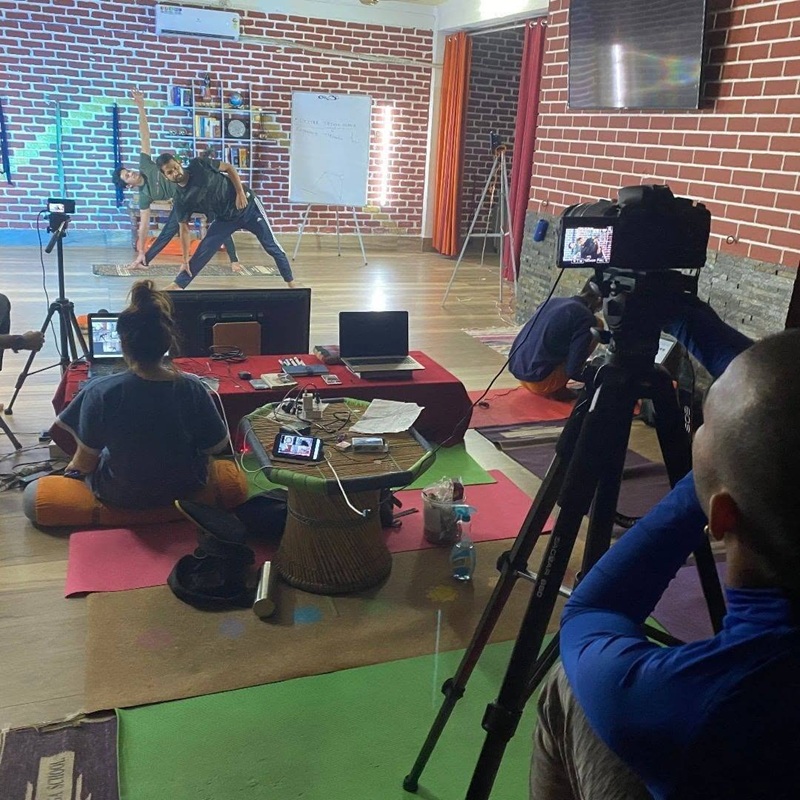
Online yoga teacher training is a structured program that prepares you to teach yoga through digital learning instead of a physical classroom.
A Best online yoga teacher training course comprises:
- Pre-recorded lessons on sequencing, asana, anatomy, and philosophy
- Live sessions with your trainer and batchmates over video call
- Written assignments, reflective journaling, and exams
- Practice teaching (where you teach and get feedback on your teaching)
- Mentorship from experienced teachers
Point to Remember: The big difference between a good online YTTC and a bad one comes down to the last two points. Without them, you’re not really being trained to teach. You’re just watching someone else teach.

Online vs In-Person Teacher Training: Honest Comparison
Many practitioners, especially beginners, ask this a lot. And the honest answer is that neither is better. They’re different, and different things matter differently for people.
| What You’re Comparing | Online YTTC | In-Person YTTC |
| Flexibility | Study on your own schedule | Fixed daily schedule, residential |
| Cost | Significantly lower (often 60-80% less) | Higher (includes travel, stay, food) |
| Hands-on adjustments | Hands-on adjustments | Regular, direct physical feedback |
| Certificate recognition | Yoga Alliance credential | Yoga Alliance credential |
| Community | Built through live calls and group cohorts | Deep bonds, shared space |
| Pace | Usually self-directed or cohort-based | Intensive, full-time |
| Suits best | Working professionals, parents, remote learners | Those who can take time off, prefer physical immersion |
What’s The Reason People Choose Online Teacher Training?
Let’s skip the usual “flexible! affordable! convenient!” opener that every website seems to copy from the same idea.
The truth is, most people who sign up for online yoga teacher training aren’t doing it because it’s the easier path. They’re doing it because their life doesn’t pause for them to take a month off and dive into a practice somewhere.
They work full-time, have families and responsibilities. They live in towns where the nearest reputable yoga school is a six-hour drive away. Or they’ve already been teaching yoga, wellness, school subjects, and need a recognised credential to open the next door.
Online yoga teacher training courses let you build a professional qualification around your actual life. But, don’t you think ‘when done well’ is doing a lot of heavy work in the above sentence? That’s what we’re going to talk about here.
What Does Online Teacher Training Involve?
Before anything else, an online yoga teacher training course helps you know what you’re getting into. Most courses online fall into one of these three forms:
- Live Cohort-Based (synchronous): You join scheduled video sessions with a trainer and a group of peers. There’s structure, accountability and real-time feedback. It feels much closer to an in-person training.
- Self-Paced (asynchronous): You get access to video lessons, readings, assignments and assessments, and you work through them on your own schedule. No fixed class times. Great for discipline-heavy learners.
- Blended or Hybrid: Most well-structured online yoga training courses are a mix of both. You complete self-paced modules during the week and join live calls for Q&A, practice teaching or community time.
For multistyle yoga programmes, like the ones offered here at Vinyasa Yoga Academy, a blended format tends to produce better outcomes than purely self-paced study. Yoga teaching is about how you hold a room, how you read a student, and how you cue with your voice. That doesn’t develop by watching videos alone.
What Do You Actually Learn in a Quality Online YTTC?
A proper 200 hour online yoga teacher training covers the same core areas as an in-person program. Yoga Alliance USA, which sets the standards for certified yoga schools worldwide, requires every RYS (Registered Yoga School) to meet its Enhanced Common Core Curriculum standard (teaching) hours:
| Educational Category | Minimum Hours Required (For 200-hr YTTC) |
| Techniques, Training & Practice | 75 hours |
| Anatomy & Physiology | 30 hours |
| Yoga Humanities | 30 hours |
| Professional Essentials | 50 hours |
| Elective Hours | 15 hours |
Beyond the hours, a quality programme builds three things in you:
1. Knowledge
This is the academic layer of philosophy, anatomy, history, and methodology. In yoga training, this means diving into the principles behind postures, how breath connects to movement, the yogic texts that shape modern practice, and how the body actually works.
2. Practical Skills
You can’t just watch a video and call yourself a teacher. You need to practise cueing, sequencing, and adjusting your tone when something isn’t landing. Strong programs incorporate this deliberately. They will ask you to record yourself teaching and to set up practice sessions with real learners.
3. Community and Mentorship
This one is undervalued, and it’s often the first thing online programmes drop to cut costs. Learning to teach is partly about being seen. High-value online yoga courses build this in through small group calls, mentorship hours, peer teaching, and feedback sessions. Look for it when you’re comparing yoga teacher training courses online in India or globally.
Strict Yoga Alliance Guidelines for Online Yoga Courses
A minimum of 15% of the total program (at least 30 hours) must be delivered through sequential learning, where students and Lead Trainers interact online in real-time.
Students in an online RYS must be actively assessed and successfully pass a core competency evaluation (covering anatomy, philosophy, and live practice teaching) to earn their completion certificate.
What Are The Honest Drawbacks And How to Work Around Them?
Any piece that claims online yoga training is perfect is trying to sell you something. Below is a list of what is truly harder in the online training format. Remember that none of these are reasons to avoid online training. They’re just things to prepare for, honestly.
1. Physical Feedback is Limited
In yoga, a hands-on adjustment tells a student something in seconds that ten verbal cues can’t. Online, you lose that. Good courses compensate with high-quality video assessment, detailed cueing coaching, and encourage trainees to practise in-person teaching with friends or local, nearby classes during the training.
2. Self-Discipline is Everything
With no class to show up to, the learning sits entirely on you. This is where people drop out, not because the programme is bad, but because life happens and there’s no external pressure to keep showing up. If you know you need structure, choose a part-time/cohort-based format.
3. The Community Feels Different
There’s something about being in a room together, eating lunch together, practising side-by-side that builds a particular kind of bond. Online yoga cohorts can be quite warm and supportive, but they require more intentional effort from both the programme and the student to create that connection.
4. Screen Fatigue is Real
Spending hours on video calls for your training, on top of a full working day, is draining. Sustainable programmes are designed with this in mind, and they don’t overload you with live hours. They space things out and use recorded content when live interaction isn’t necessary.
Who Online Teacher Training Works Best For?
The practice of yoga brings us back to the centre. Our mission is simple: to help a searching soul explore their true nature and attain the eternal peace within.
– Guru Yogi Vishnu Panigrahi
Not everyone does equally well in an online learning environment. The online format suits people who:
- Already have a solid, consistent personal practice (at least 6 months to 1 year is ideal)
- Can set aside regular, dedicated study time each week
- Are self-motivated and don’t need external pressure to get things done
- Have clear reasons for wanting the qualification; the “why” keeps you going
- Live somewhere where in-person access to quality training is limited or expensive
- Are working, parenting, or juggling life while trying to grow in this direction
It can be harder for people who are brand new to yoga, who learn best through touch and physical demonstration, or who need the social energy of a classroom to stay engaged and committed. Knowing what kind of person you are is just useful self-knowledge before you invest.
What to Look for When Choosing an Online Teacher Training Course?
From life-changing promises to prices that sound too good to be true, we admit there’s a lot of noise in this space. So, here’s what actually matters in an online yoga teacher training course:
1. Accreditation & Recognition
For yoga, this means Yoga Alliance registration (the school should be a Registered Yoga School). For broader yoga teacher certification, look for programs accredited by recognised educational bodies in your region. An RYT-200 or RYT-500 credential from a Yoga Alliance RYS is the global standard and is recognised by institutions and employers internationally.
2. Live Contact Hours
A purely pre-recorded course is better for fast content delivery, not skill development. Ask specifically: how many live sessions are included? What’s the format? Can you access recordings if you miss one?
3. Mentor Feedback on Your Teaching
Ask the school if anyone will actually watch you teach. Or will you get written or recorded feedback? And who gives it, the lead trainer or someone unrelated to the curriculum?
4. Curriculum Depth & Scale
For a 200-hour yoga teacher training, Yoga Alliance requires specific minimum hour commitments (as mentioned above). For any school that can’t show you how its hours break down, you shall question more.
5. Graduate Results
Real feedback from real people is worth more than any marketing copy. Speak with graduates. Ask what they’re doing now. Ask if they felt ready to teach after completing the program.
6. Refund & Enrolment Policies
Know exactly what happens if you need to pause or cancel your course midway or at any time after enrolment.
The Certificate Question Everyone Asks
One of the most common searches around online yoga teacher training is, ‘Will my certificate be taken seriously?‘ The honest answer is that it depends on the programme’s accreditation and who you’re showing the credential to.
For yoga, a certificate from a Yoga Alliance Registered Yoga School carries the same weight whether you earned it online or in person. Studios and gyms that ask for Yoga Alliance credentials often don’t distinguish between the two formats. What is crucial is the school’s registration status, not the delivery method.
Requirements for formal school teaching differ significantly from one country or state to another. In many places, online alternative certification programs are now accepted for licensure, provided they meet the state board’s specific requirements. This needs to be validated for your specific location before you enrol anywhere.
An honest note: The yoga industry, in particular, is self-regulated. Yoga Alliance registration is voluntary, not government-mandated. Some studios don’t require it at all. Others require it particularly. Know the scenario of the place where you want to teach before you invest.
How to Do Well in an Online Yoga Teacher Training Course?
People who complete online teacher training programmes effectively tend to share a few habits. After years of training teachers, both physically and online, here’s what we’ve noticed about the students who come out honestly ready to teach:
1. They Treat Training As If It Were a Job
They block specific hours in the week for study, and don’t wait to feel inspired. They show up anyway.
2. They Practise Teaching Early and Often
Long before the course requires them to, they try to lead people through movements, record themselves, and analyse the recordings. It’s effortful and uncomfortable. But it’s also how you reach excellence.
3. They Engage With the Community
They show up to optional calls, feedback or Q&A sessions. They stay active in the group and offer advice to their peers. They take the most out of what they had put in.
4. They Connect Theory to Practice Daily
They don’t separate “studying” from “doing.” They step onto their mat or into their self-practice with the week’s concepts in mind.
5. They Ask For Help Before They Drown
They ask the mentor when a concept isn’t landing. They reach out when they fall behind. Online yoga courses almost universally have some system to support the students who use it to do better than those who quietly struggle alone.
Online Teacher Training at Vinyasa Yoga Academy
At Vinyasa Yoga Academy, our online yoga teacher training is put together by teachers who have been teaching in the birthplace of yoga for years.
– Guru Yogi Vishnu Panigrahi
At Vinyasa Yoga Academy (an RYS 500), our online teacher training is built around the belief that what you learn isn’t limited by where you learn, but how you’re supported while learning.
Our 200, 300, and 500 Hour Online Yoga Teacher Training courses include live sessions with experienced senior teachers (E-RYT-certified), structured peer teaching circles, detailed feedback on your actual teaching videos, and a community of practitioners from around the world who genuinely show up for each other.
Whether you’re seeking a 200-hour YYT certification to begin your yoga teaching path or a 300-hour advanced yoga training to deepen what you already offer, our online courses are structured to make you a real teacher.
The Bottom Line
An online yoga teacher training isn’t a shortcut; it’s a bridge. By combining the profound, authentic wisdom of traditional lineages with Yoga Alliance’s strict modern standards, you get a world-class education right from your living room. You don’t need a plane ticket to Rishikesh to transform your practice; you just need the willingness to step onto your mat.
Ready to start your journey? Explore our fully certified, flexible online YTTCs today and begin your journey to finding your voice as a teacher.
Frequently Asked Questions About Online Yoga Teacher Training
Is online yoga teacher training recognised by Yoga Alliance?
Yes. As long as your school holds RYS (Registered Yoga School) status with Yoga Alliance, you can apply for your RYT-200 credential after completing the 200-hour yoga teacher training.
How long does a 200-hour online yoga teacher training take to complete?
Depends on the course arrangement and how much time you commit each week. Most self-paced programs can be completed in 3 to 6 months. Some allow up to a year. Cohort-based programs typically run 4 to 6 months with a set schedule.
How much yoga experience do I need before starting an online YTT?
You don’t need to be advanced. But you do need to know what yoga feels like from the inside before you try to help others find it. If you’re brand new to yoga, it is advised to spend some time building a practice first, then enrol in an online YTTC to strengthen it.
Can I teach professionally after completing an online yoga teacher training?
Yes. Studios, gyms, wellness centres, and online teaching platforms hire teachers with Yoga Alliance credentials, regardless of whether their training was online or in person. What matters is your credential, the school’s registration, and most importantly, your ability to lead a class.
What is the difference between a self-paced online YTT and a live cohort online YTT?
Self-paced programs give you access to content that you work through on your own timeline with no fixed class times. A cohort-based program runs with a group, i.e., you join scheduled live sessions together and progress through the curriculum at the same pace.
What should I look for in an online yoga teacher training curriculum?
At minimum, the curriculum should cover asana technique and sequencing, pranayama and breathwork, anatomy and physiology, yoga philosophy and ethics, teaching methodology, and supervised practice teaching.
This article is for general information and is not medical advice. If you have a respiratory or heart condition, are pregnant, or are unsure whether these practices suit you, please speak to your doctor before beginning.