Reiki Healing: What It Is, How It Works, and Why People Are Turning to It

Table of Contents
- Quick Summary
- What Is Reiki Healing?
- Reiki Healing Foundation: Where Did It All Start?
- What Is Reiki Healing Good For?
- How Does Reiki Healing Actually Work?
- Reiki Healing Benefits: What People Actually Experience?
- 1. Stress and Anxiety Reduction
- 2. Better Sleep
- 3. Emotional Release and Mental Clarity
- 4. Pain Management Support
- 5. Support During Illness or Recovery
- 6. Spiritual Connection
- Reiki Healing Symbols: The Language of Energy
- Reiki Healing Stones and Crystals
- Reiki Healing Course: What to Look for?
- How to Learn Reiki Healing: The Three Levels
- Level 1: First Degree (Shoden)
- Level 2: Second Degree (Okuden)
- Level 3: Master Level (Shinpiden)
- Pranic Healing vs Reiki: What’s the Difference?
- Reiki Healing in India: Growing Roots in Ancient Soil
- Wrapping Up
- Frequently Asked Questions About Reiki Healing
- What is the definition of Reiki healing?
- How long does it take to become a complete Reiki practitioner?
- Can Reiki be combined with yoga?
- What happens during a Reiki healing session?
- Can Reiki be done online or at a distance?
- Do I need to believe in Reiki for it to work?
- Is Reiki healing proven scientifically?
There’s a moment many people describe after their first Reiki session as a kind of stillness they hadn’t felt in years. Not sleep or numbness. Just quietness. As if the background noise of strain had been turned all the way down. The Reiki experience is hard to put into words, which is probably why Reiki healing is both widely talked about and widely misunderstood.
Whether you’re looking to try a session, take a course, or just understand what this practice actually involves, this piece is for you. No technical or mystical overload. Just clear, honest information about one of the oldest energy-healing practices still in use today.
Healing is simply the return of life force to its rightful flow.
– Guru Yogi Vishnu Panigrahi
Quick Summary
Reiki healing is a Japanese energy healing practice where a trained practitioner channels life force energy through their hands to help the patient’s body relax, recover, and rebalance. It works on the idea that blocked or low energy causes stress, illness and emotional heaviness, and that restoring that flow helps the body heal itself.
Here we cover everything: Reiki healing definition, history, how sessions work, real benefits people experience, healing symbols and stones, how it compares to pranic healing, how to learn it, and what a Reiki healing course in India looks like. There’s also a full FAQ section at the end covering the most common questions people search.
What Is Reiki Healing?
Reiki (pronounced ‘ray-kee’) is a Japanese healing technique based on the idea that the human body has a life force energy running through it. The word itself comes from two Japanese words, ‘Rei‘, meaning ‘universal’ or ‘higher power’, and ‘Ki‘, meaning ‘life energy’. So, Reiki healing, by definition, is the practice of channelling universal life energy to support recovery in the body, mind, and emotions.
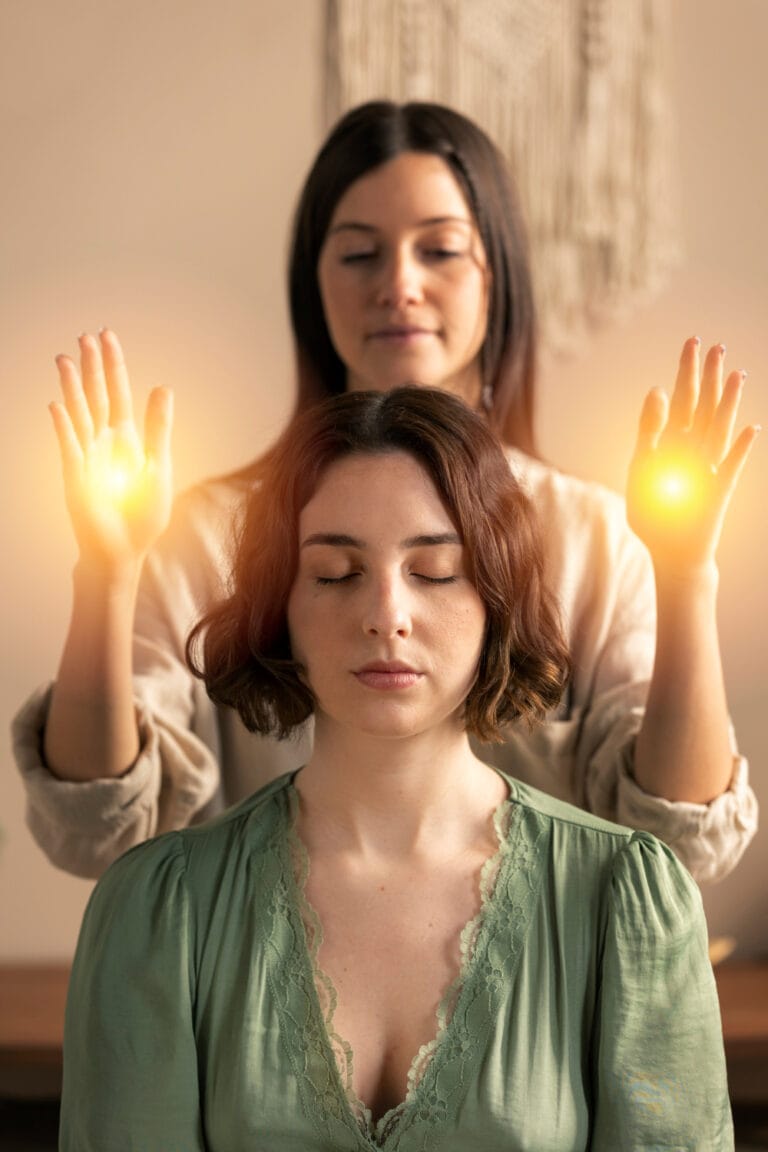
The same concept exists in other traditions under different names. In yoga, it’s prana. In Chinese medicine, it’s chi or qi. A Reiki practitioner channels this energy through their hands (yes), either by lightly touching specific areas of the body or hovering above them with the intention of restoring balance and promoting the body’s natural ability to heal.
At its core, Reiki healing is about energy. The belief that the human body isn’t just bones, tissue, and organs. It’s a field of energy that can get congested, worn out, or thrown off balance.
– Guru Yogi Vishnu Panigrahi
Reiki Healing Foundation: Where Did It All Start?
Reiki, as we know it today, was developed in the early 1920s by a Japanese man named Mikao Usui. He was more of a spiritual seeker who spent years studying theology, meditation, and healing practices.
In 1922, after 21 days of fasting, praying, and meditation on Mount Kurama, Usui reportedly experienced a profound awakening and a mystical experience that gave him both the understanding and the ability to heal using energy. He crafted a structured system of teachings and began training students.
One of his students, Dr. Chujiro Hayashi, further refined the hand positions and methods. Later, a Japanese-American woman named Hawayo Takata brought Reiki to Hawaii and eventually to the Western world in the late 1930s. And from there, it spread globally.
The Reiki healing foundation that Usui built rests on five principles that its practitioners are asked to live by:
- Just for today, I will not be angry.
- Just for today, I will not worry.
- Just for today, I will be grateful.
- Just for today, I will do my work honestly.
- Just for today, I will be kind to every living thing.
These are daily reminders that healing involves how we think, feel, and relate to the world around us.
What Is Reiki Healing Good For?
People use Reiki for a wide range of reasons. It works well as a standalone practice and even better when combined with yoga, breathwork, or mindfulness. Here’s how people use Reiki healing:
- Managing everyday stress and burnout
- Supporting recovery from surgery or illness
- Working through grief, anxiety, or emotional stagnation
- Deepening meditation and spiritual practice
- Supporting cancer patients as a complementary care option
- Managing chronic pain alongside conventional treatment
- Sleep issues and fatigue
- General maintenance of physical and emotional well-being
How Does Reiki Healing Actually Work?
From a traditional standpoint, Reiki works by influencing the body’s energy field (sometimes called the aura) and the internal energy centres, known in ancient Indian traditions as chakras. When these are balanced and open, the body and mind function better.
From a modern perspective, researchers have begun looking at Reiki through the lens of biofield science, i.e., the study of electromagnetic and other fields generated by living organisms. While research is still developing, studies have shown Reiki may reduce anxiety, lower heart rate, and support relaxation responses in the nervous system.
During a Reiki session, you lie in your clothes on a table. The practitioner will work through a series of hand positions on or just above your head, chest, abdomen, and limbs, spending a few minutes at each. Sessions typically last 45 to 90 minutes. Many people report feeling warmth, tingling, or deep relief. Some fall asleep. A few do experience emotional releases.
What you feel depends on your own sensitivity and what your body needs at that time.
Reiki Healing Benefits: What People Actually Experience?
Reiki isn’t about leaving reality behind. It’s about paying attention to the energetic, the emotional, and the spiritual dimensions of health that conventional medicine often overlooks.
– Guru Yogi Vishnu Panigrahi
Reiki is neither a cure nor a substitute for conventional medical care. But as a complementary practice, the benefits of Reiki healing, as reported by regular recipients, are consistent and worth knowing.
1. Stress and Anxiety Reduction
Reiki activates the parasympathetic nervous system, the “rest and digest” state, which counteracts the chronic stress response most people live in. After a session, people often describe feeling lighter, calmer, and clearer-headed.
2. Better Sleep
Many people who receive Reiki regularly report that they sleep more deeply. This ties directly to the nervous system response when your body genuinely relaxes, and sleep quality improves.
3. Emotional Release and Mental Clarity
Stored emotions, like grief, anger, or old anxiety, can surface and release during Reiki. The experience can be surprising, but most people find it relieving rather than overwhelming.
4. Pain Management Support
Several hospitals and care centres in the US and UK now offer Reiki as a complementary therapy for patients managing chronic pain or recovering from surgery.
5. Support During Illness or Recovery
Reiki doesn’t treat disease directly. But it can support the body during recovery from illness, surgery, or cancer treatment by reducing tension, improving sleep, and promoting a general sense of well-being.
6. Spiritual Connection
For those inclined towards spirituality, Reiki deepens meditation practice, helps increase intuition, and creates a greater sense of connection to oneself and to something larger, together.
Reiki Healing Symbols: The Language of Energy
As practitioners advance through higher training levels, they’re introduced to Reiki healing symbols. These are sacred geometric and calligraphic symbols drawn in the air or visualised mentally during a session to enhance specific intentions.
The four primary symbols in traditional Usui Reiki are:
- Cho Ku Rei – The power symbol, used to increase energy focus
- Sei He Ki – The mental/emotional symbol, used for clearing emotional blockages
- Hon Sha Ze Sho Nen – the distance symbol, used to send Reiki across space and time (yes, it is used in distant healing sessions)
- Dai Ko Myo – The master symbol, made available at the top level of training
These symbols are like magic spells for focus and intention. A practitioner trained to use them can direct energy with more precision and depth than without.
Reiki Healing Stones and Crystals
Many Reiki practitioners work with healing stones and crystals in their sessions. Popularly called Reiki crystal healing, they combine the energy principles of Reiki with specific vibrational traits associated with different crystals.
Common stones used include:
- Black Tourmaline: Grounding, protection
- Rose Quartz: Emotional healing, heart energy, emotional softness
- Amethyst: Calming, spiritual clarity, connected to intuition
- Clear Quartz: Amplifies energy, clarity; all-rounder
- Citrine: Warmth and confidence, solar plexus energy
During a session, stones may be placed on or around the body at specific energy points (chakra points) while the practitioner works for your healing. The idea is that crystals can help hold and direct energy, making the session more focused.
Reiki Healing Course: What to Look for?
There are a lot of Reiki healing courses out there now, especially online. Some are excellent. Some are average. If you’re ready to learn, here’s what matters when choosing a course:
- Lineage and Certification: Ensure your teacher holds a verifiable lineage. Your teacher should be able to tell you exactly who trained them, and their teacher before that. Legitimate lineages trace back to Usui or one of the major modern masters.
- Attunement Included: The attunement requires a trained, living master present in person or, at a minimum, via a live video session. A pre-recorded YouTube video cannot give you a Reiki attunement.
- Practice Hours: Best Reiki healing courses include supervised practice, not just lectures. You should be practising on real people with feedback before you’re certified to work independently.
- Integration Time: Responsible teachers don’t push you through all three levels in a single go. Level 1 alone deserves several hours of practice before Level 2.
At Vinyasa Yoga Academy, Reiki healing is taught as part of a broader energy healing and wellness framework. We integrate the principles of yogic philosophy with the hands-on practice of Reiki, so students leave with both conceptual grounding and practical skill. Understand the energetic system that makes the practice make sense. Explore us today!
How to Learn Reiki Healing: The Three Levels
Reiki is taught in levels, each building on the last. You cannot simply learn Reiki purely from a book. The attunement (energy transmission) is essential.
Level 1: First Degree (Shoden)
The purpose here is to build a continuous self-practice and to know what your inner energy feels like.
This is where you start. The focus here is entirely on yourself. You learn the history, the five principles, and the basic hand positions. You receive your first attunement, which opens your channels to Reiki energy. And then you practise on yourself daily for several weeks at a minimum before moving to the next level. This stage is about getting to know what Reiki feels like.
Level 2: Second Degree (Okuden)
Most practitioners who work with clients publicly operate from Level 2.
At Level 2, you’re introduced to the Reiki symbols and their uses. You learn how to conduct sessions on others, and you’re taught how to send distant Reiki, which is a practice that allows you to send healing energy to someone who isn’t physically present. This level is for those who want to work in Reiki professionally or deepen their practice significantly.
Level 3: Master Level (Shinpiden)
Becoming a Reiki master is less about status and more about taking responsibility for the lineage and continuing to pass on the teaching. The master level is divided in many lineages into Master Practitioner and Master Teacher. At this stage, you learn the master symbol and are trained to pass attunements to others.
Pranic Healing vs Reiki: What’s the Difference?
Reiki teaches us to become a hollow bamboo, letting the universal life force flow without interference. Pranic Healing calls us to become a master gardener, actively cleansing the aura so vital energy can bloom.
– Guru Yogi Vishnu Panigrahi
People often ask about this because both practices deal with life force energy. Both are non-invasive and a complement to conventional health care. But they’re quite different in approach. The first key difference is touch. Pranic healing is strictly no-touch, while Reiki healing can involve light physical contact.
Pranic Healing, developed by Grand Master Choa Kok Sui, is a no-touch system that uses prana (the Sanskrit equivalent of ‘Ki’) to cleanse and energise the body’s energy field. Practitioners learn to assess the aura for congestion and depletion, then actively cleanse those areas before re-energising them. Pranic Healing is more diagnosis-based in its approach.
Reiki, by contrast, is more intuitive and receptive. The practitioner doesn’t manipulate energy so much as allow it to flow where it’s needed. They act as channels. Also, there’s less active intervention and more trust in the energy flowing where it’s needed.
Some people study both and use them together, which also works well.
Reiki Healing in India: Growing Roots in Ancient Soil
India is a country already deeply connected to energy healing through yoga, Ayurveda, and various tantric and Vedic traditions. So it’s perhaps no surprise that Reiki has found a natural home here.
Reiki healing in India has grown substantially over the last few decades. Cities like Rishikesh, Goa, Mumbai, Delhi, Bengaluru, Pune, and Chennai have active Reiki communities, trained masters, and certification programs. Yoga schools, wellness centres and holistic health practices now often include Reiki alongside asana, dhyana (meditation), and pranayama.
Worth Mentioning: There is an interesting integration taking place in India. Practitioners are increasingly exploring how Reiki blends with traditional yogic practices like chakra healing, sound therapy, and mantra-based meditation.
Wrapping Up
Reiki healing may not be for everyone. But if you’ve been carrying stress for too long, if sleep doesn’t restore your energy, if emotions feel stuck somewhere you can’t quite reach, then it might be worth trying. At minimum, a Reiki healing session is an hour of deep rest. At most, it can be genuinely life-changing. Whether you come to Reiki for stress relief, personal growth, or a deeper spiritual path, what most people find is a practice that embraces your inner self and helps you move past your past.
And if you’re drawn to learning it through a course, the path is clear. Vinyasa Yoga Academy in Rishikesh offers a certified Reiki Healing course, with healers and curriculum rooted in traditional lineage and enriched with yogic principles, for complete beginners and experienced practitioners alike. Contact us today!
Frequently Asked Questions About Reiki Healing
What is the definition of Reiki healing?
Reiki (Ray-kee) is a Japanese energy healing practice that channels universal life force energy through the hands to support physical, emotional, and mental well-being. The word comes from Japanese ‘Rei‘ (universal) and ‘Ki‘ (life energy).
How long does it take to become a complete Reiki practitioner?
Level 1 can be completed in a weekend, but should be practiced for weeks before moving forward. Most people reach a solid Level 2 practice within three to six months. Master level is typically a year or more of serious practice.
Can Reiki be combined with yoga?
Yes, it could be, very naturally. Yoga opens and prepares the body’s energy channels; Reiki healing works directly with them. Practitioners who combine both often find that their meditation deepens and their overall healing work becomes more integrated.
What happens during a Reiki healing session?
You lie in full clothes on a table. The practitioner places their hands on or just above different parts of your body for several minutes at each position. Sessions are usually 45-90 minutes. People are commonly known to feel warmth, tingling, or deep relaxation. Some experience emotional releases. Some fall asleep.
Can Reiki be done online or at a distance?
Yes, this is what distant Reiki is. Using the Hon Sha Ze Sho Nen symbol, Level 2 practitioners can send Reiki to someone anywhere in the world. Many people express strong experiences during distance sessions.
Do I need to believe in Reiki for it to work?
No. Skeptics, too, have reported genuine, shifting experiences. Being relaxed, ready and open helps, but belief isn’t a requirement at all. Although you may believe in it after session.
Is Reiki healing proven scientifically?
Research is still developing. Several studies show measurable Reiki healing benefits, like reduced anxiety, lower heart rate, and improved sleep. But it’s not yet as widely studied as pharmaceutical treatments. However, many health institutions now offer Reiki as an additional therapy based on patient outcomes and safety.
This article is for general information and is not medical advice. If you have a respiratory or heart condition, are pregnant, or are unsure whether these practices suit you, please speak to your doctor before beginning.