






8 Yoga Poses For Fast Neck and Shoulder Pain Relief
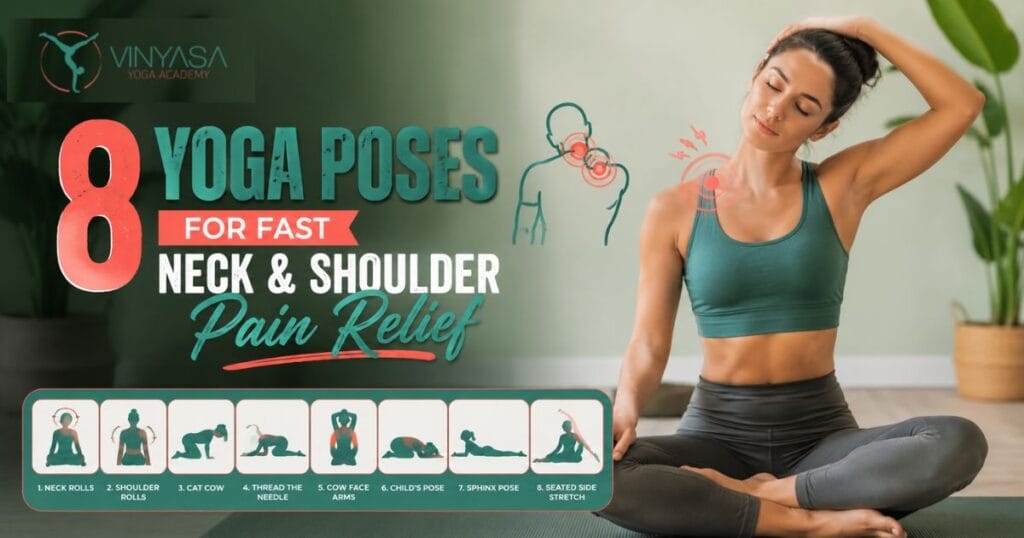
Table of Contents
- The Anatomy Behind Neck and Shoulder Pain
- 8 Best Yoga Poses for Neck and Shoulder Pain Relief
- 1. Marjariasana-Bitilasana | Cat-Cow Pose
- 2. Ardha Matsyendrasana | Half Lord of the Fishes (Seated Twist)
- 3. Parsva Balasana | Thread the Needle
- 4. Garudasana Bhuja | Eagle Arms
- 5. Balasana | Child’s Pose
- 6. Viparita Karani | Legs Up the Wall
- 7. Gomukhasana Bhuja | Cow Face Arms
- 8. Uttana Shishosana | Puppy Pose
- Practical Reference of Yoga Poses by Specific Need
- How Yoga Works on Neck and Shoulder Pain: Three Mechanisms
- 1. Musculoskeletal Function
- 2. Neuromuscular
- 3. Root of Stress
- What to Avoid During Neck And Shoulder Pain?
- 1. Fast-Paced Vinyasa and Ashtanga Sequences
- 2. Deep Backbends
- 3. Skipping Medical Consultation
- Final Reflection
- Frequently Asked Questions
- 1. What are the main causes of neck and shoulder pain?
- 2. How does yoga relieve neck pain when painkillers cannot?
- 3. How long before yoga reduces neck and shoulder tension noticeably?
- 4. Why does neck tension cause headaches?
- 5. Can yoga help with tech neck (neck pain from phone use)?
- 6. What type of yoga is best for neck pain?
“The neck is the bridge between the head and the heart. When it is rigid, nothing flows freely.”
Most people treat neck and shoulder pain the way they treat their morning alarm, which is by trying to silence it. They twist and turn their necks, press on the knot, take something for the pain, and sleep on a different pillow in a different position. The pain fades for a while. Then returns.
The approach of yoga is quite distinct. Not because it has better stretches or ready-to-do asanas, but because it asks a vital question that most miss: ‘Where does this tension actually begin?‘ And the answer is not where the pain lives, but where it originates from.
Here, we’ll help you know the best yoga poses to relieve shoulder and neck pain and understand the real anatomy behind why each pose works and how to practise the same in the right way through yoga for shoulder and neck tension.
The Anatomy Behind Neck and Shoulder Pain
The human head weighs between ten and twelve pounds in its natural, balanced position. But for every inch the head extends outwards from that balanced point, the effective load on the cervical spine multiplies. It happens when you look at screens, drive, or read with your chin lowered. At three inches forward, the neck is managing an equivalent of forty pounds of downward force.
The muscles that respond to this demand are:
| The Upper Trapezius | Spans from the base of the skull across the shoulders |
| The Levator Scapulae | Runs from the upper spinal vertebrae to the inner corner of the shoulder blade |
| The Scalenes | Work constantly to stabilise the head |
When these muscles are chronically overworked, they develop dense, contracted knots, called ‘trigger points’, within the muscle tissue that radiate pain to unrelated areas. This explains why neck pain causes headaches at the base of the skull; why left shoulder pain can be traced back to the cervical spine; and why pain in both shoulders often has nothing to do with the shoulders themselves.
Why did ancient teachers give such careful attention to the neck and upper spine in their practice?
Because, the yogic tradition understood the relationship between the spine, the breath, and the quality of the mind. It describes this region as the gateway between prana (the life force) and the brain. Chronic tension here does not merely cause physical pain. It affects the quality of thought, the steadiness of mood, and the capacity for rest.
8 Best Yoga Poses for Neck and Shoulder Pain Relief
We have carefully selected these poses because each one addresses a specific layer of the problem, from the surface of the skin down to the nervous system itself. They are selected not for being the most popular yoga poses for neck pain, but for their usefulness as effective practices in yoga to relieve neck and shoulder tension. Each is tried and tested by our experienced masters and rooted in yogic science to ensure they deliver true, functional relief.
1. Marjariasana-Bitilasana | Cat-Cow Pose
Targets: Neck and upper back, spinal flexibility and breathing rhythm
What differentiates the Cat-Cow pose from a neck stretch is that the neck in this pose does not get stretched. It becomes the final receiver of the spinal wave that begins in the sacrum area. The vertebrae are decompressed through movement rather than pressure, and the long muscles surrounding the spine begin to let go of the holding pattern that leads to neck stiffness.
How to do Cat-Cow Pose or Marjariasana-Bitilasana?
Begin on all four limbs, with wrists beneath shoulders and knees beneath hips. On an inhale, let the belly be lowered, the tailbone be lifted, and allow the head to rise. Perform as if the movement originates in the pelvis and travels like a wave up the spine.
On the exhale, reverse the same. Curl the tailbone, round the spine upward from the base, and allow the chin to drop toward the chest as the final expression of the movement. Six to ten slow cycles, breath-led throughout.
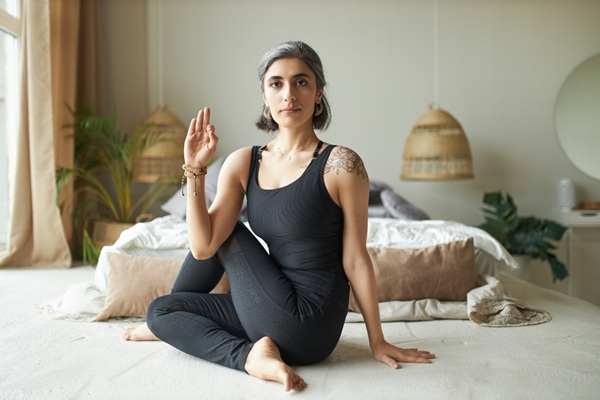
2. Ardha Matsyendrasana | Half Lord of the Fishes (Seated Twist)
Targets: Mid-back twisting, muscles along the spine, shoulder flexibility and neck rotation
Spinal twists are among the most powerful tools for releasing the paraspinal muscles that run the full length of the spine into the neck. It decompresses the joints of the middle section of your back. These are the joints that, when compressed, post-tension upward into the cervical region (neck). The gaze over the shoulder, when done intuitively, restores neck rotation and stability that daily forward-facing positions somehow restrict.
How to do Half Lord of the Fishes or Ardha Matsyendrasana?
Sit with the legs extended. Bend the right knee and place the right foot on the outer part of the left thigh. Ground the left hand behind you. On an inhale, lengthen the spine. This forms the foundation of the twist. On the exhale, rotate the torso to the right, bringing the left elbow to the outside of the right knee.
The neck turns in the end, gazing beyond the right shoulder. The twist originates from the thoracic (middle) spine, not the neck. Hold for five breaths, then release and repeat on the second side.
3. Parsva Balasana | Thread the Needle
Targets: Shoulders, upper back, mid-back twisting, and deep tissue relief between the shoulder blades
The Thread the Needle yoga pose addresses the inter-scapular region, the dense territory between the shoulder blades. This region is one of the most commonly compressed areas in people who sit for long hours. The gentle thoracic rotation involved in the pose brings freshly oxygenated blood to the upper parts of the body, which chronic tension often limits.
How to do Thread the Needle or Parsva Balasana?
From the tabletop level, inhale and lift the right arm toward the ceiling to open your chest. On the exhale, thread the right arm beneath the left one to allow the right shoulder and the right side of the face to settle toward the floor.
The left hand may remain where it is or stretch forward to deepen the opening. Hips stay at level, neither collapsing left nor right. Hold for five to eight breaths. Release on an inhale and repeat on the other side.
4. Garudasana Bhuja | Eagle Arms
Targets: Upper back, lower shoulders, side-neck muscles, and the back of the shoulder joint
Eagle Arms is one of the advanced yoga poses that offers a natural remedy for neck and shoulder pain. It creates a posterior shoulder stretch that is difficult to access through any other movement, making it highly effective in yoga for shoulder and neck tension. The arm-crossing position isolates the shoulder joint and separates the scapulae, directly relaxing the muscles most responsible for the burning tension between the shoulder blades. The mild chin tuck simultaneously lengthens the scalene muscles along the sides of the neck.
How to do Eagle Arms or Garudasana Bhuja?
Seated or standing, extend both arms forward. Bring the right arm beneath the left, cross at the elbows, and attempt to bring the palms together. Or, if that is unavailable, hold opposite shoulders. Lift the elbows to shoulder height while drawing the shoulder blades away from the ears.
Allow a slight lowering of the chin toward the chest. Breathe directly into the space between the shoulder blades to feel it open. Hold for six-seven breaths, then slowly wrap the elbows in both directions before switching arms.
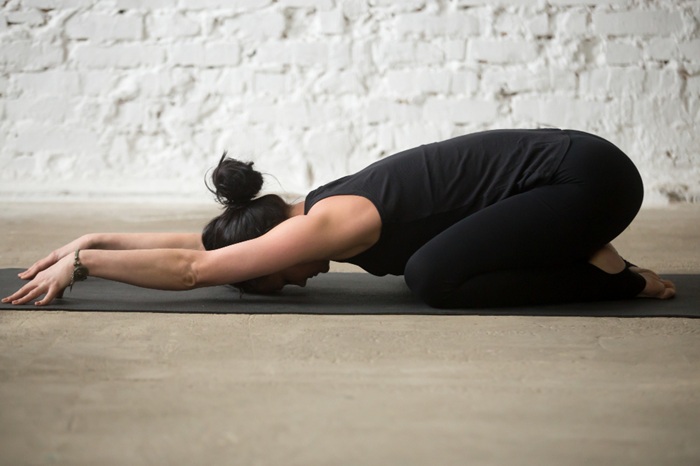
5. Balasana | Child’s Pose
Targets: Upper back, back of the neck, nervous system relaxation and deep breathing
Child’s Pose yoga is often underestimated because it appears to be a passive position. However, this pose is neck pain relief in its most intelligent form, as the body releases itself.
Balasana’s forehead contact with the floor activates the frontal lobe’s parasympathetic response, directly reducing the stress signals in the body. And, the extended spine posture slowly mobilises the neck vertebrae under gravity alone.
How to do Child’s Pose or Balasana?
From a kneeling position, walk with your hands forward and allow your forehead to rest on the mat or on a folded blanket if it does not comfortably reach the floor. Arms may extend forward or rest alongside the body with palms facing up. The spine lengthens with each exhale. Try to remain for ten breaths or longer. There is no correct duration for this pose, only the correct quality of surrender.
6. Viparita Karani | Legs Up the Wall
Targets: Nervous system calm, neck pressure relief, healthy circulation, and total body rest
Legs Up the Wall is the least-utilised yoga pose for shoulder and neck pain, and possibly the most powerful among practices used in yoga to relieve neck and shoulder tension. The half inversion of the body causes the effect of gravity on the cervical spine to reverse. The supported elevated position of the pelvis creates mild traction in the mid and lower-back junction that spreads upward into the neck. These two things are enough to push the body for rest.
However, the benefit of Viparita Karani is that the nervous system, in this position, has very little to manage. It rests. And resting is, for the systematically tense body, a profound act.
How to do Legs Up the Wall or Viparita Karani?
Place a folded blanket or a chair three to four inches from the wall. Sit sideways, then swing the legs up as you lower the back to the floor. The sacrum (triangular bone at the base of the spine) rests on the blanket; the shoulders rest on the floor below it. Palms stay open, and arms rest at the sides. Remain for five to fifteen minutes, breathing naturally.
7. Gomukhasana Bhuja | Cow Face Arms
Targets: Neck-to-shoulder muscle, shoulders, back of the arms, front of the shoulders, and upper back alignment
Gomukhasana Bhuja yoga asana creates an external rotation in the upper arm and internal rotation in the lower arm simultaneously. This results in an uncommon combination that stretches the levator scapulae, one of the primary sources of neck pain, at its attachment point.
Many people discover a significant asymmetry between sides while performing this pose. That asymmetry often correlates exactly with the side where neck pain is more prominent.
How to do Cow Face Arms or Gomukhasana Bhuja?
Being seated comfortably, raise the right arm and bend the elbow, allowing the right hand to fall below the shoulder blades. Bring the left arm behind the back from below, bending the elbow and reaching upward. If the hands meet, allow them to firmly hold each other. If they do not, hold a strap or folded belt between them. Hold for at least five breaths, then switch sides.
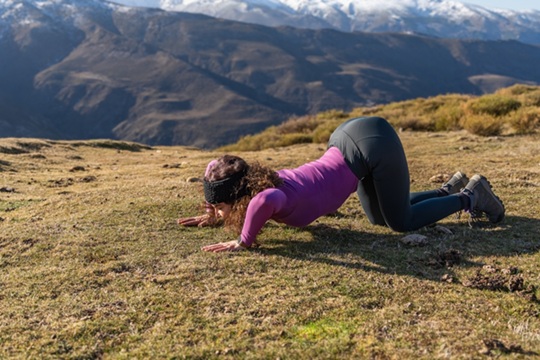
8. Uttana Shishosana | Puppy Pose
Targets: Mid-back flexibility, front of the shoulders, side-chest muscles and chest opening
Puppy Pose is a thoracic spine extension pose that counters the forward rounding that generates neck pain at its source. As the chest sinks and the thoracic spine (lower neck) opens, the muscles whose chronic shortening compresses the neck and pulls the shoulder blades begin to stretch and relax.
How to do Puppy Pose or Uttana Shishosana?
From the tabletop position, bring your hands forward while keeping your hips above the knees. Allow the chest to descend toward the floor as the arms extend. Let your forehead rest on the mat. Do not allow the lower back to collapse; maintain a slight engagement of the abdomen to protect your lower back’s structural core.
Hold for eight to ten breaths, allowing the load of gravity to open the chest and shoulder joints without any muscular effort to assist or resist.
Many practitioners are surprised to find that the Puppy pose yoga, which apparently targets the chest, produces immediate relief for neck pain.
Practical Reference of Yoga Poses by Specific Need
Now that you understand which yoga poses are beneficial for shoulder and neck pain, here’s your brief starting point:
| Your Situation | Recommended Starting Pose | Why |
| Stiff neck on waking | Cat-Cow (Marjariasana-Bitilasana) | Mobilises the cervical spine without any force or weight |
| Between-shoulder-blade tension | Thread the Needle (Parsva Balasana) | Deeply dissolves upper-back tightness |
| Burning in the upper shoulders | Eagle Arms (Garudasana Bhuja) | Releases intense, burning compression |
| One-sided neck pain or stiffness | Cow Face Arms (Gomukhasana Bhuja) | Unlocks painful neck knots |
| Stress-driven neck tension | Child’s Pose (Balasana) | Activates the parasympathetic system, releasing emotionally-held tension |
| Forward head posture, tech neck | Puppy Pose (Uttana Shishosana) | Opens the anterior shoulder (source of forward head posture) |
How Yoga Works on Neck and Shoulder Pain: Three Mechanisms
1. Musculoskeletal Function
A 2025 peer-reviewed study in a musculoskeletal disorders journal established that yoga asanas create measurable glenohumeral joint distraction; for example, they enlarge the space within the shoulder joint itself, softening the musculoskeletal ligament axis that chronic tension had compressed.
2. Neuromuscular
Through sustained, breath-synchronised holds, yoga teaches chronically contracted muscles to receive the signal to release the tension. It is something that force, pressure, massage, or passive stretching often cannot achieve. The muscles learn a new resting state.
3. Root of Stress
The third mechanism is perhaps the most significant and the least discussed. Chronic neck and shoulder tension is one of the most reliable physical signatures of psychological stress. The upper trapezius, in particular, responds to anxiety and emotional load the way a fist responds to threat. Yoga’s power to regulate the nervous system means that it addresses the emotional root of muscular tension, not only its physical symptom.
A randomised controlled trial found that Hatha yoga is not inferior to conventional stretching for pain relief in sedentary office workers with neck and shoulder pain and superior in its long-term effects on mood, functional mobility, and the prevention of recurrence.
What to Avoid During Neck And Shoulder Pain?
Not every yoga pose is therapeutic in the context of neck and shoulder tension. Certain common misalignments can actively worsen the condition, and are worth knowing before you jump to practising in real life.
1. Fast-Paced Vinyasa and Ashtanga Sequences
The head moves quickly through multiple positions in each sun salutation, which can aggravate an inflamed spine, causing the neck and shoulder tension to rise. Speed does not allow the deep stabilising muscles enough time to engage before the next demand arrives. In acute neck pain, restorative yoga, Yin, and Hatha at a limited pace are the appropriate styles to work with.
2. Deep Backbends
Dropping the head all the way back in Cobra, Upward Dog, or Camel pose hyperextends the posterior cervical joints and compresses the facet joints of the neck. For most practitioners with any history of neck tension, the instruction to ‘look up’ in backbends is better replaced with the eyes directed straight or a relaxed gaze.
3. Skipping Medical Consultation
The most important caution of all. If neck pain is severe, sudden, or accompanied by numbness, tingling, or radiation extending down the arm, it is not a situation for self-directed yoga practice. It requires a proper clinical assessment or at least a doctor’s enquiry before indulging in any kind of movement.
Final Reflection
The neck and shoulders carry more than the weight of the head. They carry the weight of the unresolved conversation, the hours of concentration, and the sustained vigilance that modern life asks of us without pause. The fact that they ache is not a malfunction or disorder. It is an honest signal.
There is a quality of attention that separates rehabilitative yoga from exercise, and it cannot be taught through written instructions alone. Yoga, in addressing the ache, invites you to build a different relationship with your body. One where you listen before the pain becomes the only language available. The poses mentioned above are doorways into that relationship. What you find once you walk through them belongs entirely to you.
At Vinyasa Yoga Academy, our masters have worked with hundreds of individuals from all walks of life and geography. In our Yoga Teacher Training courses and Retreats, we offer a holistic understanding and experience of all yoga asanas across different styles of yoga, helpful for your internal and external transformation and health. Whether dealing with back pain, neck pain, lost mind, decreased energy, or burnout, we welcome you to take a step for yourself with us in Rishikesh and Bali.
Frequently Asked Questions
1. What are the main causes of neck and shoulder pain?
Forward head posture from screen use is the dominant cause. Chronic psychological stress, poor sleeping posture, and habitual one-sided movements such as carrying a bag on one shoulder are also significant contributors.
2. How does yoga relieve neck pain when painkillers cannot?
Painkillers hide the sensation of pain without addressing the mechanical and neurological conditions that create it. Yoga works at the level of cause, releasing excessively strained muscles, restoring mobility to restricted spinal joints, improving the postural patterns, and regulating the nervous system that keeps tissues contracted under stress.
3. How long before yoga reduces neck and shoulder tension noticeably?
Acute tension, or the kind that accumulates over a single working day, can respond within a single well-targeted session. For chronic neck and shoulder pain that has been present for weeks or months, consistent practice over four to six weeks is required to typically reduce pain intensity and frequency of recurrence.
4. Why does neck tension cause headaches?
The upper trapezius and the suboccipital muscles at the base of the skull are among the most common sources of headache. When these muscles are chronically contracted, they compress the nerves that run from the base of the skull over the scalp, producing the infamous headband or base-of-skull headache that many people experience.
5. Can yoga help with tech neck (neck pain from phone use)?
Yes. Tech neck, the forward head posture produced by looking down at screens, creates conditions similar to the other causes of stress and tension. Puppy Pose, Cat-Cow pose, and any yoga pose that opens the neck joints and draws the shoulder blades toward the midline directly combat the postural pain that tech neck produces. Consistent practice is the key variable.
6. What type of yoga is best for neck pain?
Slow Hatha yoga, Yin yoga, and Restorative yoga are the most suitable styles for anyone with active neck or shoulder pain. These types of yoga prioritise long holds, supported positions, and rest-response activation, all of which create the conditions for complete muscle release.