








7 Benefits Of Yoga Nidra: Refresh Your Spirit, Rest Your Soul
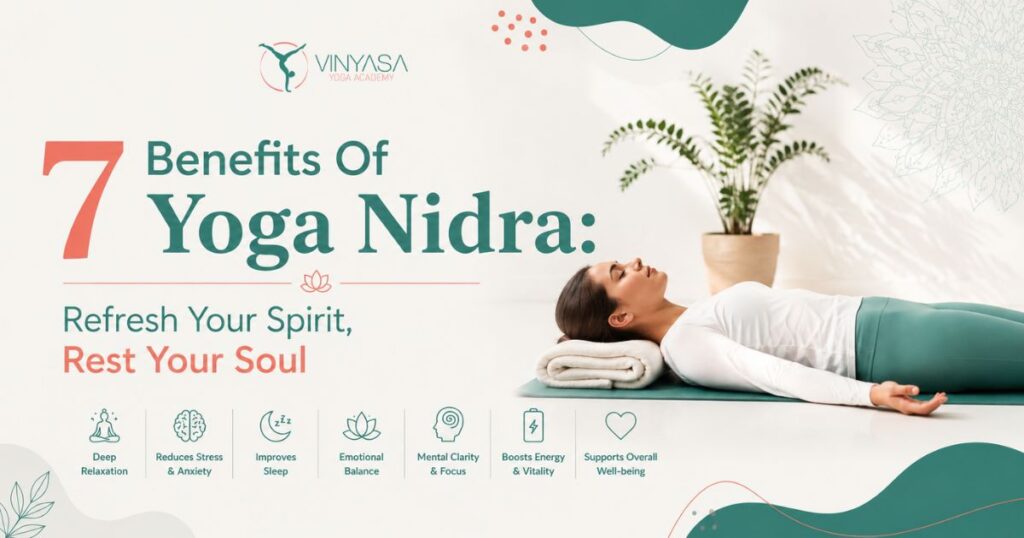
Table of Contents
- What Is Yoga Nidra, Really?
- Yoga Nidra vs. Sleep: What Is the Difference?
- The Key Difference
- The 7 Benefits of Yoga Nidra (That Actually Matter)
- 1. It Resets Your Nervous System, Not Just Your Mood
- 2. Sleep Quality Transforms, Not Just Sleep Duration
- 3. Anxiety is Reduced from the Source, Not the Surface
- 4. Concentration and Creative Thinking Sharpen
- 5. Emotional Patterns Become Visible and Workable
- 6. Physical Recovery Accelerates
- 7. Spiritual Clarity Without Doctrine
- What Is Vishnu Yoga Nidra? (Special Note on Lineages)
- How to Do Yoga Nidra: Your Practical Starting Point
- What Happens in a Yoga Nidra Session: Step-by-Step
- Step 1 | Physical Settling
- Step 2 | Sankalpa (Intention)
- Step 3 | Rotation of Consciousness
- Step 4 | Pairs of Opposites
- Step 5 | Visualisation
- Step 6 | Return of Sankalpa
- Step 7 | Externalisation
- How to Teach Yoga Nidra: What Sets The Standard?
- Yoga Nidra Side Effects: What to Expect and What Is Normal?
- Winding Up: Where to Begin Yoga Nidra?
- Frequently Asked Questions About Yoga Nidra
- What is Yoga Nidra for beginners? Where do I start?
- What are the benefits of Yoga Nidra?
- How is Yoga Nidra different from Savasana?
- Can I do Yoga Nidra for deep sleep if I have insomnia?
- How long should a Yoga Nidra session be?
- What is the best time to practise Yoga Nidra?
- How many times a week should I practise Yoga Nidra?
- What is the difference between Yoga Nidra and meditation?
Most of us cannot remember the last time we felt really, deeply rested. Not just ‘not tired’ but actually restored. We sleep for hours but wake up still tired. We take breaks, but our minds never stop. We try meditation (maybe a hundred times) and give up because sitting and letting the mind be blank still feels impossible.
Yoga Nidra, or yogic sleep, does not ask you to sit still. It doesn’t need you to clear your mind. It does not even state that you try. Yes, all it asks of you is to be grounded.
This is our honest, practical, and written take for real people on the benefits of Yoga Nidra for beginners, the sleep-deprived, the anxious, and the curious alike.
What Is Yoga Nidra, Really?
Yoga Nidra is a sequential journey through the human layers of body, breath, mind, intellect, bliss, and awareness, leading towards consciousness.
– Guru Yogi Vishnu Panigrahi
The literal translation of ‘Yoga Nidra‘ from Sanskrit is ‘yogic sleep.’ But calling it ‘sleep’ would be like calling an orchestra some ‘loud, assorted sounds’. This description completely misses the essence of Yoga Nidra.
In classical Tantric texts, particularly the Mandukya Upanishad, this territory was considered the seat of deep healing and insight. Swami Satyananda Saraswati, who systematised the modern form of Yoga Nidra in the 20th century, described it as a state in which one hour of practice can equate to four hours of ordinary sleep in terms of nerve restoration.
It sounds bold. But consider what happens physiologically. As you enter Yoga Nidra, your brain begins to produce alpha and then theta brainwaves. These are the same waves present in deep creativity, emotional processing, and the first stages of sleep. You access parts of the nervous system that usual wakefulness never touches, even when not sleeping.
Yoga Nidra vs. Sleep: What Is the Difference?
Yoga Nidra is a centuries-old practice that modern neuroscience has only recently begun to understand. And at Vinyasa Yoga Academy, we have seen it quietly change people in profound ways. If you have ever laid down for a Yoga Nidra session and woken up an hour later wondering if you just took an exaggerated nap, you are not alone.
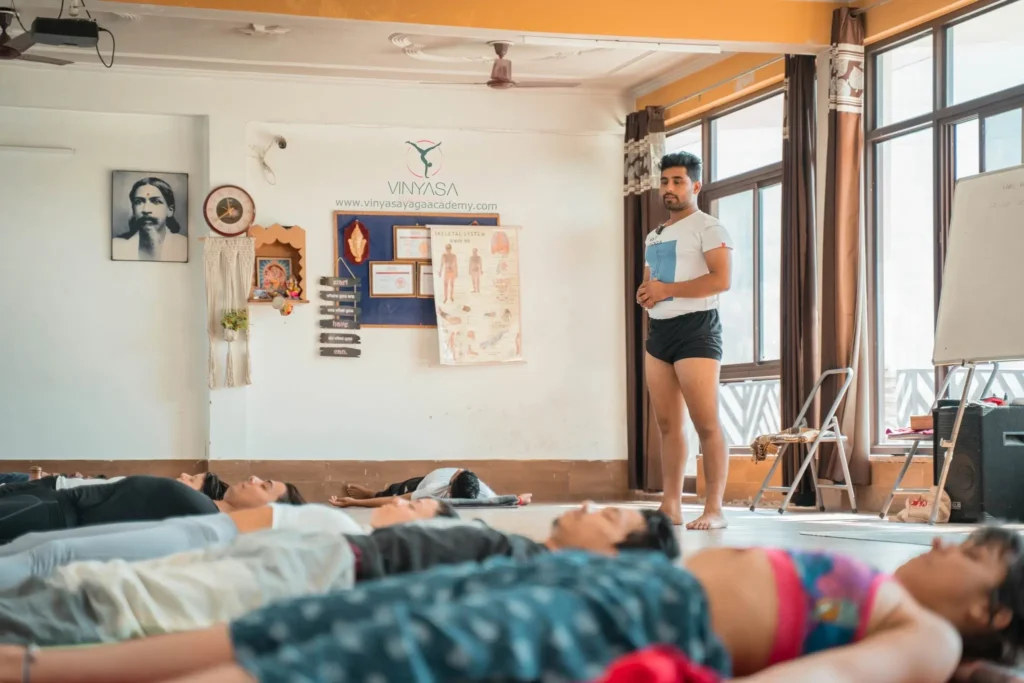
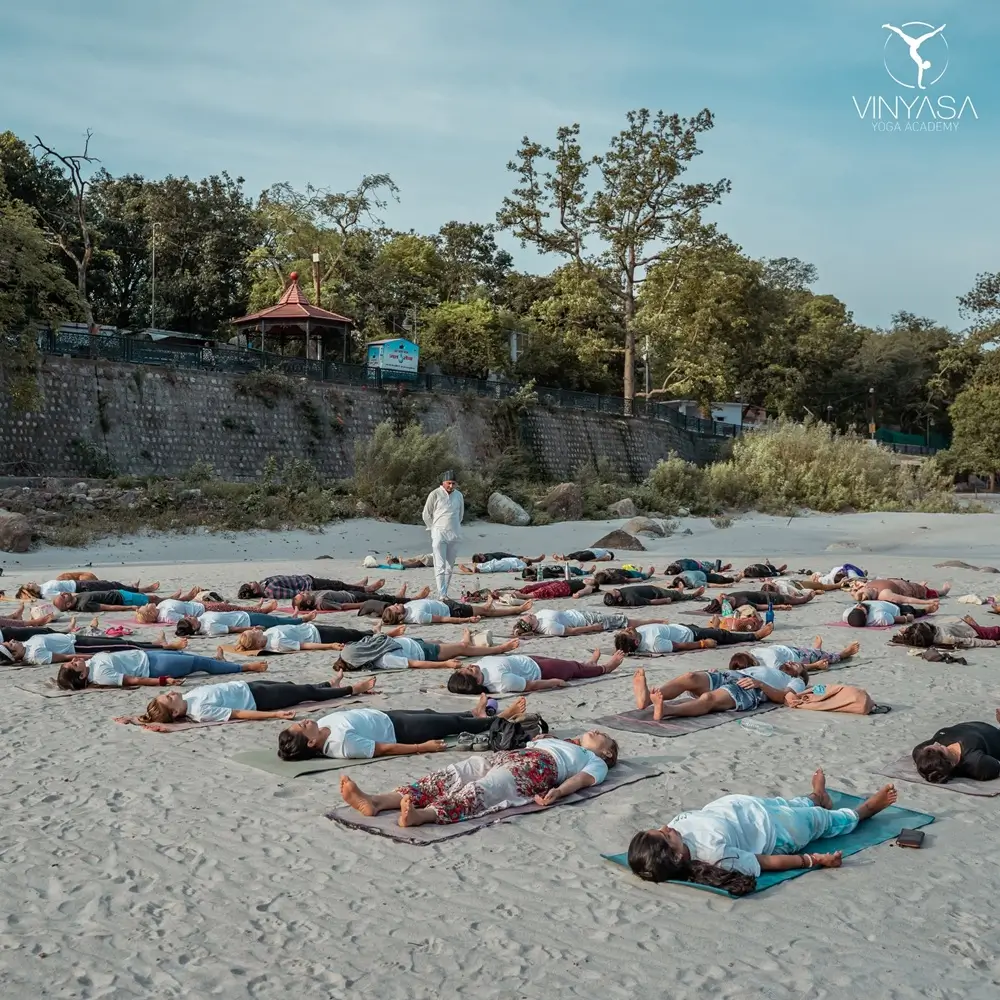
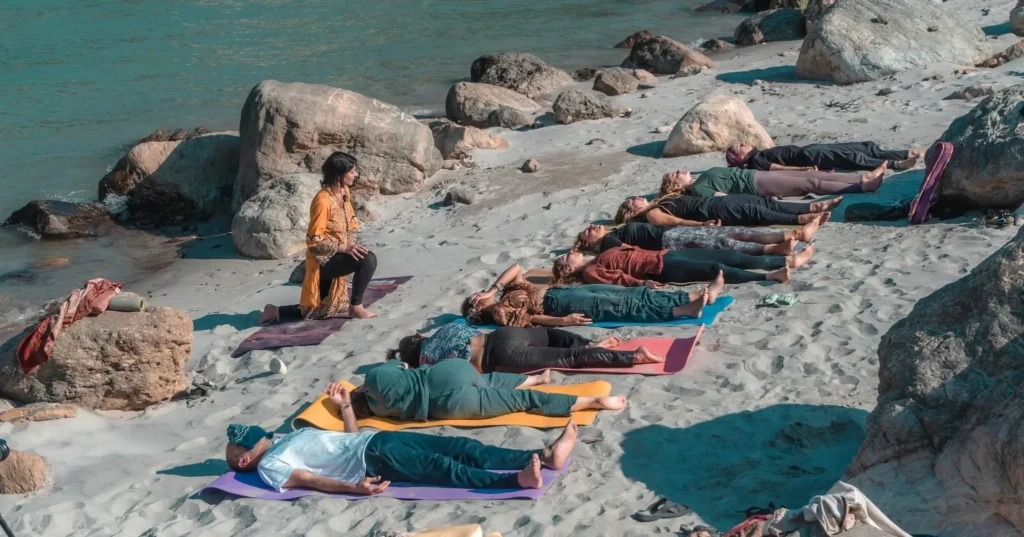
The practice of Yoga Nidra is done entirely lying down in Savasana (Corpse Pose) under a cosy blanket. It looks and feels almost like getting ready for bed. However, beneath the surface (we mean, internally), your brain and nervous system are doing two entirely different tasks.
The Key Difference
The easiest way to understand the difference between Yoga Nidra and sleep is through awareness.
When you fall asleep, your conscious mind turns off, you lose track of your surroundings, and you move into an unconscious state. In Yoga Nidra, your physical body drops into the exact same deep, restorative state as sleep, but your mind remains completely awake, following the steady thread of the instructor’s voice.
And, you hover right on the fragile threshold between being awake and dreaming. Here is a quick look at how these two states of rest compare against each other:
| Feature | Regular Sleep | Yoga Nidra |
| State of Mind | Unconscious and dreaming | Conscious, alert, and observing from a distance |
| Nervous System | Cycles through various stages, including active dreaming | Shifts directly into rest and digest mode |
| Brainwaves | Moves mechanically from light stages to deep Delta waves | Hovers intentionally in the calm Alpha and Theta zones |
| Physical Effort | Toss and turn naturally to find comfort throughout the night | Complete, motionless stillness from start to finish |
| The Intention | To disconnect from the world and rest the physical brain | To release deep mental patterns while staying fully aware |
The 7 Benefits of Yoga Nidra (That Actually Matter)
These 7 benefits of Yoga Nidra are what we have observed across years of teaching, alongside what research systematically supports.
1. It Resets Your Nervous System, Not Just Your Mood
Yoga Nidra activates the parasympathetic nervous system — the branch responsible for rest, digestion, and cellular repair.
Most people live in a chronic low-grade sympathetic state (fight-or-flight), even when they feel ‘fine’. This underlies fatigue, poor digestion, hormonal imbalance, and shallow breathing.
Yoga Nidra does not just calm you temporarily. With regular practice, it begins to shift your default nervous system rhythm. You become harder to shake. And recovery becomes faster.
2. Sleep Quality Transforms, Not Just Sleep Duration
This benefit is particularly significant for those exploring Yoga Nidra for sleep and anxiety.
Yoga Nidra does not necessarily mean longer sleep, but deeper, more restorative cycles. Research published in the Indian Journal of Physiology and Pharmacology found that regular Yoga Nidra practitioners experienced significant improvement in sleep quality.
The reason behind: Yoga Nidra trains the brain to voluntarily slow its electrical activity. You transition to slow-wave sleep more efficiently as your brain has practised the pathway. Over time, this skill becomes obtainable at night.
Read More: Mastering Breathwork: A Natural Solution For Stress And Anxiety
3. Anxiety is Reduced from the Source, Not the Surface
Many anxiety therapies work at the level of thought, i.e., challenging beliefs and reframing situations. Yoga Nidra works at a subconscious level, in the body’s stored reactivity.
Long-term anxiety is not just a thought pattern; it is a habit. Your body has adapted to react with tension in response to tension. Through repeated entry into deep relaxation, the body literally learns a new state.
The felt sense of safety begins to feel familiar. This is why practitioners after Yoga Nidra often report that their anxiety does not just feel more manageable but less fundamental to them.
4. Concentration and Creative Thinking Sharpen
The theta brainwave state that Yoga Nidra induces is the same state in which many artists, mathematicians, and writers report spontaneous insight. It is the state you sometimes touch just before fully waking — when solutions to problems seem to arrive from nowhere.
Regular practitioners often report a noticeable improvement in focus during the day. An easier, more sustained attention, not the forced, caffeinated focus of effort.
5. Emotional Patterns Become Visible and Workable
One of the most underappreciated aspects of Yoga Nidra is the practice of Sankalpa, which is a short, personal intention/goal set at the beginning of the session, when the mind is most receptive.
In deep states of relaxed attention, the subconscious is more open. A Sankalpa (mission) planted here during this root works in a way that affirmations recited during busy wakefulness rarely do.
Over time, practitioners find that patterns they have tried to change for years (emotional, habitual, self-limiting) begin to dissolve without force.
6. Physical Recovery Accelerates
During deep Yoga Nidra (Yogic Sleep), the body enters a state similar to slow-wave sleep. This causes human growth hormone secretion to increase, cortisol levels to drop, and inflammatory markers to decrease.
It is a physiologically meaningful recovery time for athletes, individuals managing chronic pain, or anyone recovering from depression or illness.
7. Spiritual Clarity Without Doctrine
The spiritual benefits of Yoga Nidra are rarely spoken about in modern wellness contexts, but they are real and worth naming. As the analytical and emotional layers of the mind quieten, many practitioners witness a silent, aware internal presence in an external environment that does not belong to rational thought.
This is not mystical speculation. The experience of pure awareness, unaffected by materiality, has been reported across spiritual traditions for centuries. Yoga Nidra offers a disciplined, accessible pathway to this state (with no particular belief system).
You do not have to be spiritual to practise it. But you may find, after some time, that the practice has quietly expanded what you think the word means.
What Is Vishnu Yoga Nidra? (Special Note on Lineages)
Some practitioners ask about Vishnu Yoga Nidra, a term that refers to Mahavishnu’s cosmic yogic sleep described in Vaishnava scripture.
In this mythology, Lord Vishnu rests on the cosmic serpent Shesha Naag (snake) between cycles of creation, in a state of divine, aware repose. The universe dissolves and re-emerges from this state. It is a meaningful cosmological metaphor for what happens in Yoga Nidra, i.e., a return to the source state, beyond individual identity, from which rebirth becomes possible.
Some teachers draw on this imagery explicitly. At Vinyasa Yoga Academy, we honour this lineage context while making the practice fully accessible to modern students from any background.
How to Do Yoga Nidra: Your Practical Starting Point
Yoga Nidra for beginners does not require some special equipment, a flexible body, or any previous experience. Here is how you can get started fast:
The basic setup involves:
- Lie flat on your back, with your legs slightly apart and arms away from the body, palms facing up
- Use a blanket as body temperature drops during deep rest and warmth supports the process
- An eye pillow or a folded cloth over the eyes helps block light and encourages release
- Choose a time when you will not be urgently needed for at least 30 minutes
- Begin with a guided recording from a qualified teacher or attend a live session
What Happens in a Yoga Nidra Session: Step-by-Step
If you’ve never tried Yoga Nidra before, the idea of yogic sleep might sound a little mysterious. However, the experience is simple and welcoming. To give you a clear idea of what to expect, let’s walk through the session stepwise and see how that journey unfolds.
Step 1 | Physical Settling
The guide/teacher invites you to feel your body and make contact with the floor. Joint by joint, weight by weight, internal tension begins to dissolve.
Step 2 | Sankalpa (Intention)
A short, personal resolve is given to the deeper mind. Keep it positive, present-tense, and meaningful, for example, ‘I am at peace.’ ‘I trust my body.’ It is planted here, in the receptive state, and repeated while closing.
Step 3 | Rotation of Consciousness
Rapid awareness moves through body parts. This is one of the most distinctive features of classical Yoga Nidra. It creates a state of widespread neural activation combined with deep physical stillness.
Step 4 | Pairs of Opposites
You are offered contrasting sensations, such as heaviness and lightness, heat and cold, pain and pleasure. It trains the nervous system to remain stable in the face of polarity, which is the foundation of emotional regulation.
Step 5 | Visualisation
Deep visual imagery is offered. The mind’s perception function is engaged without analysis or interpretation.
Step 6 | Return of Sankalpa
The intention you set at the start is revisited as the practice draws to an end, seeding it once more in the still, receptive state.
Step 7 | Externalisation
Gradually, awareness is drawn back to the room, the sounds around you, and the contact of the floor. You return, but not quite the same as when you left.
How to Teach Yoga Nidra: What Sets The Standard?
If you are a yoga teacher exploring how to teach Yoga Nidra, the most important thing to understand is that the quality of your guidance is everything. Unlike a physical asana class, the teacher’s physical demonstration is largely irrelevant. What the student receives is your voice, your pacing, and your own depth of understanding.
- Voice quality matters; slow, warm, unhurried delivery creates the state
- Silence is an active teaching tool; the pauses are as important as the words
- Avoid over-explaining or adding philosophical opinions mid-practice
- Your own regular practice as a teacher is non-negotiable
- Understand the structure of all eight stages before adapting or shortening for time
Read More: 10 Teaching Tips for Yoga Teachers: Go From Good To Unforgettable
Yoga Nidra Side Effects: What to Expect and What Is Normal?
Any honest discussion of Yoga Nidra side effects should begin with some good news. For the vast majority of people, a regular Yoga Nidra routine produces nothing but benefits. However, there are a few things worth knowing.
Before Yoga Nidra, be mindful of:
- Emotional Surfacing: As the nervous system unwinds, stored, hidden emotions sometimes arise. This is not a side effect in the negative sense; it is Yoga Nidra working. But it can feel surprising. Old memories, unexpected tears, or a sudden sense of grief or joy are not unusual, particularly in your starting sessions.
- Falling Asleep: Most beginners fall asleep during their first several sessions. This is not a failure to perform Yoga Nidra. It is the body taking what it needs. With practice, the ability to remain aware but rested develops naturally.
- Disorientation on Re-Entry: Coming out of deep Yoga Nidra (yogic sleep) can feel slow. Allow yourself five minutes before standing up directly. Do not practise immediately before driving or any task that may require your intense attention and focus.
- Caution For Those With Trauma History: Body-awareness practices can, in some cases, activate stored trauma. If you have a history of major traumas, working with a teacher who understands trauma-sensitive facilitation is strongly recommended.
Yoga Nidra will only ask that you allow yourself to rest.
– Guru Yogi Vishnu Panigrahi
Winding Up: Where to Begin Yoga Nidra?
The best way to understand Yoga Nidra is not to read more about it. It is to lie down, close your eyes, and experience it yourself once. Whether you are coming for sleep, for anxiety, for spiritual depth, or simply because something in you is tired in a way that rest has stopped fixing, Yoga Nidra is your comfort partner.
At Vinyasa Yoga Academy, we offer guided Yoga Nidra sessions for complete beginners in our immersive yoga teacher training programmes and yoga and Ayurveda retreats. Our sessions are built on the classical eight-stage structure, adapted thoughtfully for individuals from all walks of life. For those who want to carry this ancient practice forward, contact us today!
Frequently Asked Questions About Yoga Nidra
What is Yoga Nidra for beginners? Where do I start?
Yoga Nidra is a practice that asks nothing of you except your willingness to lie still. Start by lying down in a quiet room with a blanket, an eye cover, and a 20 to 30-minute guided recording from a qualified teacher. You need no prior yoga experience, no flexible body, and no meditation background. Simply follow the guide’s voice and allow whatever happens to happen.
What are the benefits of Yoga Nidra?
Yoga Nidra benefits include deep nervous system reset, improved sleep quality, reduced anxiety, sharper focus, faster physical recovery, emotional regulation, and access to conscious rest that many people are deprived of. Unlike most wellness practices, it works holistically on the body, mind, and subtler dimensions of well-being simultaneously.
How is Yoga Nidra different from Savasana?
Savasana at the end of a yoga class is rest. Yoga Nidra is a structured journey. The depth, the use of body scanning, Sankalpa, visualisation, and the specific guiding techniques take practitioners into states that Savasana does not reach.
Can I do Yoga Nidra for deep sleep if I have insomnia?
Yes, and it is very well-suited for it. Yoga Nidra guides the neural pathways that lead to slow-wave sleep. Many practitioners with chronic insomnia report significant improvement within three to four weeks of daily practice.
How long should a Yoga Nidra session be?
Sessions typically range from 20 to 45 minutes. A 30-minute session is considered a complete practice. Beginners may start with 20-minute recordings and extend as their comfort with stillness grows. Even a 15-minute shortened Nidra session offers measurable benefit.
What is the best time to practise Yoga Nidra?
Any time works, but there are natural advantages to each. Morning practice sets a calm start for the day. Midday practice offers restoration without drowsiness. Evening practice signals the nervous system into sleep mode. Avoid practising immediately after heavy meals.
How many times a week should I practise Yoga Nidra?
Daily practice leads to more satisfying results, especially in the initial four to six weeks. Even three sessions per week can help produce measurable shifts in stress response and sleep quality. Consistency matters more than time.
What is the difference between Yoga Nidra and meditation?
Traditional meditation involves an awake, upright posture, active attention, and a technique like following the breath, using a mantra, or observing thoughts. Yoga Nidra requires none of this. You lie down. You receive. You are guided, not imposed.