







8 Yoga Poses To Heal Lower Back Pain: 15 Minutes to Sustained Recovery
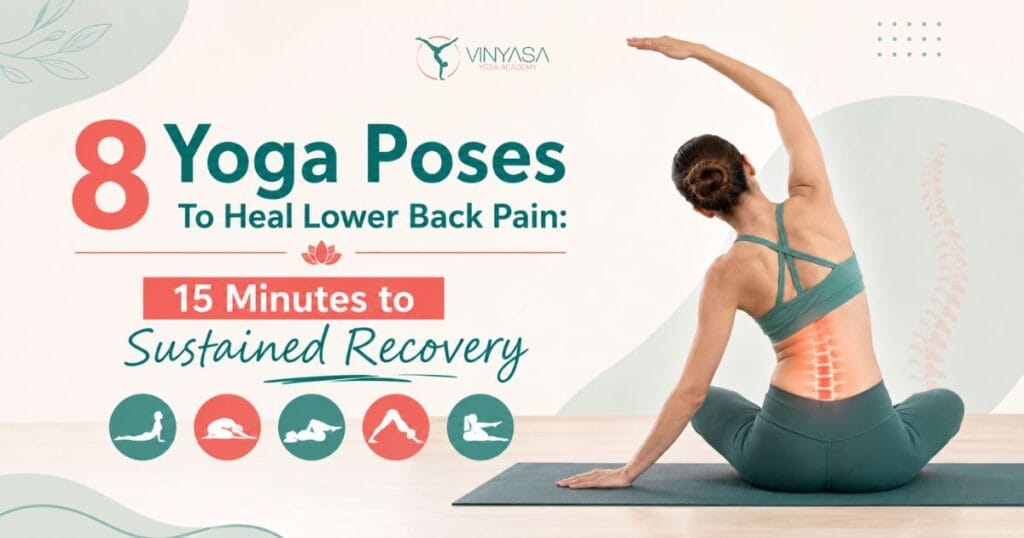
Table of Contents
- Why Does Lower Back Pain Happen in the First Place?
- What Causes Lower Back Pain in Females Specifically?
- Does Yoga Actually Relieve Back Pain? What Science Says
- The 8 Best Yoga Poses for Lower Back Pain Relief
- 1. Cat-Cow Pose (Marjaryasana-Bitilasana)
- 2. Legs Up the Wall (Viparita Karani)
- 3. Child’s Pose (Balasana)
- 4. Bird-Dog (Dandayamana Bharmanasana)
- 5. Sphinx Pose (Salamba Bhujangasana)
- 6. Supine Twist (Supta Matsyendrasana)
- 7. Downward-Facing Dog (Adho Mukha Svanasana)
- 8. Pigeon Pose (Eka Pada Rajakapotasana)
- Yoga for Lower Back Pain and Sciatica: A Special Note
- Yoga for Lower Back Pain Relief at Home: Beginner’s 15-Minute Routine
- Pregnancy Yoga for Back Pain: Is It Safe?
- Practical Tips: Getting Better Faster
- Go Deeper
- Frequently Asked Questions
- Can I do yoga with lower back pain?
- How long does it take for yoga to relieve back pain?
- Which yoga style is best for lower back pain?
- Which doctor to consult for lower back pain?
- Is Child’s Pose safe for lower back pain?
- What are the worst yoga poses for lower back injury?
Did you wake up and feel your lower back is stiff again?
Maybe it’s from sitting too long. Maybe you slept wrong. Maybe it just showed up one day and never fully left. Whatever the reason, you’re not alone. Lower back pain is one of the most common health concerns worldwide, affecting nearly 8 out of 10 people at some point in their lives.
The good thing? You don’t always need a pill, a doctor’s appointment, or an expensive therapy to feel better. Yoga for lower back pain is one of the most researched, most accessible, and most effective ways to find real relief and make it yours forever.
Why Does Lower Back Pain Happen in the First Place?
Before we talk about yoga asanas for back pain, it’s important to understand the root cause. Because yoga is most effective when you know what and why it works.
Some common causes of lower back pain in men and women are:
| Cause | What’s Happening |
| Prolonged sitting | Tightens hip flexors, weakens core muscles |
| Poor posture | Compresses mid-vertebrae over time |
| Weak core | Spine loses its support system |
| Sciatica | Sciatic nerve constricted, pain reaches down the leg |
| Stress & tension | Muscles tighten as a physical response to mental load |
| Tight hamstrings | Pulls the pelvis out of alignment |
| Muscle imbalance | One side stronger, the other compensating |
What Causes Lower Back Pain in Females Specifically?
The beauty of mindful yoga is that it offers a complete structural reset. It addresses the roots of back pain by stretching our tight tissues, rebuilding vital strength in our weak muscle groups, and bringing the nervous system out of a pain-amplifying state.
– Guru Yogi Vishnu Panigrahi
Women’s bodies navigate unique hormonal changes that can make the lower back highly vulnerable. Think about pregnancy or the natural transitions during the menstrual cycle and menopause. For instance, during pregnancy, your body releases a hormone called relaxin, which does exactly what it sounds like.
It loosens up your ligaments to prepare for birth. While that is a biological feat, it temporarily makes your pelvis and lower spine a little less stable, forcing your lower back muscles to work harder just to keep you upright. Additionally, endometriosis and uterine fibroids are also known to cause pain in the lower back.
Does Yoga Actually Relieve Back Pain? What Science Says
Yes, and it isn’t just a fable.
A major study in the Annals of Internal Medicine put yoga head-to-head against traditional physical therapy for chronic lower back pain. And, the results had lasted for over a year. It also stated that a consistent yoga practice significantly reduces the need for pain medication. Regular yoga builds your strength from the inside out, helping both your mind and body handle physical and mental pain and stress much better.
Yoga works on three levels simultaneously:
- At Physical Level: It stretches tight muscles, strengthens the core, and decompresses the spine
- Neurologically: It slows you down. Deep breathing activates the parasympathetic (calm) nervous system, which literally reduces pain perception
- Posture-wise: It teaches you body awareness, so you stop repeating the habits that created the pain
So, can yoga cure lower back pain? For non-specific pain, like general stiffness and aching that has no structural cause, yes, consistent yoga can resolve it completely. However, for serious issues like herniated discs or severe sciatica, yoga becomes a powerful complement to medical care, not a replacement.
The 8 Best Yoga Poses for Lower Back Pain Relief
These yoga asanas for back pain are beginner-friendly, safe, and actually effective. Designed in collaboration with our expert yoga educators, this selection focuses on intelligent sequencing rather than complex flexibility. You can do most of these at home with just a mat.
1. Cat-Cow Pose (Marjaryasana-Bitilasana)
Best for: Morning stiffness, spinal mobility, warming up the back
This is the single best starting point for anyone with back pain. It’s gentle, rhythmic, and it wakes up every vertebra in your spine. The constant to-and-fro formation of positions in this asana places it at the top of all other poses of yoga for lower back pain relief.
It is not only directly effective but also straightforward, accessible, and beginner-friendly as well. You can do it right now.
How to do Cat-Cow Pose: Begin on all fours. Wrists under shoulders, knees under hips. On an inhale, drop your belly and lift your chest and tailbone (Cow). Pull your belly in and round your spine toward the ceiling as you exhale. And gently draw your chin towards your chest. Flow through both positions slowly for 8-10 rounds.
How it works: The movement lubricates the spinal joints, stretches the back muscles in both directions, and syncs with your breath to release tension held in the lumbar region (lower back).
2. Legs Up the Wall (Viparita Karani)
Best for: End-of-day relief, nerve calming, reducing lower back pressure
Legs Up the Wall is the best passive antidote, yoga pose for lower back pain relief. It is a restorative inversion that frees up the entire musculoskeletal structure of the lower torso, making it incredibly effective, yet underrated.
How to do Legs Up the Wall: Sit sideways next to a wall, then swing your legs up the wall while lowering your back flat on the mat. Let your arms rest by your sides, palms up. Stay for 5-10 minutes.
How it works: Gravity reversal removes all compressive weight from the lumbar spine. It also activates the parasympathetic nervous system, which reduces the tension and inflammation that fuels chronic pain.
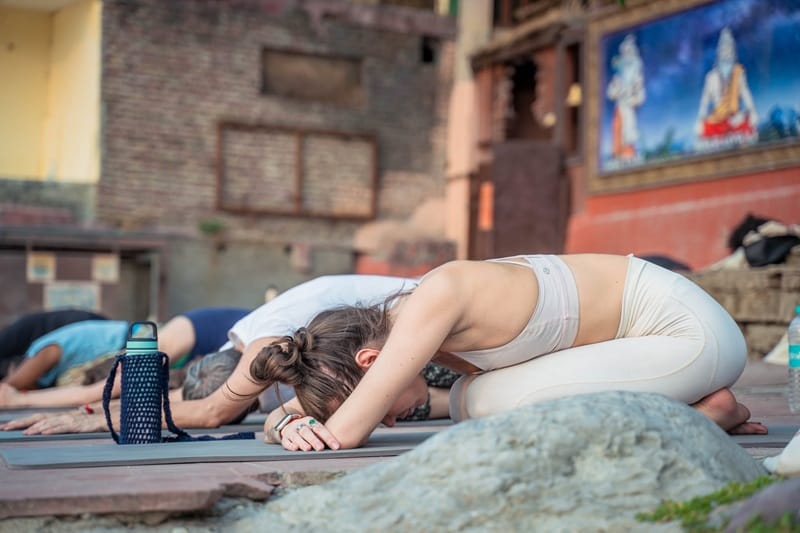
3. Child’s Pose (Balasana)
Best for: Immediate lower back relief, stretching the sacrum, calming down
This yoga asana is your reset button. Anytime your back aches, come to Child’s Pose. Why? Because Child’s Pose (Balasana) is universally treated as one of the peak resting postures.
If you look at how it works mechanically, it is actually a highly functional movement for the lower back. Shifting into this shape creates a physical opening in the spine that provides swift relief from back pain.
How to do Child’s Pose: Kneel on your mat, big toes touching, knees wide. Sit your hips back toward your heels and stretch your arms forward, forehead on the mat. Hold for 5-10 slow breaths.
The way it works: Child’s Pose yoga stretches the lower back and creates tension along the spine. It’s one of the best yoga stretches for lower back pain and you don’t need any flexibility to start.
4. Bird-Dog (Dandayamana Bharmanasana)
Best for: Core stability, muscle balance and preventing future spasms (severe contraction of muscles)
Bird-Dog is a great yoga pose to relieve lower back pain. It’s about producing deep structural stability, training your core and pelvis to be stable as your limbs move
How to do Bird-Dog: Begin in a tabletop position on all fours. Slowly extend your right arm straight out forward and your left leg straight out behind. Make your limbs parallel to the floor. Keep your back foot flexed and your gaze down to keep your neck long. Hold for 3 to 5 breaths, return to centre, then switch sides.
The way it works: Keeping your spine completely level against gravity trains your deep core, taking the structural load off your lower back joints. It specifically strengthens the multifidus muscles, the tiny stabilisers that run along your vertebrae.
5. Sphinx Pose (Salamba Bhujangasana)
Best for: Reversing desk posture, gentle spinal extension, and disc decompression
Sphinx Pose offers a safe, highly controlled way to bring a soft backward arch into the spine. It is the perfect alternative to deeper backbends, as it allows you to control exactly how much pressure you put on your lower back region.
How to do Sphinx Pose: Lie flat on your stomach, resting your forearms on the mat and your elbows directly under your shoulders. Press your palms and the tops of your feet firmly into the floor. Slowly lift your chest forward and up, keeping your shoulders relaxed away from your ears. Perform 5 to 8 deep breaths.
How it works: Sphinx Pose creates a mild, passive extension in the lower back while opening up the tight thoracic (mid-back) spine.
6. Supine Twist (Supta Matsyendrasana)
Best for: Tight lower back, hip tightness, spinal rotation
There is a reason almost every yoga class ends with a Supine Twist or Supta Matsyendrasana. Resting on your back and letting your knees fall to the side discharges stiffness from both sides of the lower back, leaving your back (and spine) feeling completely refreshed.
However, when it comes to treating lower back pain, it is a double-edged sword. Physiologically, it can either serve as a brilliant tool for spinal release or a direct trigger for a severe muscle spasm. Therefore, understanding Supta Matsyendrasana and its effects on the lower back is crucial for a safe practice.
How to do Supine Twist: Lie on your back and bend your knees. Let both knees fall to one side while you extend the opposite arm. Let both shoulders stay on the mat. Hold for 5 breaths on each side.
How it works: Rotational movement releases the small muscles between vertebrae that often hold chronic tension. It also stretches the piriformis (a key muscle involved in sciatica). Remember to perform with caution and under guidance, if possible.
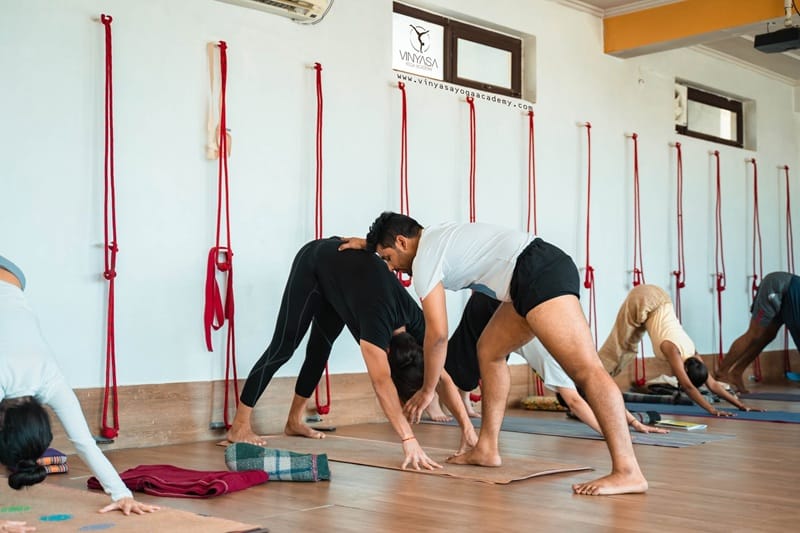
7. Downward-Facing Dog (Adho Mukha Svanasana)
Best for: Full spine decompression, hamstring and calf release, upper and lower back pain
One of the most recognised yoga poses for back pain, Downward-Facing Dog, is often taught as a hamstring stretch, but in the context of back therapy, its primary job is to uniformly lengthen the entire spine from the tailbone to the crown of the head.
However, because it is an inversion pose that fights gravity, it can either be a useful remedy or a direct cause of lower back strain, depending entirely on the legs.
How to do Downward-Facing Dog: From all fours, curl your toes, lift your hips towards the ceiling, and straighten your legs as comfortably as possible. Press your hands into the mat, keep a long spine, and breathe for five to six breaths. You may try to bend your knees if your hamstrings are tight.
The way it works: This pose creates axial traction, meaning it lengthens the spine from both ends simultaneously.
Caution: The biggest mistake in the Downward Dog pose is forcing your legs fully straight just to make your heels touch the floor. If a practitioner has tight hamstrings, the tension will be pressed downward on the sit bones, rounding the lower back and placing a massive load on lower back joints, which can instantly trigger pain.
8. Pigeon Pose (Eka Pada Rajakapotasana)
Best for: Hip tightness, sciatica, piriformis release
If you have pain radiating from your lower back into your buttocks or legs, this yoga pose is for you. Most people misunderstand the Pigeon Pose. It targets the hidden culprit of back pain, the deep lateral rotators of the hip.
When you sit for hours with your hips locked and rigid, the tightness travels directly up into your pelvis and lower back. Pigeon Pose acts as a circuit breaker for that tension. This is one of the most beneficial yoga asanas for lower back pain and sciatica.
How to do Pigeon Pose: From the Downward Dog yoga pose, bring one knee forward behind your wrist. Extend the other leg back on the mat. Drop your hips back and bend forward at your own pace. Hold 8-10 breaths per side.
How it works: Tight, stiff hips are a massive contributor to lower back issues. Pigeon Pose targets deep hip rotators like the piriformis muscle. By opening up this space, you instantly take the crushing pressure off the nerve, giving you a fast pass to sciatica relief. Having strong glutes is one of the best defences against lower back pain.
Yoga for Lower Back Pain and Sciatica: A Special Note
Sciatica is not just back pain. It’s a kind of shooting, burning, or tingling sensation that flows from the lower back through the buttocks and down the leg, and sometimes all the way to the foot. It usually happens when the sciatic nerve is compressed or tensed.
Yoga can genuinely help with sciatica, but choosing the right poses matters.
Do these for sciatica:
| Yoga Pose | Benefit |
| Pigeon Pose | Releases piriformis pressure on the nerve |
| Sphinx Pose | Opens up space between loaded spinal discs |
| Legs Up the Wall | Calms the nervous system |
| Cat-Cow Pose | Easy, effective, ergonomic |
Avoid these with sciatica (at least initially):
- Deep forward folds with straight legs
- Full backbends
- Any pose that increases the shooting pain down the leg
If you don’t feel any visible change or symptoms worsen, consult a doctor or physiotherapist before continuing.
Yoga for Lower Back Pain Relief at Home: Beginner’s 15-Minute Routine
You don’t need a large setup or a group of twenty people by your side to perform yoga. All you need is a mat, 15 minutes, willingness to do, and consistency. Here we have crafted a very simple routine for you to practice the above-mentioned yoga asanas at home with minimal external requirements.
| Order | Pose | Time |
| 1 | Cat-Cow | 2 minutes |
| 2 | Child’s Pose | 2 minutes |
| 3 | Bird-Dog Pose | 2 minutes |
| 4 | Sphinx Pose | 2 minutes |
| 5 | Pigeon Pose | 2-3 minutes |
| 6 | Legs Up the Wall | 4-5 minutes |
Engage daily. Even once a day, for fifteen minutes, is enough to create a real, lasting change. Remember that consistency beats intensity every time.
Pregnancy Yoga for Back Pain: Is It Safe?
If you are carrying a baby, your lower back is basically acting as a supportive anchor for all that evenly distributed extra weight. This is exactly why prenatal yoga is an absolute lifesaver, particularly once you step into your second trimester.
A relaxing, restorative yoga practice acts like a pressure valve for a compressed spine. It brings tight muscles into relaxation, gets your circulation moving better, and gives your nervous system a much-needed break from the physical stress of growing a human inside you.
Safe yoga poses during pregnancy:
Modifying yoga for pregnancy is for total support and zero strain. Here are five foundational postures that may feel amazing on a maternal lower back:
| Yoga Pose | Benefit for Pregnancy |
| Gentle Cat-Cow | Fluidly stretch the spine without putting any weight on your belly |
| Supported Child’s Pose | Provides a grounding sensation while lengthening lower back muscles and stretching glutes |
| Bound Angle Pose (Baddha Konasana) | Improves hip joint flexibility and prepares pelvic muscles for a smoother delivery process |
| Goddess Pose (Utkata Konasana) | An empowering standing posture that focuses on lower-body strength |
| Side-Lying Restorative Stretches | Using blocks and blankets to support your body while resting on your side |
Always practise with a certified prenatal yoga teacher and get clearance from your doctor or midwife first.
Practical Tips: Getting Better Faster
- Start Slow: Especially if you’re new to yoga, pain is a signal, not a challenge for your body. Breathe into tight spots. When you find a strained area, direct your exhale toward it. This actually helps release muscle tension and relax the region.
- Sleep Position Matters: If you’re wondering how to sleep with lower back pain, try sleeping on your side with a pillow between your knees and extend your legs a bit apart. This way the spine stays neutral and it takes pressure off the lower back while sleeping.
- Move During the Day: Even short walks, a break from the sitting patterns that cause lower back pain, can aid in diminishing the same.
Go Deeper
Understanding yoga for back pain at a surface level is one thing. Understanding why the body moves the way it does and how to read postural patterns of motion is a different level entirely.
At Vinyasa Yoga Academy, our yoga teacher training courses in Rishikesh, India, and Bali, Indonesia, go far beyond poses. You learn anatomy, therapeutic yoga applications, and how to guide others through pain and transformation.
From deepening your practice to becoming a certified yoga teacher, our residential courses provide the kind of immersive, authentic experience you can’t get from a video or blog. Contact us today!
Frequently Asked Questions
Can I do yoga with lower back pain?
Honestly, it depends on what your back is signalling right now. If you are experiencing a severe, flaming pain, a vigorous flow is the last thing you need. However, for chronic tightness or dull aches, easy-going yoga is incredibly safe and therapeutic.
How long does it take for yoga to relieve back pain?
You will likely feel a sense of release and open space after your very first 15-minute session. But long-term structural changes don’t happen overnight. Commit to a regular practice (even just 10 to 15 minutes daily or every other day) for about 4 to 8 weeks, and you’ll notice a massive shift in how your back feels overall.
Which yoga style is best for lower back pain?
Look for slower, mindful styles like Hatha or gentle Vinyasa with a high therapeutic focus. These styles give you the time to properly align your spine. The ideal poses for back pain relief are gentle dynamics like Cat-Cow Pose; supportive holds like Child’s Pose, Bridge Pose, and Pigeon Pose; and resting with your legs up the wall.
Which doctor to consult for lower back pain?
If back pain is constant, sharp, or aching down in your legs, start by booking an appointment with your local general practitioner or family doctor. They can give you an initial assessment and connect you with a physical therapist, an orthopaedist, or a dedicated back pain specialist. Yoga works, but it performs best as a supportive ally alongside professional medical care.
Is Child’s Pose safe for lower back pain?
For 90% of people, Child’s Pose yoga is the ultimate relief. However, if you have a confirmed disc injury, bending forward deeply can trigger discomfort. To make it totally safe and supportive, try widening your knees toward the edges of the yoga mat and place a thick pillow or bolster under your body.
What are the worst yoga poses for lower back injury?
You need to stay far away from deep, unsupported forward bends (like standing forward fold with straight legs) and aggressive twists. Avoid deep backbends like Full Wheel or Camel Pose, which crunch the lumbar spine. If a pose requires you to lock your knees or strain your neck, skip it or call for a modification.